IndiGo’s Pilot Shortage and the Disproportionate Impact of New Fatigue Rules
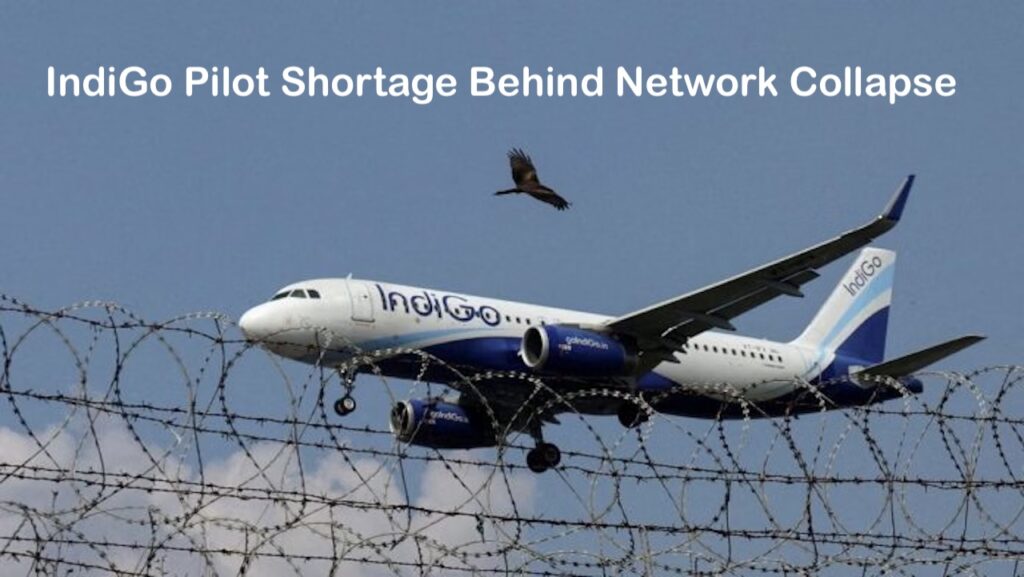
The recent aviation crisis has revealed a structural imbalance at IndiGo, India’s largest carrier. While new DGCA fatigue-management rules affected every airline, only IndiGo’s network collapsed at scale. Tata Air India-Vistara, SpiceJet and Akasa continued operating with manageable disruptions. This disparity raises a fundamental question: why did one airline account for the overwhelming majority of cancellations if all carriers faced the same regulatory environment?
The answer lies in IndiGo’s rapid expansion, aggressive utilisation model and a deep pilot deficit that had remained masked until tighter fatigue norms forced structural compliance.
A Dominant Airline Without Proportional Crew Strength
IndiGo has grown into a carrier with more than 360 aircraft and more than two thousands of daily flights. This expansion has not been matched with a corresponding increase in pilot strength. A typical global benchmark requires 16–18 pilots per aircraft for sustainable operations under modern fatigue rules. By that estimate, IndiGo needs at least 5,500–6,000 pilots.
Industry assessments suggest a deficit of 800–1,000 pilots within IndiGo’s current network design. This gap remained manageable only when fatigue regulations were more flexible. Once DGCA tightened rest cycles, the shortage became impossible to conceal. In contrast, other Indian airlines maintain more balanced pilot-to-aircraft ratios that allow them to meet revised norms without mass cancellations.
Why Other Airlines Remained Stable Despite the Same Rules
Smaller Networks and Balanced Rostering Structures
Tata Air India-Vistara and Akasa operate significantly smaller narrow-body fleets and fewer daily rotations. Their networks demand fewer consecutive night duties and early-morning departures. These airlines therefore faced a lighter compliance burden under the new rules. Their rosters could be rebalanced without a large-scale network reset.
Greater Proportion of Senior Crew
Tata Air India-Vistara maintain a stronger pool of senior commanders with long-haul experience. Their scheduling systems, inherited partly from Singapore Airlines partnerships and global legacy-carrier standards, offer better fatigue planning and higher cockpit redundancy.
Lower Night-Duty Concentration
IndiGo’s network relies heavily on late-night and dawn departures, both of which are stress factors under the revised rules. Other airlines operate fewer high-fatigue cycles. As a result, they required fewer additional pilots to meet the newer restrictions.
This structural difference explains why Tata Air India-Vistara, SpiceJet and Akasa did not face the cascading failures visible at IndiGo.
IndiGo’s Overstretched Utilisation Model Reached Its Limit
IndiGo has built its dominance on a tightly optimised model: high aircraft utilisation, fast turnarounds and a dense night-operation network. However, this model leaves little redundancy. It functions smoothly only when regulatory conditions are stable and crew availability is plentiful.
The introduction of stricter DGCA fatigue norms disrupted that balance. IndiGo’s crew buffers were too thin to accommodate the new rest requirements. This forced the airline to cancel hundreds of flights and attempt a full reset of its scheduling system. Other airlines, operating with more slack, avoided such extreme measures.
The DGCA Rules Were Not Sudden, So Why the Collapse?
The DGCA’s fatigue rules were announced nearly two years ago and rolled out in stages. Airlines were expected to adjust gradually. Most carriers complied through incremental roster adjustments and measured hiring. IndiGo appeared to delay full adaptation. It continued to rely on a stretched workforce, assuming that leniency or phased implementation would continue.
When enforcement became strict, IndiGo’s deferred compliance became untenable. The collapse was therefore not a sudden regulatory shock. It was the result of a long period of under-preparation.
How Many More Pilots Does IndiGo Need?
Based on industry norms, fleet size and fatigue-rule requirements, IndiGo requires hundreds of additional pilots to operate its current route network sustainably. An estimated shortfall of 800–1,000 pilots would need to be addressed through accelerated hiring, expanded training pipelines and recalibrated rosters.
The scale of IndiGo’s operations means that any staffing deficit translates into immediate system strain. This deficit made regulatory compliance impossible without cancellations. Crew shortages at this magnitude highlight the overstretched nature of its scheduling philosophy.
A Crisis Rooted in Structural Choices, Not External Pressure
Other carriers demonstrated that compliance was entirely possible within the updated regulatory environment. IndiGo’s disproportionate disruption indicates that the issue lay within its internal planning, crew-management philosophy and aggressive scaling, not the DGCA’s rules.
The crisis should be viewed as a structural correction. IndiGo must realign its network with sustainable crew capacity, build reserve strengths and modernise fatigue-management systems. The airline’s dominant position also means that its operational health has national implications. Structural resilience is therefore not merely desirable; it is essential.