EU Russian Gas Ban Agreement: Europe’s Defining Energy Shift
Europe’s Big Announcement Masks a Long, Painful Road to Implementation
The EU Russian gas ban agreement, finalised on 3 December 2025, is being presented as a bold geopolitical milestone. Yet the timeline reveals a far more constrained reality. Commission President Ursula von der Leyen described the move as “the dawn of a new era,” signalling Europe’s resolve to end financial flows that support Russia’s war effort. Although the announcement carries strategic and moral weight, its execution requires a careful balance between market stability, geopolitical alignment, and accelerated diversification.
The Ukraine War began in February 2022, but Europe announced a full gas ban only in December 2025. Even with this decision in place, the bloc still needs another eighteen months to two years before the regulation becomes fully operational. These extended timelines highlight a structural weakness rooted in Europe’s long-standing reliance on Russian energy. The ban aspires to deliver autonomy and strategic clarity, yet the actual path to implementation remains slow, expensive, and politically vulnerable.
A Timeline That Reveals Europe’s Vulnerabilities
Europe spent decades turning to Russia because Russian gas was cheap, abundant, and delivered through extensive pipeline infrastructure. In 2021, dependence stood at 45%. By early 2022, the EU paid Moscow €1 billion per day for fossil fuels. Despite the Ukraine–Russia conflict, Europe continued purchasing LNG from Russia, increasing LNG imports by 40% between 2022 and 2024 as pipeline volumes collapsed.
It took nearly four years for the EU to muster political unity to enact a full ban. Even now, the regulation requires a phased withdrawal until late 2027. Europe’s slow movement demonstrates how deeply Russian energy shaped its economies, grids, and industrial competitiveness.
Stepwise Deadlines Show Cautious, Not Courageous, Planning
The EU designed the ban in several stages. Short-term gas contracts must end by mid-2026. Long-term LNG agreements terminate on 1 January 2027. Pipeline contracts receive the longest runway, ending by September 2027 with a possible extension to November. Each deadline reflects the same challenge: Europe lacks the infrastructure to replace Russian volumes quickly. LNG terminal construction, grid reinforcement, storage expansion, and new interconnectors require years.
France, Germany, Italy, and Spain warned that abrupt bans could trigger industrial disruption. Germany’s chemical and manufacturing sectors rely heavily on stable gas supply. Spain and France pointed to grid constraints. Consequently, Europe’s political ambition had to adjust to engineering reality.
Strict Controls on Turk-Stream and Re-Routing Attempts
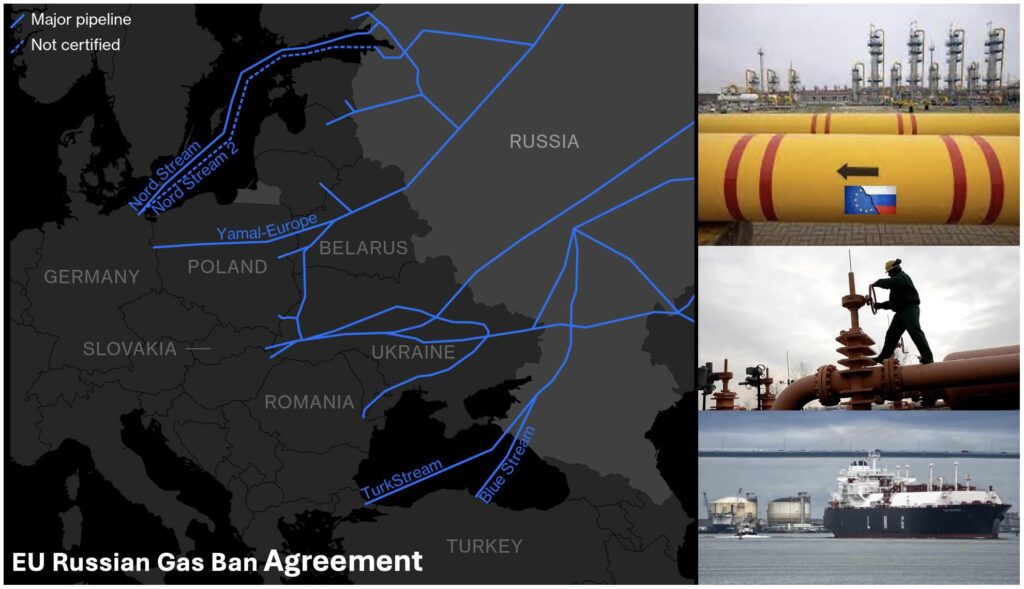
A specific clause bars imports via Turk-Stream unless the gas is proven to be non-Russian. The EU seeks to prevent Russian gas from being laundered through Turkey or Balkan intermediaries, reflecting lessons from earlier sanctions where re-routing diluted enforcement.
National Diversification Plans and Penalties for Non-Compliance
Every member state must submit a detailed diversification plan by March 2026 explaining how it will replace Russian supplies. The Commission will monitor these plans.
Failure to comply may result in penalties up to 3.5% of a company’s global turnover or fixed fines of up to €40 million. Individuals may face penalties up to €2.5 million. These measures aim to prevent covert procurement or spot-market loopholes.
Landlocked States Face the Hardest Reality: Geography Cannot Be Legislated
The most vulnerable states are landlocked Central European countries whose energy systems depend on pipelines traditionally flowing from the east. Slovakia, Hungary, Austria, and, to some extent, the Czech Republic lack direct access to seaports. Their reliance on Russian energy remains high.
Slovakia
Slovakia still receives 60% of its gas from Russia via Ukraine. Its refineries and heavy industries were built around Russian pipeline chemistry. It argues that the ban ignores physical constraints. Bratislava has already challenged it before the European Court of Justice, calling it discriminatory.
Hungary
Hungary remains the strongest opponent, with dependence exceeding 80%. It relies on both Turk-Stream and Ukraine’s transit route. Budapest warns that substitution could increase prices by up to 35%. Prime Minister Viktor Orbán calls the ban “economic vandalism” and rejects Brussels’ narrative.
Austria
Austria still imports about 20% of its gas from Russia. OMV holds long-term contracts with Gazprom extending to 2040. These contracts now fall under force majeure provisions, yet adjusting Austria’s energy mix will be costly.
Romania
Romania has Black Sea reserves, yet its domestic infrastructure still relies on regional transit routes through Central Europe. Bucharest warns of short-term instability and grid congestion. Though it supports the ban, it accepts that emergencies may require temporary exemptions.
These states have filed, or intend to file, legal challenges. Their objections focus on geography and fairness. They argue Brussels cannot impose uniform timelines on countries with different access to alternatives.
Legal Battles Could Delay or Dilute the Ban
The European Court of Justice may take up to two years to rule on these cases. A decision in 2027 or 2028 could coincide with the final implementation period. If the ECJ accepts even parts of the challenges, Europe may face new exemptions, revised deadlines, or compensation requirements. The EU placed the regulation under trade legislation to avoid vetoes, but Hungary and Slovakia argue this violates procedural norms.
Economic Burden on Europe: The Price of Principle
Europe must invest at least €300 billion to support the transition. LNG terminals in Germany, the Netherlands, and Italy need final commissioning. Renewables must reach 45% by 2030. Hydrogen corridors need development, and storage capacity must rise to protect winter supply.
Energy-intensive sectors face higher costs. A 20–30% increase in gas prices could weaken Germany’s chemical industry, Italy’s ceramics sector, and Europe’s steel plants. Deindustrialisation risks are real. Policymakers argue that long-term resilience justifies short-term cost, though business leaders remain sceptical.
Geopolitical Dimension: Alignment with US Strategic Objectives
Washington has consistently urged Europe to eliminate Russian energy dependence. US LNG exports surged after the Ukraine invasion. The US also sanctioned Russian-owned refineries in Europe, triggering nationalisations in Germany, Serbia, and Bulgaria.
Critics argue the ban enhances American energy influence. Supporters counter that Europe had no viable alternative, as Russia repeatedly used energy as leverage.
Politics and Public Opinion: A Divided Debate and a Slow Countdown
Reactions across Europe show clear division. Supporters of the ban argue that it reduces Russia’s leverage and demonstrates Europe’s long-term strategic intent. Critics, however, warn that the shift may simply replace dependence on Russia with dependence on the United States, given the rapid rise in American LNG exports. Many also highlight the delayed announcement and lengthy implementation as evidence that Europe did not have practical alternatives during the early years of the conflict.
Across member states, the ban has become a domestic political issue. In Germany, the debate focuses on industrial competitiveness and the risks to energy-intensive sectors. In Hungary and Slovakia, it is framed as an encroachment on national sovereignty. In France, it is linked to a broader discussion on Europe’s pursuit of strategic autonomy.
Public discourse reflects widespread scepticism. Some view the ban as largely symbolic rather than transformative. Others argue that Europe postponed the decision because alternative supply routes and infrastructure were not available. Energy Commissioner Dan Jørgensen speaks of “turning off the tap,” yet critics point out that Europe is not turning off anything immediately. Instead, it is closing the valve slowly while hoping new pipelines, terminals, and renewable capacity arrive in time.
The Big Question: Will the Ban Really Harm Russia?
Politically, Brussels claims the ban cuts a critical revenue stream for Moscow. Economically, the outcome is more complex. Russia has redirected large volumes to China, Turkey, and India. LNG cargoes originally sent to Europe now move to Asia. The Arctic LNG-2 project is expanding capacity, and Russia is developing the Power of Siberia-2 pipeline to China. These measures cannot fully replace Europe’s pre-war market, but Russia has created alternative revenue routes.
Hard Numbers That Complicate the EU’s Narrative
• Before 2022, Russia earned €21 billion annually from gas exports to the EU.
• In 2024, Europe still paid €15 billion for Russian LNG.
• By 2025, payments fell to €1.5 billion per month.
• The complete ban may reduce Russia’s revenue by €20–25 billion annually.
• Yet Russia still earned €524 million per day from global fossil-fuel sales in late 2025.
Europe reduces Russian earnings, but not decisively. Markets adjust, Russia reroutes, Asian buyers gain from discounted gas, and Moscow offsets losses with oil revenues and diversification.
Europe’s Attempt at Strategic Autonomy Remains Fragile
The EU Russian gas ban is a significant policy shift. Yet its delayed announcement, extended implementation, structural constraints, internal opposition, and uncertain impact on Russia reveal a complex reality. Europe is not acting from a position of strength but out of necessity. The Ukraine War exposed long-standing vulnerabilities. The next two years will test whether Europe can escape Moscow’s energy leverage or whether the ban becomes a symbolic commitment struggling against geography, economics, and geopolitics.