Ukraine War Narratives Fuel Western Envoy Controversy Before High-Profile Putin Visit
Western Envoy Started an Unusual Public Spat
The Western envoy controversy has erupted at a time when India is preparing to host Russian President Vladimir Putin for a state visit on 4–5 December 2025. The episode has triggered intense debate within New Delhi’s diplomatic circles, not only because of its timing but also because it breaks conventional norms under the Vienna Convention. Three top European envoys—representing the United Kingdom, France and Germany—published a sharply critical joint op-ed about Russia’s actions in Ukraine. Their commentary appeared only days before Putin’s arrival, creating a tense and highly unusual public confrontation. Russia responded with equal force, while India’s Ministry of External Affairs (MEA) expressed displeasure through carefully calibrated informal briefings. This unprecedented exchange underscores India’s delicate balancing act between old partnerships and emerging strategic alignments.
The Joint Op-Ed and the Spark Behind the Western Envoy Controversy
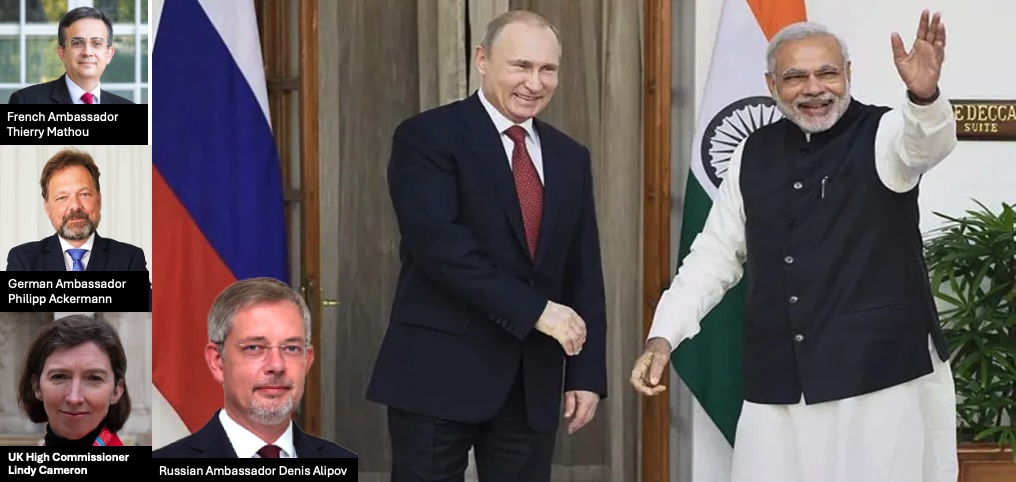
The Western envoy controversy began on 1 December 2025 when UK High Commissioner Lindy Cameron, French Ambassador Thierry Mathou and German Ambassador Philipp Ackermann jointly wrote an article in The Times of India. It accused Russia of continuing aggressive military escalation in Ukraine despite renewed efforts for peace. The op-ed asserted that Russia had chosen war “systematically” and remained unwilling to engage constructively in any meaningful ceasefire discussion.
Key Claims Against Russia
The envoys highlighted several issues:
- Russia’s unprovoked war of aggression on their home
- Russian missile and drone attacks targeting civilian infrastructure
- High civilian casualties and humanitarian collapse
- Cyber attacks and disinformation campaigns
- Attempts to undermine global stability and territorial sovereignty
They also emphasised that Ukraine’s resistance had now entered its fourth year and asserted that President Putin alone had the capacity to halt the conflict. According to the piece, Europe had maintained unwavering support for Ukraine due to the broader implications for global security and democratic values.
Call for India’s Influence
The envoys referenced Prime Minister Narendra Modi’s longstanding message that “this is not an era of war” and urged India to use its growing global standing to push Moscow towards a lasting peace. They suggested India’s involvement could lend credibility to long-term security guarantees for Ukraine.
The op-ed appeared to hint indirectly that India’s deepening energy trade with Russia—crossing USD 65 billion in 2024—should not dilute New Delhi’s moral voice. Diplomatic observers saw this as a subtle attempt to influence the mood before the summit.
Ackermann’s ANI Interview Reinforces Europe’s Position
On the same day, German Ambassador Philipp Ackermann gave a detailed interview to ANI, which added momentum to the Western envoy controversy. He stated that Germany would “follow the visit closely” and stressed that Russia had initiated the conflict, regardless of geopolitical complexities.
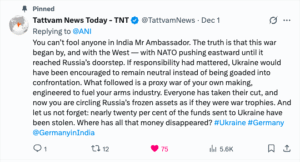
The ANI interviews clip appeared on X and people, especially Indian media, intellectuals and the general public have heavily criticised and exposed the western agenda behind the Ukrainian War.
India’s Strategic Role in Putin’s Visit
Ackermann noted that India, with its established bilateral relationship with Russia, could communicate difficult messages that Europe could not. He also connected the conversation to U.S. President Donald Trump’s attempts at facilitating peace, referencing high casualty numbers and recent discussions between American and Russian diplomats.
Subtle Pressure with Diplomatic Politeness
While acknowledging India’s sovereign decisions, Ackermann expressed hope that Modi would articulate the need for peace directly to Putin. His words were measured, yet unmistakably designed to reinforce Europe’s stand at a sensitive moment.
Russia’s Counteroffensive — Alipov’s “Four Treacheries” Narrative
Two days later, Russian Ambassador Denis Alipov responded with a forceful op-ed titled “Europe’s 4 Treacheries Are Impeding Peace in Ukraine.” This escalation transformed the issue into a full-blown Western envoy controversy.
Russia’s Version of Events
Alipov argued that Russia never sought a war. He framed the 2014 Ukrainian revolution as a Western-backed coup that unlawfully removed President Viktor Yanukovych. He accused Europe of provoking conflict in multiple ways:
- Supporting the Maidan uprising to create an anti-Russian government
- Breaking verbal assurances regarding NATO’s non-expansion (eastward)
- Undermining the Minsk Agreements with military support to Ukraine
- Fuelling escalation since 2022 for geopolitical gain
Positioning Europe as the Aggressor
According to Alipov, Russia repeatedly sought negotiations, while Europe allegedly sabotaged settlement efforts to maintain influence over Ukraine. He also accused European states of shedding “crocodile tears” over casualties while calculating strategic advantages.
India’s Position Praised
Alipov subtly praised India’s balanced approach and cautioned against Western “echo chambers”. He reaffirmed the strength of Russia–India relations, citing nuclear cooperation, defence projects and energy trade. The message was clear: Moscow values New Delhi as a stabilising partner in a changing global order.
MEA’s Quiet Yet Firm Response to the Western Envoy Controversy
India refrained from issuing a formal public statement. Instead, senior MEA officials informally briefed reporters on 2–3 December, describing the envoys’ actions as “very unusual” and diplomatically inappropriate.
Breach of Norms Under Vienna Convention
Officials stated that foreign envoys are expected to avoid public commentary on India’s third-country relationships. The coordinated op-ed was viewed as a breach of diplomatic etiquette. India conveyed its dissatisfaction privately to the envoys.
Strategic Autonomy Reaffirmed
MEA emphasised that India maintains independent bilateral relationships, regardless of geopolitical pressure. The response was deliberately calibrated to avoid escalation yet assert sovereignty. Analysts believe this approach aligns with India’s long-standing principle of multi-alignment.
Broader Implications for India’s Foreign Policy
The Western envoy controversy highlights several important geopolitical dynamics.
India’s Delicate Balancing Act
India’s ties with Russia remain robust, driven by energy imports, defence equipment and nuclear cooperation. Simultaneously, India’s partnerships with Europe and the United States continue to expand across digital trade, mobility, and clean energy. The controversy tests India’s ability to maintain equilibrium.
Potential Impact on Europe–India Relations
The episode may slow certain negotiations, especially in defence sectors and the EU–India FTA discussions. However, both sides recognise the broader strategic value of cooperation.
Putin’s Visit and Outcomes
The summit is expected to cover:
- Long-term defence cooperation
- A mobility pact for Indian workers
- Continued oil trade
- Payments mechanism under sanctions
- BRICS coordination
Muted public statements are expected as both leaders will prioritise bilateral deliverables over contentious global narratives.
A Diplomatic Storm before a Strategic Summit
The Western envoy controversy has created unexpected turbulence ahead of President Putin’s arrival. Yet, the episode reinforces India’s evolving role as an independent pole in global politics. For New Delhi, the primary task remains the preservation of strategic autonomy while engaging constructively with all sides. As Russia and India prepare for their high-level discussions, the geopolitical theatre surrounding Ukraine continues to shape global alliances. The summit may ultimately reaffirm that India’s foreign policy will not be dictated by external pressure, however coordinated or forceful.