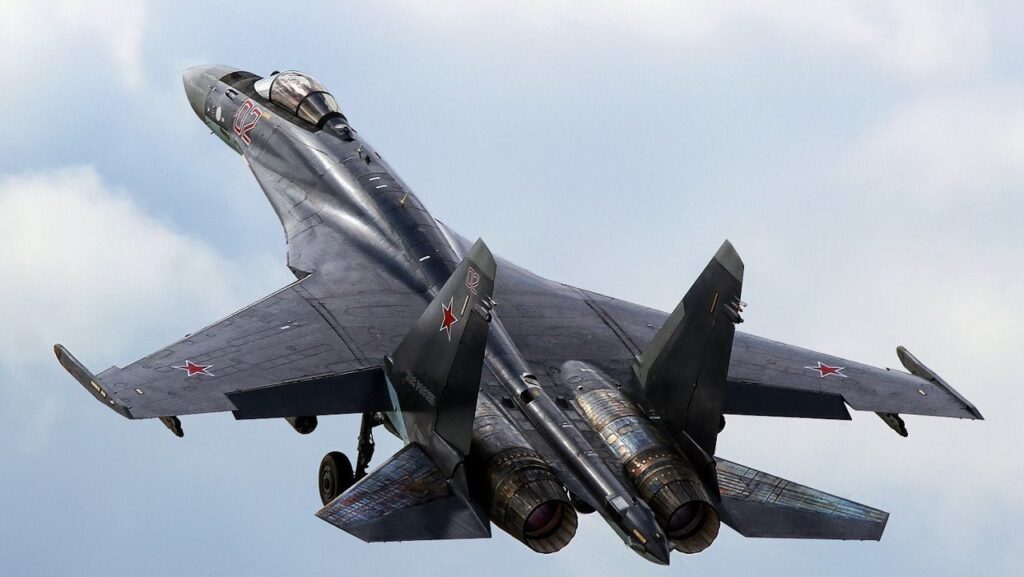
Russia Begins Su-35 Production for Iran Under €6 Billion Arms Deal
Moscow/Tehran — Newly leaked documents from Russia’s military-industrial complex confirm that production of the first 16 Su-35 fighter jets for Iran is now underway. The papers — originating from Rostec and associated aviation enterprises — outline the structure of a €6 billion Su-35 deal Iran signed with Moscow, financed through a barter system involving Iranian drones and missiles.
The files, dated March 2024 to September 2025, reveal a detailed production roadmap for the aircraft. Component manufacturing runs from 2025 to 2027, centred at the Yuri Gagarin Aviation Plant in Komsomolsk-on-Amur, one of Russia’s primary fighter-jet facilities. Prepayments were logged in March, July and December 2024, indicating that Iran met its financial obligations early in the process.
Russia’s Ministry of Defence is directly supervising export-standard avionics and electronic-warfare suites for customer “K10”, a code explicitly linked to Iran in the leaked correspondence.
Contract Scale and Earlier Leaks
This leak follows a major disclosure in October 2025 from KRET, a Rostec subsidiary. That earlier tranche exposed an even larger order for 48 Su-35s, listed under customer code “364”, with an estimated value of €5–6 billion. The package included Khibiny-M electronic-warfare pods, radar-warning receivers and other advanced systems typically reserved for high-priority export clients.
The newly surfaced documents narrow their focus to the initial 16 jets already in serial production. Deliveries for the first batch are projected between 2026 and 2028, consistent with barter conditions tied to Iranian Shahed drones and short-range missiles supplied to Russia for its war effort in Ukraine.
Despite the demands of its own conflict, Russia continues to allocate manufacturing capacity to the Iranian order — a sign of strengthened strategic alignment between Moscow and Tehran.
Geopolitical Impact on Middle Eastern Airpower
The arrival of the Su-35s could reshape regional power balances. Iran’s current fighter fleet relies heavily on ageing, pre-1979 American aircraft such as the F-14 Tomcat and F-4 Phantom II. In contrast, the Su-35 is a 4.5-generation air-superiority fighter, equipped with advanced radar, long-range missiles and high-agility flight controls.
Two squadrons of Su-35s would significantly improve Iran’s air defence posture. The aircraft could strengthen deterrence against Israel, Gulf rivals and Western airpower, especially during potential confrontations around the Strait of Hormuz. The deal also represents Russia’s largest confirmed fighter-export programme since the invasion of Ukraine, signalling Moscow’s growing reliance on sanctioned partners to sustain both its economy and its war machinery.
However, full verification of the contract’s scale, delivery timelines and final configuration still awaits official confirmation from either government.
The Larger Picture
The leaked files provide strong evidence that the Su-35 deal Iran sought from Russia has moved from negotiation to active production. The contract deepens Moscow-Tehran defence ties, reinforces barter-based sanction-evasion mechanisms and promises to modernise Iran’s outdated air fleet. If deliveries proceed on schedule, the Middle East may soon witness one of its most consequential military upgrades in a decade.