Pakistan Navy Unveils SMASH ASBM, Signalling Major Shift in Arabian Sea Deterrence
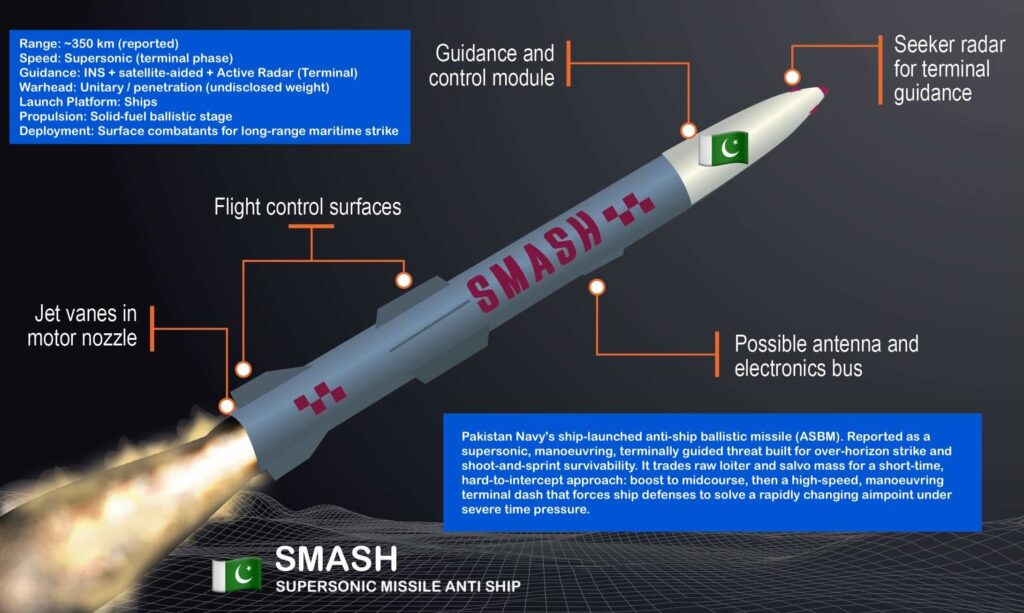
Pakistan has formally introduced the SMASH Anti-Ship Ballistic Missile (ASBM), claimed to be a domestically developed system intended to reinforce the country’s anti-access/area-denial (A2/AD) posture across the Arabian Sea. The missile, with an officially stated range of around 350 kilometres but reportedly capable of far greater reach, represents Pakistan’s most consequential naval-strike capability since its induction of the Chinese-origin CM-302 supersonic cruise missile.
A Shift From Cruise Missiles to Ballistic Naval Strike
For years, speculation surrounded the nature of Pakistan’s next-generation naval strike weapon—whether it would follow the established cruise-missile architecture or shift to a ballistic trajectory. The ambiguity ended after the Pakistan Navy released footage confirming that SMASH is a ballistic missile and has been successfully test-fired from a surface combatant, specifically a Zulfiquar class frigate (F-22P).
This milestone is significant for several reasons:
Pakistan becomes the first South Asian navy to publicly demonstrate a ship-launched ASBM.
The test indicates that existing platforms—F-22P and possibly Type 054A/P frigates—can deploy ballistic anti-ship weapons without major redesign.
Ballistic profiles offer dramatically higher terminal speeds and top-attack angles, complicating conventional air-defence intercept geometry.
Technical Features and Possible Lineage
Although official specifications remain classified, multiple open-source assessments link SMASH’s design lineage to Pakistan’s Fatah-II guided ballistic missile. Common features include:
A quasi-ballistic trajectory with a high-altitude boost phase.
Terminal-phase manoeuvrability.
Avionics tailored for precision against both stationary and moving maritime targets.
Some analysts also highlight visual similarities with China’s CM-401 short-range ASBM—particularly in airframe shape and launch-canister dimensions—though Pakistan denies direct replication. Whether the system reflects indigenous development, licensed adaptation or collaborative engineering, the final product aligns with the evolving global trend of compact, high-speed anti-ship ballistic systems.
Conflicting Range and Speed Claims
Officially, SMASH carries a range of approximately 350 kilometres. However, Pakistan’s recent test—conducted around November 24–25, 2025—featured parameters that observers interpret as far more ambitious. Independent tracking suggests:
Terminal velocity could exceed Mach 7–8, placing the missile in hypersonic closing-speed territory.
Strike reach may extend to 700–850 kilometres, depending on payload configuration and launch elevation.
Pakistan has not endorsed these enhanced claims, but the recurring pattern across multiple OSINT communities indicates that SMASH is designed to offer standoff coverage across the wider Arabian Sea, including potential engagement envelopes against large surface groups.
Impact on India’s Naval Posture
The introduction of a ship-launched ASBM forces India’s naval planners to account for a new kind of threat—one that differs sharply from existing subsonic (Harbah, Babur-3) or supersonic (CM-302) profiles.
Ballistic anti-ship weapons challenge naval defence systems through:
- Steep terminal dives that stress radar acquisition timelines.
- High closure speeds reducing intercept windows.
- Non-linear manoeuvres in the terminal phase.
- The ability to strike the less-armoured upper decks of major vessels.
While Indian sources maintain confidence in layered interceptors such as the PGLRSAM (Mach 7-class), the Pakistan Navy’s evolving mix of ballistic, subsonic, and supersonic threats imposes additional operational burdens on India’s carrier and escort groups.
Platform Compatibility and Future Launch Variants
The SMASH test fired from PNS Tippu Sultan (a Zulfiquar/F-22P frigate) validates the system’s compatibility with inclined-launch canisters already embedded on older Chinese-built hulls. Integration with vertical-launch systems (UVLS) on the newer Tughril-class (Type 054A/P) is considered feasible.
Pakistan is also exploring:
Land-based launch options (not yet confirmed).
An air-launched ballistic variant, designated P282, expected to equip:
Jinnah-class future frigates, and
Sea Sultan maritime patrol aircraft.
If fielded successfully, Pakistan would join a very small group of nations experimenting with airborne ballistic anti-ship platforms.
Chinese Cooperation and the Modernisation Arc
Pakistan’s ASBM progression aligns with China’s wider support for the Pakistan Navy’s modernisation. Whether or not SMASH directly inherits the CM-401 architecture, the operational logic is unmistakable: Pakistan seeks to impose sea-denial pressure across the northern Arabian Sea without pursuing numerical parity with the Indian Navy.
Its multi-domain anti-ship portfolio now includes:
Subsonic cruise missiles (Harbah, Babur variants)
Supersonic cruise missiles (CM-302)
Ballistic anti-ship missiles (SMASH/ P-282 line)
This mix complicates defensive planning for any adversary operating near Pakistan’s exclusive economic zone.
Clarifying the Test Timeline
There has been confusion regarding the test dates:
Early OSINT reports referenced November 7, 2025, likely tied to developmental activities.
Official confirmation of the major ship-launched operational test came only after November 24–25, 2025.
Released video footage and ISPR statements indicate the latter test as the decisive milestone validating naval deployment.
Strategic Implications for the Arabian Sea
The debut of SMASH unfolds at a time when Pakistan is actively restructuring its maritime deterrence posture. A sea-launched ballistic missile—capable of hypersonic terminal speeds and top-attack geometry—provides a standoff capability that could complicate surface operations for any major naval power in the region.
Notably, this missile emerges even as Russia remains quiet on the Ukraine peace plan, while its ground forces continue incremental gains in Ukraine’s southeast—an evolving geopolitical environment that indirectly shapes global arms development and regional security thinking, including in South Asia.
Related Reading:
Why India Chose BrahMos Over ASBMs: A Doctrinal, Technical, and Strategic Analysis [Scheduled for 28.11.2025, 7:00 AM]