Supreme Court Orders Medical Board to Evaluate Plea for Passive Euthanasia in Noida Case
In a significant move reaffirming India’s legal and ethical framework on “passive euthanasia,” the Supreme Court has directed the District Hospital in Noida to constitute a Permanent Medical Board to assess whether life-sustaining treatment may be withdrawn for 32-year-old Harish Rana, who has remained in a vegetative state for nearly 12 years following a traumatic fall.
The order, passed by a Bench of Justices JB Pardiwala and KV Viswanathan, mandates the formation of both a Primary Medical Board and, if required, a Secondary Medical Board, as per the procedure laid down in earlier landmark judgments. The Primary Board has been instructed to submit its report within two weeks.
The case is formally titled “Harish Rana Vs Union of India” (MA 2238/2025 in SLP(C) No. 18225/2024).
Case Background
Harish Rana has survived solely through artificial life support, particularly a percutaneous endoscopic gastrostomy (PEG) tube, since his accident in 2013. His father approached the Supreme Court in 2024 seeking withdrawal of life support under passive euthanasia. The plea was initially rejected after the Uttar Pradesh government stated it would continue providing medical treatment.
In his latest application, the father submitted that his son’s condition has deteriorated further, claiming 100% disability, no cognitive response, and no medical improvement for over a decade — strengthening the argument that continued treatment serves no curative purpose.
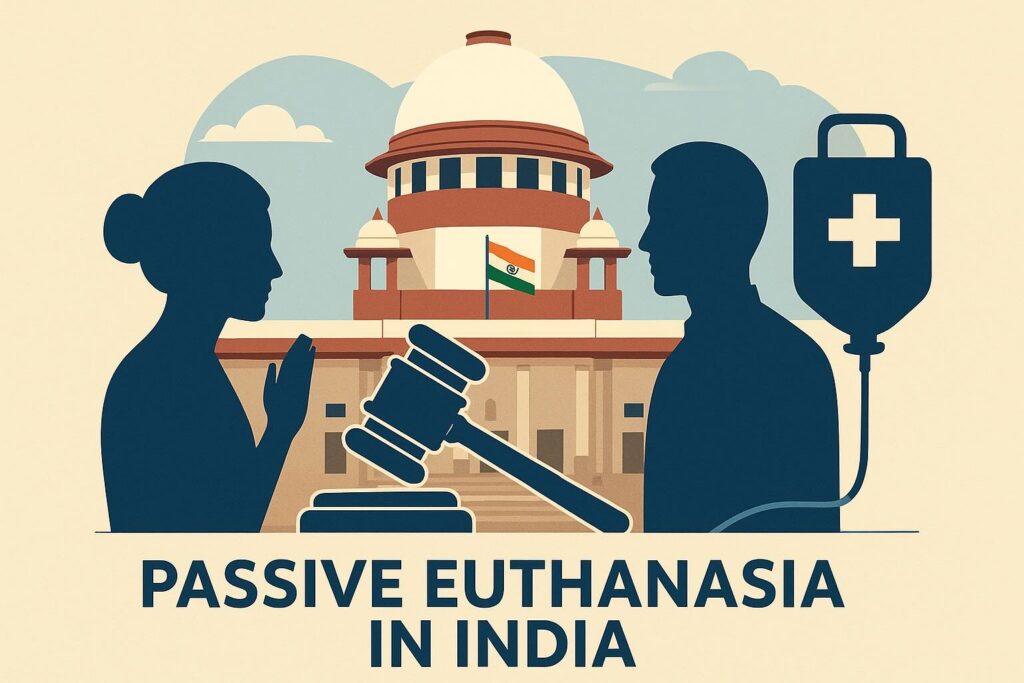
The Supreme Court clarified that the petition concerns passive and not active euthanasia. The former involves withdrawing life-sustaining treatment, allowing natural death to occur, while the latter — involving an active step to end life — remains illegal in India and is classified as culpable homicide.
Legal Framework: Right to Die With Dignity
Judicial Evolution of Passive Euthanasia in India
India’s legal position on “passive euthanasia” has developed through a series of landmark Supreme Court judgments that attempted to reconcile constitutional rights with ethical medical practice. The first substantive shift occurred in 2011 with the Aruna Shanbaug decision, where the Court permitted the withdrawal of life support in rare circumstances under strict judicial oversight. That ruling required High Courts to examine each request in detail, including the medical condition of the patient and the credentials of the attending physicians, before granting approval.
A transformative step followed in 2018, when a Constitution Bench in the Common Cause case recognised the “right to die with dignity” as an integral part of Article 21. The judgment reaffirmed the permissibility of passive euthanasia and introduced the concept of advance medical directives or “living wills,” allowing individuals to specify their end-of-life preferences in advance. Over time, however, the detailed procedure laid down in 2018—requiring multiple authorities, several certifications, and judicial intervention—proved impractical for hospitals and families. In response, the Supreme Court revisited the matter in 2023 and simplified the process, refining the role of medical boards and allowing hospitals to initiate evaluations without the earlier procedural bottlenecks.
Present Court Oversight and Broader Global Context
It is within this evolved legal architecture that the Supreme Court has now directed the District Hospital in Noida to constitute a Permanent Medical Board to examine the condition of Harish Rana. The Board’s report, followed if necessary by the assessment of a Secondary Medical Board, is intended to ensure that any decision to withdraw life-sustaining treatment is medically justified and not driven by emotional or administrative pressures. Such multilayered scrutiny reflects the Court’s commitment to safeguarding both human dignity and procedural integrity, especially in cases where the patient is incapable of communicating their own wishes.
The Supreme Court’s continued supervisory role also explains why matters involving passive euthanasia frequently come directly before it rather than lower courts. These cases often involve constitutional questions, medical ethics and irreversible outcomes, requiring uniform standards across the country—standards originally crafted and later revised by the Supreme Court itself. While India maintains a cautious approach by limiting itself strictly to passive euthanasia, many countries have moved further by legalising active euthanasia under regulated conditions. Nations such as Belgium, the Netherlands, Canada, Spain, Luxembourg, Ecuador and all six Australian states allow medically administered interventions to end life, usually after multiple medical certifications and independent reviews. India’s restraint reflects a more conservative ethical position, shaped by cultural considerations and the constitutional emphasis on the protection of life even while acknowledging the right to dignity.
The outcome of the present case will therefore contribute not only to the individual decision regarding Harish Rana but also to the continuing refinement of how courts, hospitals and families navigate end-of-life decisions within the constitutional and ethical boundaries laid down by the Supreme Court.