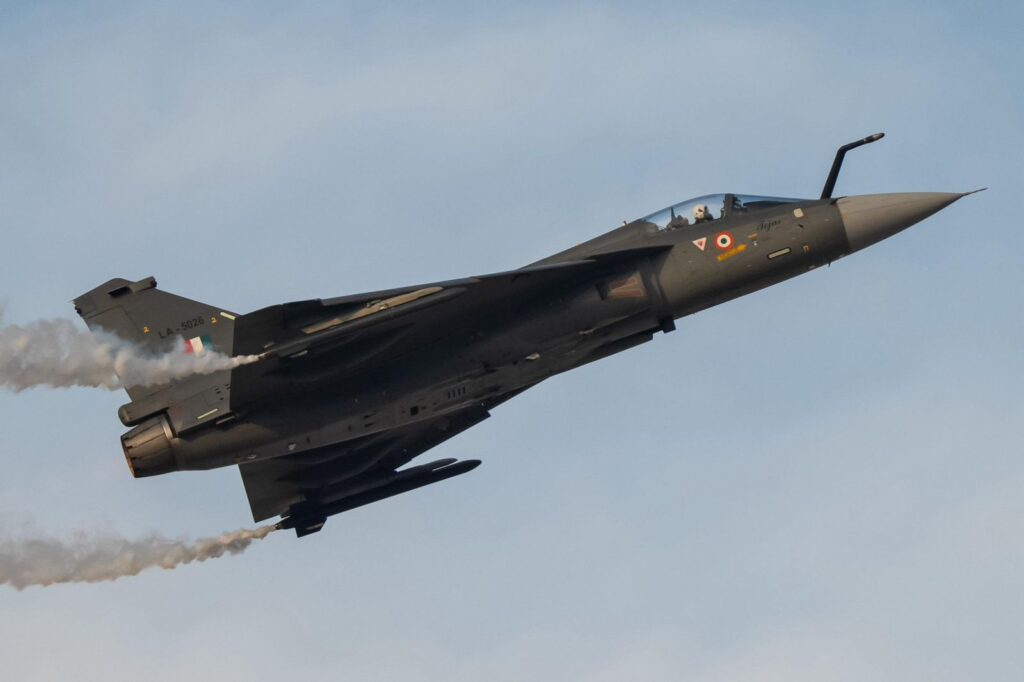
Tejas Crash Dubai Airshow 2025: How a Daring Demo Turned Into a Heart-Breaking Disaster
The Tejas crash Dubai Airshow 2025 stunned the global defence aviation community, turning what should have been a triumphant finale into a sombre tragedy. On 21 November 2025, an Indian Air Force (IAF) HAL Tejas Light Combat Aircraft (LCA) plummeted to the ground during a high-intensity aerobatic routine at Al Maktoum International Airport. The accident claimed the life of Wing Commander Namansh Syal, a veteran pilot renowned for his precision and mastery of complex manoeuvres.
As thick plumes of smoke rose above the runway and emergency sirens pierced the air, the incident cast a heavy cloud over the Dubai Airshow’s closing hours, a global event attended by over 148,000 spectators and industry leaders. The mishap has now triggered a full-scale Court of Inquiry, with early speculation centred around possible aircraft malfunction or G-induced incapacitation.
Tejas Crash Dubai Airshow 2025: How the Fatal Sequence Unfolded
The Final Manoeuvre
At around 2:10 PM local time, the HAL Tejas began a high-stakes aerobatic sequence, including a negative-G pushover — a manoeuvre that tests both pilot resilience and aerodynamic limits. Witnesses reported the aircraft dipping under 500 feet before losing stability.
Video recordings show no sign of an ejection, which immediately heightened concerns over possible G-LOC or sudden mechanical failure.
Immediate Aftermath at the Airshow
Firefighting teams rushed in within seconds, battling flames and dark smoke billowing from the wreckage. Crowds were evacuated as flying operations were promptly suspended. Although ground displays continued until 6 PM, the festive mood of the airshow collapsed instantly.
The Indian Air Force issued a brief but emotional statement expressing deep grief and confirming the pilot’s death.
HAL Tejas: India’s Indigenous Fighter Jet in Spotlight
Origins and Capability
The HAL Tejas — meaning Radiant — represents India’s decades-long ambition to replace ageing MiG-21s with a home-grown 4.5-generation multirole fighter. Developed by the Aeronautical Development Agency (ADA) and built by Hindustan Aeronautics Limited (HAL), it features:
- Mach 1.6 top speed
- 500 km combat radius
- Delta-wing agility
- Composite airframe (45% composites)
- Fly-by-wire flight controls
- GE F404-IN20 engine (84 kN thrust)
Weighing 6,500 kg empty with a maximum take-off weight of 13,500 kg, the Tejas is known for its manoeuvrability and cost-competitiveness, priced at USD 40–50 million — significantly lower than platforms like the F-35 or Rafale.
Operational Journey
Since its first flight in 2001 and induction in 2016, the Tejas fleet has logged over 12,000 flight hours. India has already inducted more than 40 Mk-1 jets, with 83 Mk-1A ordered in 2021 and 97 additional units approved in September 2025, aiming for nearly 220 aircraft in service by 2035.
Safety Record: Strong Overall, but Now Marked by a Second Crash
Two Crashes in 24 Years’ History
Before the Tejas crash Dubai Airshow 2025, the aircraft enjoyed an enviable safety record with zero fatalities and only one previous crash.
March 2024 – Jaisalmer
A twin-seat trainer variant suffered suspected engine seizure. Both pilots ejected safely. Post-crash investigations pointed to maintenance oversights rather than inherent design flaws.November 2025 – Dubai Airshow
The latest crash, however, has resulted in the first loss of life in Tejas history.
Possible Causes Under Scrutiny
Experts are examining several factors:
- Aerodynamic overload during low-speed delta-wing turns
- Potential compressor stall in the GE F404
- Hot desert conditions stressing engine performance
- Human factors such as G-LOC during negative-G manoeuvres
Flight data recorders recovered from the crash site will provide clarity in the coming weeks.
Wing Commander Namansh Syal: The IAF Ace Behind the Controls
A Decorated Aviator
Wing Commander Namansh Syal, aged 37, hailed from Kangra district in Himachal Pradesh. A stalwart of No. 45 Squadron “Flying Daggers”, he had amassed over 1,500 flying hours across Tejas, Su-30MKI, and Hawk platforms.
His achievements included:
- High-G centrifuge qualification
- Multiple precision awards at Aero India 2023
- Participation in elite national and international displays
A Personal and National Loss
Married to Captain Priya Syal and father to a five-year-old daughter, Syal’s passing has triggered an outpouring of tributes from military leaders, political figures, and the global aviation community.
His home village of Patialkadh has entered a period of mourning, remembering him as a disciplined, enthusiastic officer whose passion for flight was matched only by his devotion to service.
Impact on India, HAL, and the Tejas Programme
Will the Tejas Fleet Be Grounded?
While speculation runs high, the IAF is unlikely to announce an immediate grounding unless preliminary evidence suggests systemic engine or control issues. HAL has committed to cooperating fully with Emirati and Indian investigators to ensure full transparency.
Global and Regional Implications
The crash occurred at a time when India is strengthening regional defence ties and modernising its aerial fleet. Despite this tragic setback, experts believe the Tejas programme will continue:
- New Mk-1A jets are entering production
- GE’s F414 engine deal is progressing for the Tejas Mk-2
- Export campaigns to countries such as UAE and Argentina remain ongoing
Like other global fighters — including F-35s and J-20s — isolated crashes typically lead to improvements rather than programme cancellation.
A Tragedy That Will Shape the Future
The Tejas crash Dubai Airshow 2025 is a heartbreaking moment for India and the aviation world. Above all, it is a story of a pilot who dedicated his life to the skies. Wing Commander Namansh Syal’s unwavering commitment will remain etched in IAF history.
As investigations progress, his legacy will drive further safety enhancements and strengthen India’s resolve to advance indigenous aerospace capability. The radiance of Tejas — and the spirit of Syal — continues to guide India’s flight towards self-reliance.