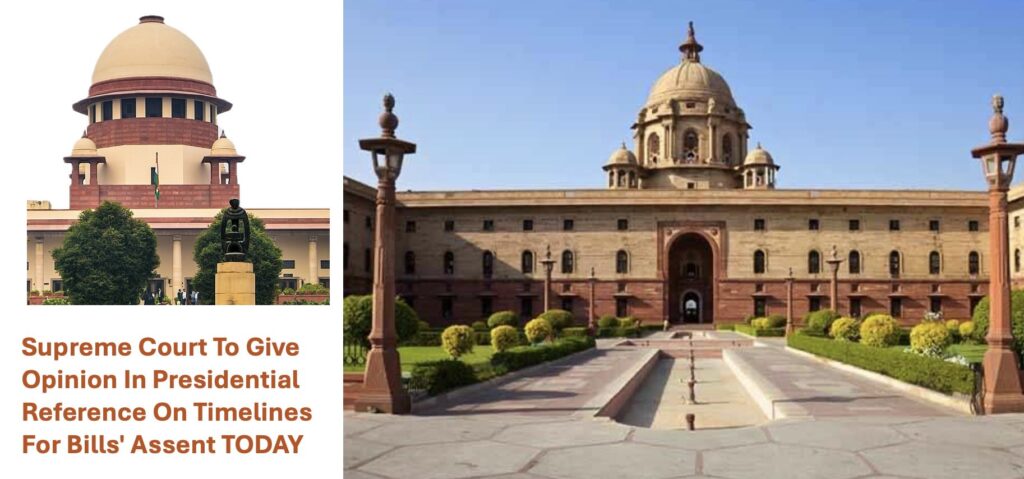
Assent Timelines: SC Opinion on Presidential Reference
Introduction — What’s at stake with the assent timelines
The Supreme Court of India is set to pronounce an advisory opinion on assent timelines on 20 November 2025. The President, Droupadi Murmu, referred 14 constitutional questions to the Court under Article 143 in May 2025 asking whether timelines and “deemed assent” can be imposed on the President and State Governors.
This story matters because the answers will affect federal balance, separation of powers, and how laws become effective across states and the Union. Below, I curate the facts, explain the legal background, outline the President’s key questions, and flag likely consequences.
Background — How the dispute began
The controversy began with the Tamil Nadu episode involving Governor R.N. Ravi, where the Governor was accused of delaying assent to several Bills. The Supreme Court, in a high-profile April 8, 2025 judgment, called the withholding of assent illegal and set timelines for Governors and for the President when bills were reserved. The Court also used its Article 142 powers to treat certain pending bills as “deemed assented,” drawing strong reactions about judicial overreach.
The April judgment required Governors to act within fixed periods and prescribed a three-month deadline for Presidential assent on Bills reserved for the President’s consideration. That directive is the central factual trigger for the Presidential Reference.
The President’s 14 questions — boiled down
The reference raises focused legal queries. The main ones are:
Can the Constitution permit the imposition of fixed timelines on the President and Governors for granting assent to Bills?
Is it constitutionally valid for a court to prescribe “deemed assent” when the President or Governor fails to act within such timelines?
Can the President or Governors be made to give reasons for withholding assent?
Is the President required to seek the Supreme Court’s advice under Article 143 when a Governor reserves a Bill?
What is the scope of discretion available to these constitutional authorities?
These distilled questions will shape today’s advisory opinion.
What the April judgment held — and why the President asked for advice
The April 8 judgment found that indefinite withholding of assent by Governors was unlawful and that it could paralyse elected governments. The Court therefore fixed timelines, and—in an unusual step—used Article 142 to treat certain pending Bills as assented to. This prompted the President and the Union to question whether the judiciary could, in effect, set deadlines or declare “deemed assent” for the President or Governors.
During hearings on the Reference, the Attorney General warned the Court against encroaching on executive functions by effectively assuming Governor-like decisions through judicially imposed mandates. Conversely, several state governments argued the Reference was not maintainable because those questions were already dealt with in the earlier judgment.
Key legal tensions — separation of powers vs. remedying gridlock
There are two competing constitutional values in play:
First, the need to prevent Governors or the President from stalling legislation indefinitely, which safeguards democratic governance. The April judgment stressed that point.
Second, the traditional understanding that the President and Governors exercise a constitutional discretion that is not easily subject to judicial time-limits or to the courts prescribing “deemed assent.” Critics argue that imposing timelines risks upsetting the separation of powers.
How the Court balances these will determine whether uniform timelines survive constitutional scrutiny.
Possible outcomes and practical consequences
If the Court upholds its timelines, state Governors and the President may face enforceable deadlines, improving legislative certainty. However, it could also narrow executive discretion and invite political friction. If the Court narrows or rejects timelines, the status quo of generous executive discretion would remain, but so might the risk of delay and legislative paralysis. Either way, the judgment will set a precedent for future inter-branch disputes.
Finally — Why you should care
Today’s advisory opinion will not decide the correctness of the April judgment on the Tamil Nadu Governor. Instead, it will address whether courts can constitutionally impose assent timelines, prescribe “deemed assent,” or require reasons from constitutional functionaries. The ruling will clarify how India reconciles judicial review, executive discretion, and federal functioning going forward. Readers who follow constitutional law, governance, and state–Centre relations should watch the judgment closely.