India’s Expanding Anti-Drone Shield Signals a New Era in Aerial Defence
The rising complexity of modern conflict has pushed nations to rethink traditional airpower, and India is no exception. As modern grammar of warfare with variety of combat drones spreads across global battlefields, the demand for a strong India anti-drone strategy has reached unprecedented levels. Drone incursions along sensitive borders, coupled with rapid technological changes, have forced India to refine and modernise its approach to aerial protection. Therefore, the country now stands at a turning point where indigenous innovation and battlefield experience converge to reshape national security.
The Changing Character of Drone Warfare
Drones have rewritten the script of twenty-first century warfare. Their evolving roles stretch from reconnaissance to precision attacks, altering how military planners assess threats and respond to them. Over the last decade, drones have become cheaper, more accessible, and more versatile, as a result proving highly disruptive in contested areas. Consequently, countries worldwide have scrambled to establish countermeasures that match this new challenge.
India’s own security environment has been deeply affected by this global shift. Hostile elements have tested the limits of Indian airspace, prompting a nationwide focus on layered countermeasures. Each intrusion has strengthened the resolve to create an integrated response capable of dealing with both lone drones, and complex swarm patterns which are – AI based, contineously communicating with each other, reconfiguring if a drone of the swarm is destroyed, and the group may split or merge and change the shape of configuration.
Operation Sindoor: A Turning Point in Counter-Drone Warfare
In May 2025, Operation Sindoor marked a defining moment in India’s modern military landscape. The offensive saw an unprecedented surge in drone use by adversarial forces, with an estimated 500–600 platforms deployed. These included small quad-copters, fixed-wing kamikaze drones, and MALE-class UCAVs such as the Turkish-origin Bayraktar TB2, capable of precision strikes and persistent surveillance.
These drones operated independently or under remote control; although some media reports referred to them as “swarm drones,” none displayed true swarm-AI behaviour. Their objectives were reconnaissance, probing India’s radar picture and forward positions, and striking high-value military bases.
India countered by activating its Integrated Counter-Unmanned Aerial System (CUAS) Grid — a networked architecture combining radar, electro-optical sensors, electronic warfare suites, and layered air-defence systems. EW units disrupted drone communication and navigation through jamming and GPS interference, while L-70 and ZU-23 AA guns, Akash and MRSAM batteries, S-400 units, and emerging laser systems formed a coordinated hard-kill shield against low-altitude threats.
This unified response enabled Indian forces to neutralise more than 95% of the incoming drones, denying the attackers any significant tactical gains. Operation Sindoor demonstrated that even large-scale, complex drone offensives can be defeated when early warning, electronic disruption, and layered kinetic firepower act in concert. The experience became a watershed moment, validating India’s integrated air-defence approach and accelerating investment in indigenous counter-drone technologies.
Induction of 16 New Laser-Based Systems
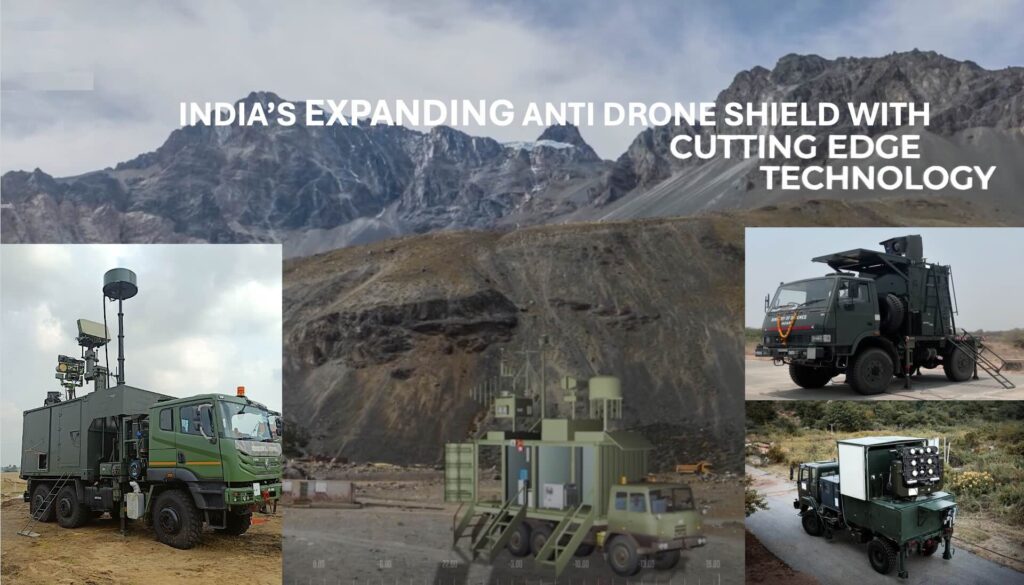
Building on the hard lessons from the LoC, the government recently announced the induction of sixteen indigenous laser-based anti-drone systems for frontline deployment. These 10kW laser systems are designed mainly by DRDO in collaboration with domestic defence manufacturers. Their 2 kilometre strike range marks a significant improvement over earlier versions. Therefore, teams operating in high-threat zones now possess the ability to engage unmanned targets faster and with greater precision.
Each unit integrates radar, electro-optical sensors, RF detectors, and high-energy lasers into a single vehicle-mounted platform. The combination ensures accurate detection, real-time tracking, and swift destruction of rogue drones. The systems also support soft-kill methods through signal jamming, which broadens the engagement envelope and reduces the need for kinetic responses in populated areas.
Progress on Higher-Powered Laser Weapons
India is also advancing its directed-energy programme beyond the newly ‘inducted’ 10-kilowatt systems. In April 2025, DRDO successfully tested a 30-kilowatt laser at its Kurnool range, demonstrating higher power output and extended engagement capability suitable for neutralising larger unmanned platforms. This system is now moving with technology transfer to private sectors for production and operationalisation. In parallel, DRDO continues work on the Surya concept, a 300-kilowatt laser intended for long-range interception of high-speed aerial threats. Surya remains under development, but its planned specifications place it in a category designed to counter targets far beyond the reach of current tactical systems. These steps collectively indicate a clear progression toward fielding a wider class of indigenous high-energy laser weapons.
How India’s 10 kW Laser System Neutralises Drones
India’s new ten-kilowatt laser anti-drone system neutralises unmanned threats by holding a concentrated beam on a single point of the target for a few seconds. Small quad-copters usually fail after two to five seconds of exposure, while larger fixed-wing drones may require up to ten seconds. The beam burns through critical components such as rotor arms, flight controllers or battery casings, forcing the aircraft to crash. The system relies on radar, electro-optical sensors and infrared detectors to maintain a stable lock throughout the engagement.
Although effective against individual drones, a laser of this class can engage only one target at a time. Swarm attacks require a layered response in which electronic jammers break swarm coordination while AI algorithms prioritise high-threat drones for laser engagement. The laser thus becomes the hard-kill element of a broader, multi-layer defence designed to contain and dismantle complex drone formations.
Higher-power systems (30 kW, 100 kW, 300 kW) reduce exposure time by delivering more energy quickly. For example:
- 30 kW laser → 1–3 seconds on small drones
- 100 kW+ laser → near-instant disable for small drones, 1–2 seconds for medium drones
- 300 kW laser (like DRDO’s Surya concept) → designed for rapid kills against bigger targets like cruise missiles and aircraft
Private Industry Strengthens India’s Anti-Drone Capabilities
India’s domestic defence ecosystem has flourished over the past few years. Several private firms now occupy critical positions in the India anti-drone sector and contribute unique strengths to national defence.
Adani Defence & Aerospace has debuted mobile counter-drone vehicles equipped with sensor fusion suites, RF detectors, and precision weapons. These platforms were showcased at Aero India 2025, and they demonstrated how private manufacturers are embracing rapid-response mobility.
Zen Technologies, known for its AI-driven approach, has developed systems such as Vyomkavach that rely heavily on real-time automation. Zen’s CUAS integrates RF detection, video-based identification, radar fusion, and automated jamming, along with hard-kill options such as kinetic guns or net-capture systems. By fusing inputs from multiple sensors, these platforms can anticipate drone movements and deliver fast, precise countermeasures.
Grene Robotics’ Indrajaal, an “autonomous drone-defence dome” built on AI-native, multi-sensor fusion, is designed for wide-area protection and autonomous decision-making. It combines radar, RF, and EO inputs with automated interdiction, and has been promoted for securing ports, refineries, and forward operational sectors. Indrajaal-type domes offer a complementary, persistent wide-area layer to point CUAS nodes like those from Zen and BEL, operating with minimal human intervention.
Kadet Defence Systems has contributed indigenous loitering munitions and specialised neutralisation technologies. Throttle Aerospace continues to refine vision-based AI tracking tools.
This industrial rise has expanded India’s options considerably. In addition, it has reduced dependency on foreign technology while boosting operational flexibility.
Towards a Layered, Integrated Counter-Drone Grid
India’s defence establishment now places strong emphasis on integrating all counter-drone assets into a unified command network. This grid is designed to function alongside established air defence systems such as AkashTeer missile platforms. As a result, radar inputs, EO feeds, and RF detections can be analysed centrally and acted upon without delay.
The SAKSHAM modular grid represents a significant step forward. Powered by AI analytics and automated threat responses, the system can evaluate swarm behaviour, assess strike patterns, and launch suitable soft or hard kill measures. The shift from isolated, manual-operated systems to an expanded, AI-enabled grid shows how India intends to keep pace with evolving aerial threats.
Experience, Innovation, and Strategic Confidence
India’s anti-drone strategy has matured considerably since Operation Sindoor. The country has achieved a cohesive blend of operational experience, indigenous research, and industrial capability. The induction of new laser systems is only one indication of this transformation. Each upgrade strengthens India’s confidence in managing the unmanned battlescape of the future.
Furthermore, the collaboration between DRDO, private industry, and the armed forces signals a long-term commitment to self-reliance. Therefore, as drone warfare becomes more complex and adversaries adapt, India remains firmly positioned to defend its airspace. The path ahead will likely see more directed-energy weapons, improved AI-driven systems, and autonomous defence networks.
A Resilient Shield for the Future
India’s journey towards a robust anti-drone shield has been shaped by real battlefield pressure and sustained innovation. Today, the nation stands better prepared, more integrated, and more technologically confident. The India anti-drone framework now represents a strategic advantage that protects vital infrastructure, secures borders, and strengthens national sovereignty.
As drone warfare evolves, India’s adaptive and proactive stance ensures that the country will not only respond to threats but also lead advancements in aerial defence. The coming years will see this foundation grow stronger, enabling the armed forces to maintain dominance in increasingly contested airspaces.