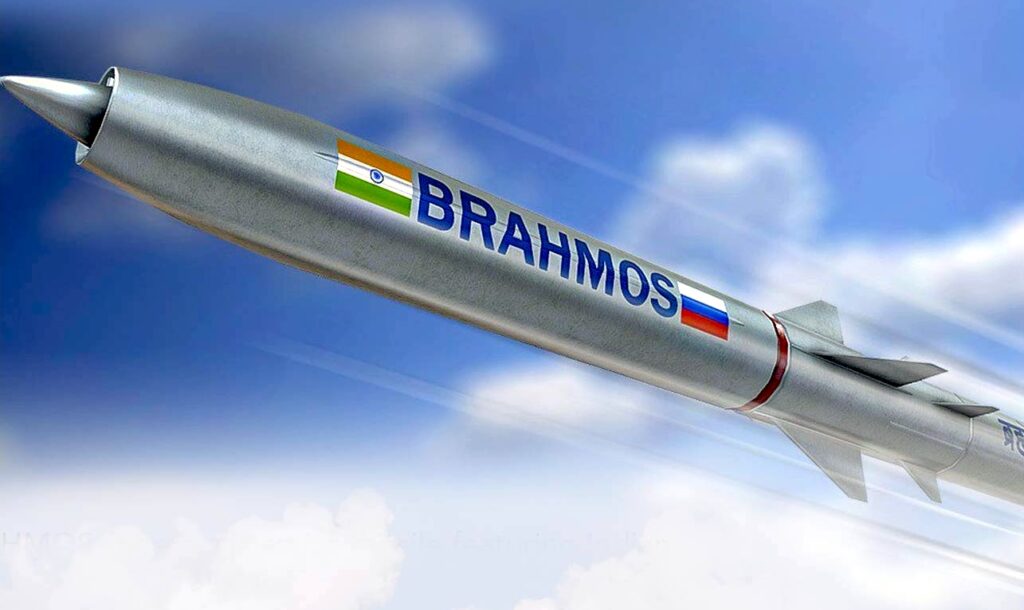
BrahMos: When Speed Became India’s Strategy
BrahMos — India’s Supersonic Edge and the Road to Hypersonic Power of Missiles
When the BrahMos missiles streaked across the night sky during Operation Sindoor, the world witnessed what Indian scientists and engineers had long promised — pinpoint precision. Terrorist establishments, followed by underground Pakistani Air Defence and Control nodes and hardened aircraft shelters, were obliterated with metre-level accuracy. Satellite images released later revealed charred hangers, cratered runways, and shattered bunkers — including those protected by Chinese-origin HQ-9 batteries.
That strike marked a turning point — India was no longer testing technology; it was defining deterrence. Power now had a supersonic face: the BrahMos missile, a weapon that flies three times faster than sound, below radar, and with a mind of its own. In a world of stealth and drones, BrahMos proved that speed is the new stealth.
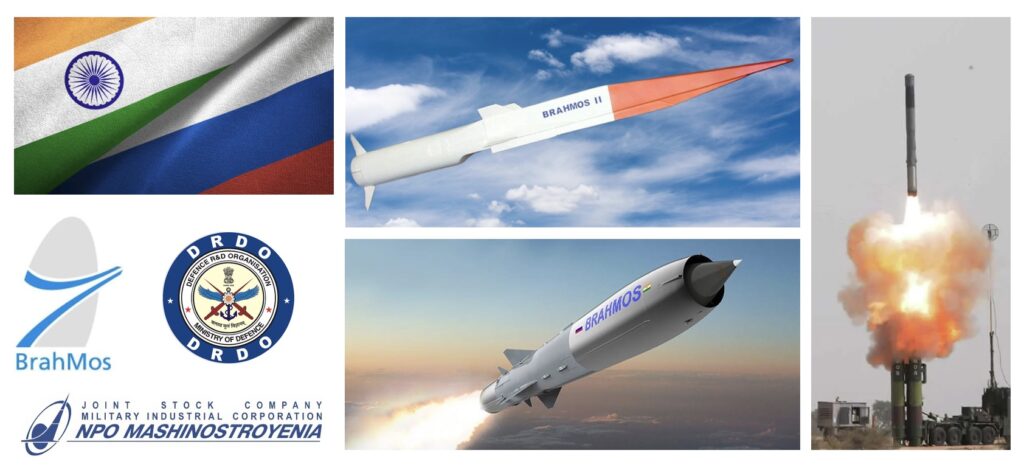
Developed jointly by India’s Defence Research and Development Organisation (DRDO) and Russia’s NPO Mashinostroyenia, BrahMos is no longer an experiment in speed — it’s a battle-validated system. Its blend of Mach 3 velocity, pinpoint accuracy, and multi-platform versatility has made it both a deterrent and an export magnet. The missile’s success in Sindoor didn’t merely destroy airbases — it destroyed doubt.
Before Sindoor, BrahMos was already on the export radar — the Philippines had finalised its purchase and received the first shipment months earlier, marking the first overseas sale of an Indian-made offensive missile. After Sindoor, fresh interest emerged from Vietnam, Indonesia, Greece, Egypt, and the Middle East — nations watching how a missile once dismissed as “too heavy and too fast to be practical” had become the global benchmark for precision and survivability. Defence planners everywhere began asking the same question: how did India build something the West still struggles to match?
BrahMos — Born from Partnership, Perfected in Autonomy
The BrahMos was born in India — in 1998 with the creation of BrahMos Aerospace Private Limited, a 50.5 %–49.5 % joint venture between DRDO and Russia’s NPO Mashinostroyenia. The name merges two rivers — the Brahmaputra and the Moskva — reflecting cooperation that evolved into strategic autonomy.
Unlike its Russian predecessor, the P-800 Oniks, BrahMos was completely re-engineered for compactness, faster processing, and full integration across India’s Army, Navy, and Air Force. Two decades later, it has matured into one of the world’s most versatile and widely deployed supersonic missile programmes.
The Engineering of Supersonic Certainty
What makes BrahMos different isn’t just what it hits — it’s how it gets there.
The missile uses a two-stage propulsion system:
A solid-fuel booster blasts it into the sky, reaching the velocity required to ignite the second stage.
A liquid-fuelled ramjet then takes over, maintaining ‘continuous’ Mach 2.8–3.0 flight all the way to the target. Some sources cite peaks of Mach 3.5 in terminal dives, but the sustained operational figure remains Mach 2.8–3.0. However, export variants are slightly derated; domestically fielded ones retain full-power profiles.
It is pertinent to note that most so-called Mach 4 or Mach 5 missiles — such as advanced BVRAAMs or terminal-phase weapons — reach those speeds only near the end of their flight. BrahMos, by contrast, achieves supersonic velocity almost immediately after launch and remains supersonic throughout its trajectory. This means it can cover 300 kilometres in under five minutes, flying low enough to stay virtually invisible to radar until the final moments.
Its Indian-built guidance system combines inertial navigation, satellite positioning (GAGAN, GLONASS, GPS) and active radar homing in the final phase. The missile “thinks” mid-air — correcting itself against wind drift, jamming, or terrain. This fusion of speed and intelligence is why its circular error probable (CEP) is in single-digit metres. During Sindoor, official data suggested 98–99 % hit accuracy — not claimed, demonstrated.
Speed, Range, and Payload — The Defining Triad
BrahMos’s edge lies in its trinity of speed, reach, and accuracy.
Speed: Sustained Mach 3 flight — about one km per second — three to four times faster than subsonic Western cruise missiles such as the Tomahawk or Storm Shadow.
Range: Export versions capped near 290 km under MTCR rules; Indian extended-range versions tested beyond 400 km and verified around 600 km, with 800 km class models in final trials.
Payload: Typically 200–300 kg high-explosive or semi-armour-piercing warhead.
- Platforms: Land, sea, and air — from truck/train to Su-30 MKI, from ship to submarine.
Although the airframe can technically host a compact nuclear payload, India employs BrahMos strictly as a conventional precision-strike weapon — its true power is the certainty of the hit, not the yield of the warhead.
Why Speed Changes Everything
To understand what makes BrahMos different, it helps to compare it with what came before.
The Tomahawk — the long-serving workhorse of the U.S. Navy — cruises subsonically at Mach 0.8. It’s stealthy and intelligent, but it still gives defenders several minutes to detect, track, and engage.
Now consider a Mach 3, low-flying missile. To intercept it, a defender needs instantaneous detection, predictive tracking, and flawless cueing. With BrahMos, the reaction window shrinks to less than a minute — even advanced systems like Russia’s S-400 Triumf or the U.S. Patriot PAC-3 have barely 45 seconds to respond.
Its true protection lies not only in speed, but in numbers. Fired in coordinated salvos, mixed with decoys and electronic-warfare cover, BrahMos can overwhelm enemy defences before they even finish computing trajectories.
BrahMos isn’t invincible — nothing in the sky is — but it is virtually impossible to intercept under real combat conditions. Pakistan’s Chinese-supplied HQ-9 air defence batteries learned that the hard way during Operation Sindoor. When India launched BrahMos missiles, the HQ-9s reportedly failed to intercept even one. Radar operators didn’t see them until impact flashes lit up their screens.
That’s not science fiction — that’s kinetic stealth.
Hypersonic Dreams, Supersonic Reality
Many assume the future of warfare is entirely hypersonic — and India’s BrahMos-II is being developed with that very vision. But sustaining hypersonic speed is far harder than it sounds. Russia’s Zircon (Mach 6–8) and China’s DF-ZF gliders promise incredible velocity, yet their guidance systems and heat-resistant materials are still believed to be experimental.
BrahMos, by contrast, is operationally hypersonic in effect — cruising steadily at Mach 3 and battle-tested today. It is to hypersonic weapons what the jet fighter once was to the rocket plane: slightly slower, perhaps, but reliable, repeatable, and deployable.
Stealth Vs Speed – Two Philosophies at War
Western cruise missiles like Storm Shadow, SCALP, and Tomahawk rely on stealth — low altitude, small radar cross-section, and subsonic silence. BrahMos flips that logic: if you can’t hide, outrun. At Mach 3, radar reflection is irrelevant; by the time you’re detected, you’re seconds away from the target.
Could stealth make BrahMos even deadlier? Possibly. DRDO engineers are experimenting with radar-absorbent coatings and shaping, but they argue the speed-stealth trade-off is physics: stealth slows you down. BrahMos prefers to stay visible and untouchable rather than invisible and slow.
The Next Generation: BrahMos-NG and the Hypersonic Frontier
India’s Hypersonic Ambition and the Zircon Question
BrahMos-NG (Next Generation) will shrink the legend without shrinking performance — about half the weight (1.5 tonnes), the same Mach 3–4.5 speed, and a 200–300 kg warhead, but compact enough for Tejas, Rafale, and the future TEDBF. The Indian variant may stretch beyond 600 km in range, giving its fighters precision reach deep into contested airspace.
BrahMos-II, meanwhile, marks India’s push into the hypersonic domain, targeting sustained speeds of Mach 6–8. It is designed to use a scramjet engine derived from DRDO’s HSTDV programme, which has already achieved successful flight demonstration. In April 2025, DRDO tested an active-cooled scramjet combustor, validating critical thermal and combustion technologies needed for a true air-breathing hypersonic system.
Yet, moving from the Mach 4.5 class of BrahMos-NG to the Mach 7–8 class of BrahMos-II is a different challenge altogether. Beyond propulsion, India must solve aero-frame integration, heat protection at sustained hypersonic velocity, and precise flight-control under extreme dynamic pressures. These hurdles may explain India’s reported interest in Russia’s 3M22 Zircon technology, although Moscow has not confirmed any formal transfer.
It therefore remains unclear whether India will achieve every component of BrahMos-II indigenously or incorporate select technologies from Zircon. It is also plausible that Zircon may evolve as a separate collaboration, similar to the proposed Kh-69 stealth cruise-missile technology transfer, even if certain know-how or subsystems eventually influence BrahMos-II’s final configuration.
When realised, BrahMos-II will keep India among the few nations capable of developing controllable hypersonic cruise missiles — a technological league that even the United States is still refining.
BrahMos in Context – How it Compares to the World’s Best Cruise Missiles
Every nation with a serious missile programme has its own symbol of precision or deterrence. The Americans built the Tomahawk for stealthy endurance; the Europeans perfected the Storm Shadow for deep, surgical strikes; Russia invested in raw power through Zircon; and China, in range and replication.
India’s BrahMos, however, carved a unique niche — the only sustained-supersonic cruise missile operationally deployed across multiple platforms.
Here’s how it stands in comparison with the world’s closest competitors:
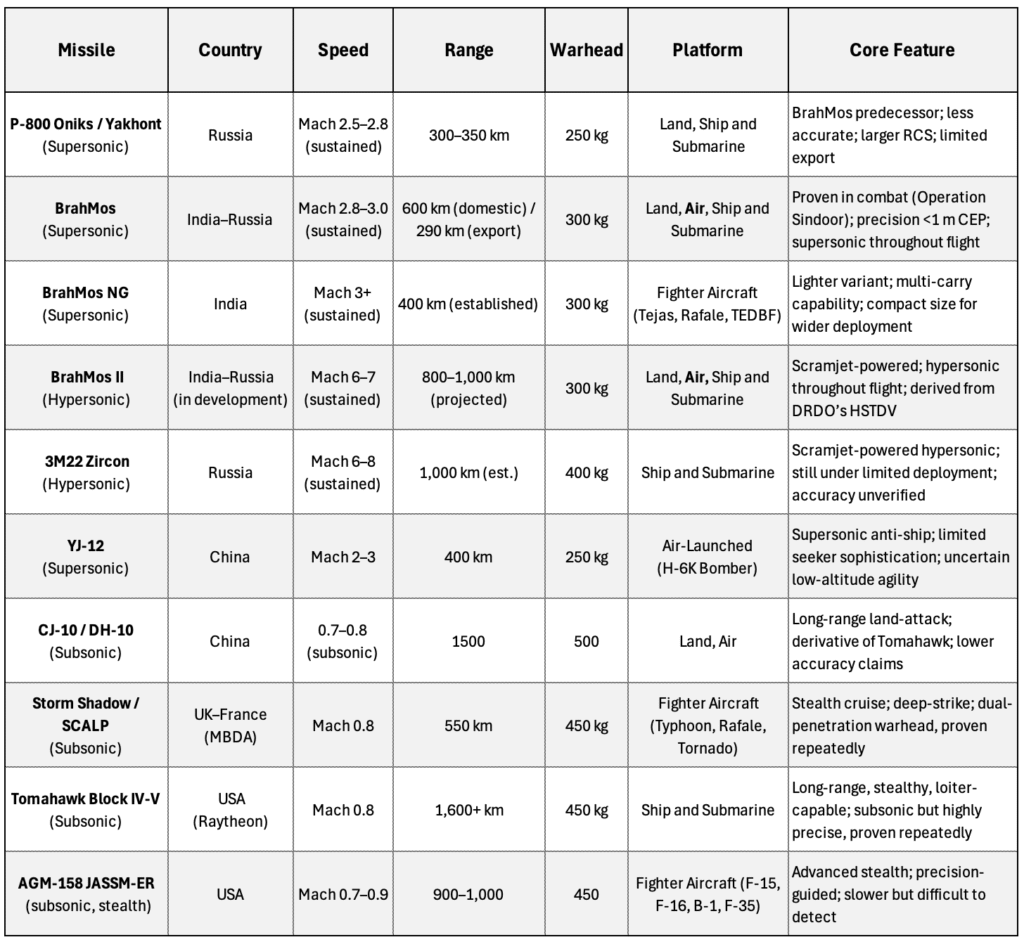
Key Takeaway
While others balance between range and stealth, BrahMos balances sub-meter precision, speed and certainty. Its sustained Mach 3 flight gives it survivability unmatched by subsonic missiles, and unlike most hypersonic prototypes, it is combat-proven, modular, and already exportable.
In doctrinal terms:
- The Tomahawk hides;
- The Storm Shadow sneaks;
- The Zircon aspires;
- But BrahMos arrives — on time, every time precisely.
On accuracy, Indian operational releases after Operation Sindoor included satelite imagery and site assessments describing direct, bull’s-eye impacts on hardened shelters and support infrastructure, reinforcing the missile’s reputation for near-pinpoint strikes. The combined test and operational record supports extremely high terminal accuracy
More Than a Weapon — A Diplomatic Tool
After the Philippines, nations like Vietnam, Indonesia, Greece, Egypt and many others have shown interest. The appeal isn’t just the missile; it’s what it represents — an export without political strings. BrahMos sells not just technology, but trust. Every new customer strengthens India’s role as a credible defence supplier, not a dependent buyer.
Why BrahMos Still Matters
In an age of hypersonic hype and AI warfare, BrahMos reminds strategists of a simple truth: certainty is the ultimate weapon. It’s fast enough to dodge defences, smart enough to find its mark, and proven enough to trust in combat.
When it launched during Operation Sindoor, it didn’t just destroy targets — it changed conversations. Suddenly, speed wasn’t a number; it was a strategy.
Other Relevant Topics
- Russia Offers Kh-69 Technology Transfer to India—What It Means and How India Stacks Up
- Building Fire: What India Makes, Buys, and Sells in the Missile Race
- Ballistic or Cruise? Why BrahMos isn’t Agni – and what that means for India
- India’s Indigenous Propulsion Leap: From 2.7–4.7 kN engines to the BrahMos hypersonic edge
- US Missile Deal with Pakistan: Sparks regional debate and official clarifications
- Readiness Redefined: India’s long march from arsenal to integration
- India Successfully Test Fires Nuclear-Capable Agni-5: Extending strategic reach