US Arms Sales to Gulf Surge: Emergency $15.2 Billion Approval Signals Strategic Shift in Gulf Security
The US arms sales Gulf push has intensified after Washington approved a massive $15.2 billion Foreign Military Sales (FMS) package on March 19, 2026. The decision follows a series of Iranian drone and missile strikes across Gulf states that reportedly killed at least a dozen people and injured over 150, exposing critical vulnerabilities in regional air defence systems.
The approvals, issued by the U.S. State Department under an emergency determination, bypassed standard congressional review. This reflects the urgency created by escalating conflict dynamics in West Asia. According to official notifications published on the State Department website, the package aims to significantly enhance air and missile defence capabilities in the United Arab Emirates, Kuwait, and Jordan.
For official details, refer to the State Department notifications:
UAE THAAD radar integration: https://www.state.gov/united-arab-emirates-long-range-discrimination-radar-with-terminal-high-altitude-area-defense-integration
UAE counter-drone FS-LIDS system: https://www.state.gov/releases/bureau-of-political-military-affairs/2026/03/united-arab-emirates-fixed-site-low-slow-small-unmanned-aircraft-integrated-defeat-system
UAE F-16 upgrades: https://www.state.gov/releases/bureau-of-political-military-affairs/2026/03/united-arab-emirates-f-16-munitions-and-upgrades
UAE AMRAAM missiles: https://www.state.gov/united-arab-emirates-advanced-medium-range-air-to-air-missiles-amraams
UAE Receives Multi-Layered Defence Boost Under US Arms Sales Gulf Programme
The United Arab Emirates emerges as the largest beneficiary under the US arms sales Gulf framework, with an estimated allocation of around $7.24 billion to $8.4 billion. The package focuses on building a layered defence architecture capable of countering both ballistic missiles and low-cost drones.
A major component includes a $4.5 billion Long-Range Discrimination Radar integrated with the THAAD system. This radar enhances early detection and tracking of ballistic threats. In addition, the $2.1 billion FS-LIDS counter-drone system addresses the growing threat posed by low, slow, and small unmanned aerial vehicles, which have proven highly effective in recent conflicts.
The UAE will also receive upgrades and munitions for its F-16 fleet worth approximately $644 million, along with $1.22 billion in AMRAAM air-to-air missiles. These upgrades aim to strengthen both defensive and offensive aerial capabilities.
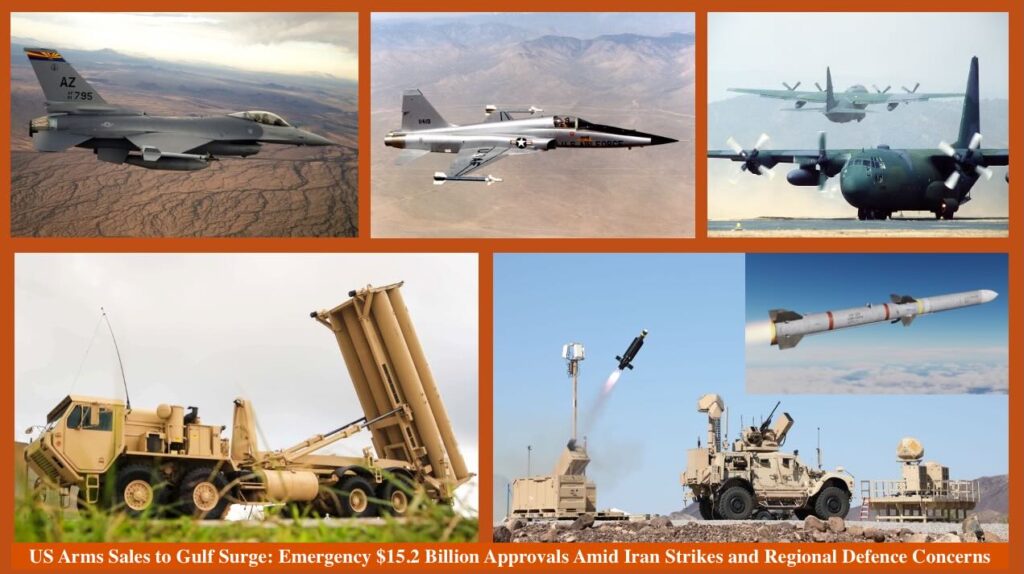
Images circulating alongside the announcement depict mobile THAAD radar systems, F-16 fighter jets loaded with advanced munitions, and Stinger missile intercepts, highlighting the operational scale of the deployment.
Kuwait and Jordan Included in Broader US Arms Sales Gulf Strategy
Kuwait’s allocation under the US arms sales Gulf package stands at approximately $8 billion. The focus remains on acquiring Lower Tier Air and Missile Defence Sensor (LTAMDS) radars. These next-generation systems improve tracking accuracy against cruise missiles and drone swarms, which have increasingly challenged traditional defence frameworks.
Jordan, although receiving a smaller package of $70.5 million, gains critical support for its aircraft fleet, including F-16s, C-130 transport aircraft, and legacy F-5 jets. The support ensures operational readiness rather than introducing new platforms.
Together, these allocations indicate a region-wide effort to create an integrated defence shield, rather than isolated national systems.
Iran’s Drone Warfare Reshapes Defence Calculations
The urgency behind the US arms sales Gulf approvals stems from Iran’s evolving military strategy. Tehran has relied heavily on cost-effective drone and missile strikes, including the deployment of Shahed-type drones, to target critical infrastructure across the Gulf.
Recent attacks have demonstrated that even advanced defence systems can struggle against swarm tactics and low-cost aerial threats. As a result, Gulf states now prioritise layered defence systems capable of detecting, tracking, and neutralising multiple threat vectors simultaneously.
However, this shift also raises questions about the long-term effectiveness of high-cost Western defence systems against asymmetric warfare tactics.
Arab Public Discourse Reflects Growing Skepticism
Despite the scale of the US arms sales Gulf package, reactions across regional social media platforms reveal widespread scepticism. Several commentators have pointed to past failures where expensive Western systems struggled to intercept relatively inexpensive drones.
Critics often cite the Yemen conflict as a precedent, where Iranian-backed groups successfully targeted high-value assets using low-cost UAVs. Recent Gulf attacks have revived these concerns, prompting debate over whether reliance on external suppliers remains a viable long-term strategy.
This scepticism reflects a broader shift in regional thinking. Many voices now advocate for indigenous defence capabilities and diversified procurement strategies rather than dependence on a single supplier.
Strategic Implications: Security or Dependency?
The latest US arms sales Gulf approvals underline a deeper geopolitical reality. While the package strengthens immediate defence capabilities, it also reinforces long-term strategic dependencies between Gulf nations and the United States.
Emergency approvals, such as the one issued on March 19, signal that Washington views the current conflict as a critical inflection point. At the same time, they highlight how rapidly escalating tensions can reshape defence procurement policies.
The development also ties into broader questions about who ultimately benefits from prolonged regional instability. A detailed perspective on this aspect is explored in our earlier analysis: Persian Gulf Crisis: Winners Behind the War?https://tattvamnews.com/official-narrative-vs-conspiracy-realities-who-gains-from-the-persian-gulf-crisis/
A Region at a Strategic Crossroads
The US arms sales Gulf surge marks a decisive moment in the evolving security architecture of West Asia. On one hand, it provides immediate technological reinforcement against emerging threats. On the other, it exposes structural vulnerabilities and fuels debate over strategic autonomy.
As drone warfare continues to redefine conflict dynamics, Gulf nations face a complex choice. They must balance immediate security needs with long-term resilience, while reassessing the cost-benefit equation of high-value defence imports in an era of low-cost asymmetric threats.