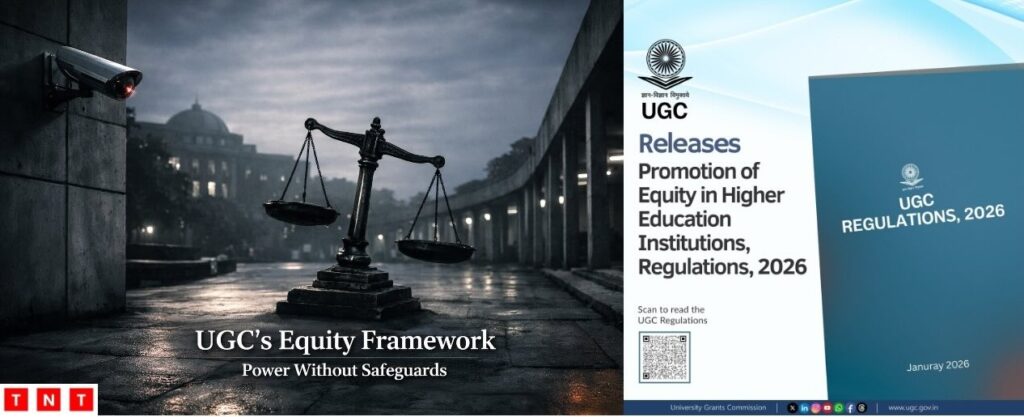
UGC Equity Regulations 2026 Aim to Redefine Inclusion in Higher Education
Why Equity Returned to the Centre of Higher Education Policy
UGC equity regulations 2026 arrive against a backdrop of long-standing concerns over caste-based discrimination within India’s higher education system. Despite constitutional guarantees under Articles 14 to 17, campuses have often reflected entrenched social hierarchies, leaving students from Scheduled Castes, Scheduled Tribes and Other Backward Classes vulnerable to exclusion, bias and harassment.
UGC data shows that reported complaints nearly doubled from 173 in 2019–20 to 378 in 2023–24, with 1,160 cases recorded over five years. Several incidents brought national attention to institutional failures, most notably the deaths of Rohith Vemula in 2016 and Payal Tadvi in 2019. More recently, the death of Darshan Solanki at IIT Bombay in 2023 reinforced concerns that grievance mechanisms remained ineffective and poorly enforced.
Judicial Pressure and the Road to Notification
The regulations did not emerge in isolation. A Public Interest Litigation filed by the mothers of Rohith Vemula and Payal Tadvi led to sustained Supreme Court scrutiny beginning in 2023. Hearings in January, April and September 2025 focused on the lack of enforceable safeguards within universities.
In September 2025, the Supreme Court directed the University Grants Commission to finalise updated regulations within a defined timeframe. Acting under Sections 12(j) and 26(1)(g) of the UGC Act, 1956, the commission released draft regulations for public consultation in February 2025.
Several revisions followed. OBCs were explicitly brought within the scope, and provisions proposing penalties for false complaints were removed. The final regulations were notified on January 13, 2026, published in the Official Gazette and made effective immediately, without requiring parliamentary approval.
Who the Regulations Apply To
The UGC equity regulations 2026 apply uniformly to all Higher Education Institutions recognised under the UGC Act. This includes central, state, private and deemed universities, along with affiliated and autonomous colleges. Institutions outside UGC’s jurisdiction, such as schools, remain excluded.
The scope covers students, faculty, staff and other stakeholders across regular, distance and online education modes. Institutional heads are made directly accountable for compliance and implementation.
What the Regulations Prohibit
The regulations prohibit both direct and indirect discrimination on grounds of religion, race, caste, gender, place of birth, disability or any combination thereof. They specifically address conduct that limits access, participation or dignity within the academic environment.
Caste-based discrimination against SCs, STs and OBCs is explicitly recognised, addressing a gap critics had long identified in earlier frameworks.
Mandatory Institutional Mechanisms
Equal Opportunity Centres Become Compulsory
Every HEI must now establish an Equal Opportunity Centre tasked with academic, financial and social support for disadvantaged groups. The EOC must operate an online reporting portal and oversee awareness programmes promoting diversity and inclusion.
An Equity Committee functions under the EOC, chaired by the head of the institution and comprising faculty, staff, student representatives, civil society members and mandated representation from SCs, STs, OBCs, women and persons with disabilities.
Helplines, Monitoring and Reporting
The regulations mandate a 24-hour equity helpline to report discrimination-related distress, with confidentiality provisions. Institutions must also deploy Equity Squads for vigilance and designate Equity Ambassadors as nodal officers.
Bi-annual demographic reports, awareness campaigns and signed undertakings affirming non-discrimination are now compulsory. Annual compliance reports must be submitted to UGC, which retains oversight through a national monitoring committee.
Complaint Handling and Redressal Process
Aggrieved individuals may file complaints through multiple channels, including online portals, written submissions, email or the helpline. The complainant’s identity may remain confidential.
The Equity Committee must convene within 24 hours of receiving a complaint and submit findings within 15 working days. The head of the institution is required to act within seven days. Criminal matters are to be referred to the police.
Appeals may be filed before the Ombudsperson within 30 days under UGC’s 2023 grievance regulations.
Penalties for Institutional Non-Compliance
UGC has been granted wide punitive powers where non-compliance is established. These include debarment from UGC schemes, withdrawal of funding, prohibition from offering degree programmes and bans on open or online education.
In extreme cases, institutions may be removed from the recognised lists under Sections 2(f) and 12B of the UGC Act. Multiple penalties may be imposed simultaneously, and accountability is placed squarely on institutional leadership.
The Debate Over False Complaints
One of the most contested aspects of the regulations is the absence of any explicit provision addressing false or malicious complaints. Earlier drafts circulated in 2025 had proposed penalties, including fines or disciplinary action, determined by Equity Committees.
These clauses were removed in the final version to avoid discouraging genuine complainants. The rationale was that fear of punishment could silence victims from marginalised communities.
Critics argue this creates an asymmetry. While complainants benefit from swift action and broad definitions of discrimination, there are no explicit safeguards against misuse. Concerns include reputational damage, academic disruption and the potential weaponisation of complaints in personal or ideological disputes. The framework relies on institutional discretion and due process, but without a defined deterrent.
Why the Regulations Were Considered Necessary
The 2012 anti-discrimination guidelines were widely viewed as weak and poorly enforced. Pending complaints rose steadily, indicating structural failures in grievance resolution.
The 2026 regulations align with NEP 2020’s emphasis on equity as foundational to student success. They also respond directly to judicial concerns about “institutional failures” that allowed discrimination to persist unchecked.
A Reform That Reshapes Campus Power Dynamics
Supporters see the regulations as a long-overdue corrective that prioritises safety and dignity for marginalised students. Critics warn of overreach, vague definitions and the risk of stifling academic freedom.
What is clear is that the UGC equity regulations 2026 significantly alter governance within higher education institutions. They embed equity mechanisms into administrative structures and shift the burden of proof and action decisively onto institutions.
As universities begin implementation, the effectiveness of these regulations will depend less on their intent and more on how impartially and transparently they are enforced.