Board of Peace: How Trump’s New Diplomatic Body Could Rival the UN
Trump Board of Peace Gains Global Attention
US President Donald Trump’s proposed Board of Peace is rapidly emerging as one of the most debated diplomatic initiatives in recent years. Initially unveiled in late 2025 as part of a 20-point Middle East Peace Plan, the body was framed as a mechanism to stabilise and rebuild post-war Gaza after the prolonged Israel–Hamas conflict. However, draft charters and official briefings now indicate ambitions that extend far beyond Gaza.
As of January 18, 2026, invitations have reportedly been sent to more than 50 world leaders, positioning the Trump Board of Peace as a possible alternative—or challenger—to established multilateral institutions, including the United Nations. The proposal has gained traction amid mounting frustration over what many governments describe as the UN’s slow response, bureaucratic inertia, and veto-driven paralysis.
From Gaza Stabilisation to Global Scope
The Trump Board of Peace first surfaced in November 2025, when it was endorsed by the UN Security Council as part of an international framework supporting Gaza’s demilitarisation, reconstruction, and interim governance. Gaza’s infrastructure had been severely damaged following hostilities that stretched from 2023 until a fragile ceasefire in late 2025, creating urgent humanitarian and administrative challenges.
Trump presented the board as a “nimble and effective” alternative to traditional UN-led mechanisms. He openly criticised existing multilateral structures for procedural delays and political deadlock, arguing that post-conflict recovery required faster decision-making and direct accountability.
Subsequent disclosures by international media outlets, including Bloomberg and The Times of Israel, revealed that the board’s draft charter makes no explicit reference to Gaza. Instead, it outlines a broader mandate to promote stability, restore lawful governance, and secure enduring peace in regions affected or threatened by conflict. This wording has intensified speculation that the board could operate in theatres such as Ukraine, Syria, Venezuela, or future crisis zones.
Governance Model and Centralised Authority
Structurally, the Trump Board of Peace is designed as a hierarchical international body, with Donald Trump positioned as its inaugural chairman. The chair holds sweeping powers, including approving decisions, extending invitations to member states, and nominating successors.
Membership terms are limited to three years, although renewable at the chairman’s discretion. Notably, nations can obtain permanent seats—free from term limits—by contributing at least USD 1 billion in cash within the first year. The board becomes operational once ratified by three member states, each holding a single vote, subject to final approval by the chair.
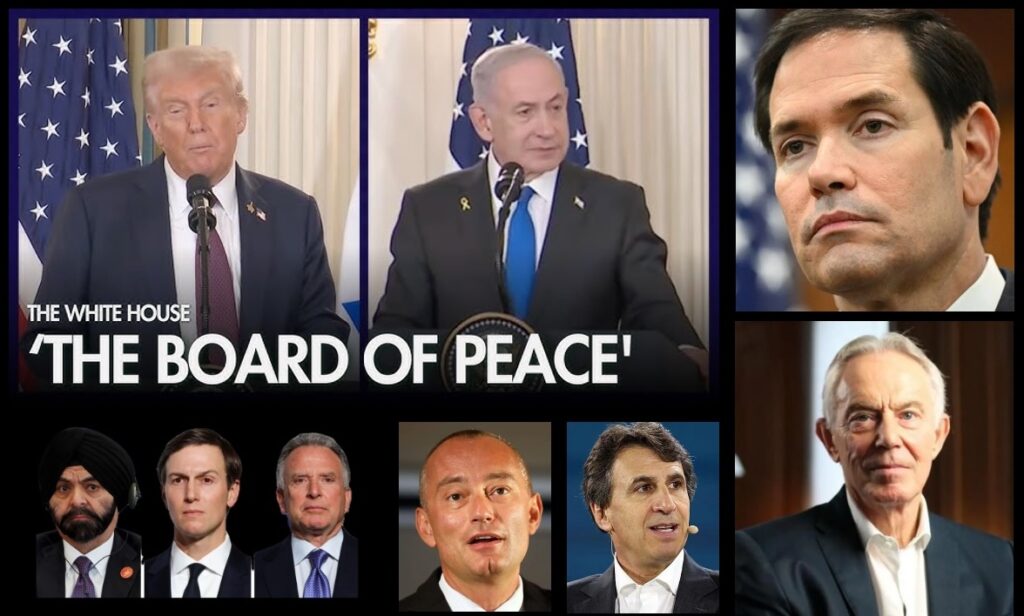
Prominent figures linked to the initiative include US Secretary of State Marco Rubio, Jared Kushner, former UK Prime Minister Tony Blair, and business leaders such as Steve Witkoff and Marc Rowan. Several participants are associated with private equity firms and pro-Israel policy circles, reinforcing perceptions of a hybrid political–corporate structure.
Funding, Enforcement, and ‘Skin in the Game’
Operational responsibilities are delegated to subsidiary bodies, including a Gaza Executive Board and an International Stabilisation Force led by a US general. These entities are tasked with demilitarisation, aid distribution, and governance oversight.
The funding model reflects Trump’s transactional approach to diplomacy. By requiring substantial financial commitments from member states, the board seeks to reduce reliance on US taxpayers while ensuring participating countries have tangible stakes in outcomes. Proponents argue this discourages symbolic participation and encourages accountability.
Critics, however, have labelled the model “pay-to-play diplomacy”, warning it risks privileging wealthy nations and private interests. Concerns have also been raised about potential monetisation of reconstruction efforts, including land redevelopment and investment opportunities in post-conflict regions.
Board of Peace vs United Nations
In form and function, the Trump Board of Peace mirrors several UN structures. It features international membership, peacekeeping oversight, and a mandate for conflict resolution and reconstruction. Yet, key differences are equally stark.
Unlike the UN Security Council’s veto-based system dominated by permanent members such as China and Russia, the board centralises authority in the chairman’s office. Supporters argue this could bypass stalemates and accelerate responses. Detractors counter that it undermines neutrality and multilateral balance, replacing collective governance with US-centric control.
Some diplomats view the board as an attempt to pressure the UN into reform, while others describe it as a parallel institution that weakens the post-Second World War international order.
International Reactions and Diplomatic Fault Lines
Invitations have reportedly been extended to leaders including Argentina’s Javier Milei, Canada’s Mark Carney, Turkey’s Recep Tayyip Erdoğan, and Egypt’s Abdel Fattah el-Sisi. Milei and Carney are said to have already accepted. Israel, while invited, has objected to the inclusion of Turkey and Qatar due to their alleged links with Hamas.
Notably, Palestinian representation is absent from the board’s leadership structure, prompting criticism that local voices are being marginalised. China and Russia are expected to oppose any initiative perceived as diluting UN authority.
Online discourse has framed the board as everything from a “network state” to a private equity-style takeover of diplomacy, while supporters argue it could attract investment and enforce discipline in conflict recovery.
Strategic Implications and What Lies Ahead
If expanded, the Trump Board of Peace could be deployed in conflicts such as Ukraine, where reports suggest it may be linked to a proposed 28-point settlement framework acknowledging limited territorial realities. Similar interest has been noted in Latin America and parts of the Middle East.
The initiative raises fundamental questions about sovereignty, equity, and the future of multilateralism. As preparations continue for its first formal meeting—potentially alongside the World Economic Forum in Davos—the global community is watching closely.
Whether the Trump Board of Peace becomes a catalyst for diplomatic reform or a fragmented, paywalled substitute for global governance remains uncertain. What is clear is that it challenges the UN’s eight-decade-old dominance, introducing a distinctly transactional model into international peacemaking.