The ‘Board of Peace’: A Personalised Power Experiment in Global Governance
Between Alarmism and Dismissal
The announcement of Donald Trump’s Board of Peace has produced two predictable reactions. One dismisses it as an empty gesture — another international talking shop destined to fade into irrelevance. The other casts it as an existential threat to the global order, a deliberate attempt to sideline the United Nations and dismantle the post-war institutional architecture.
Both interpretations miss the mark.
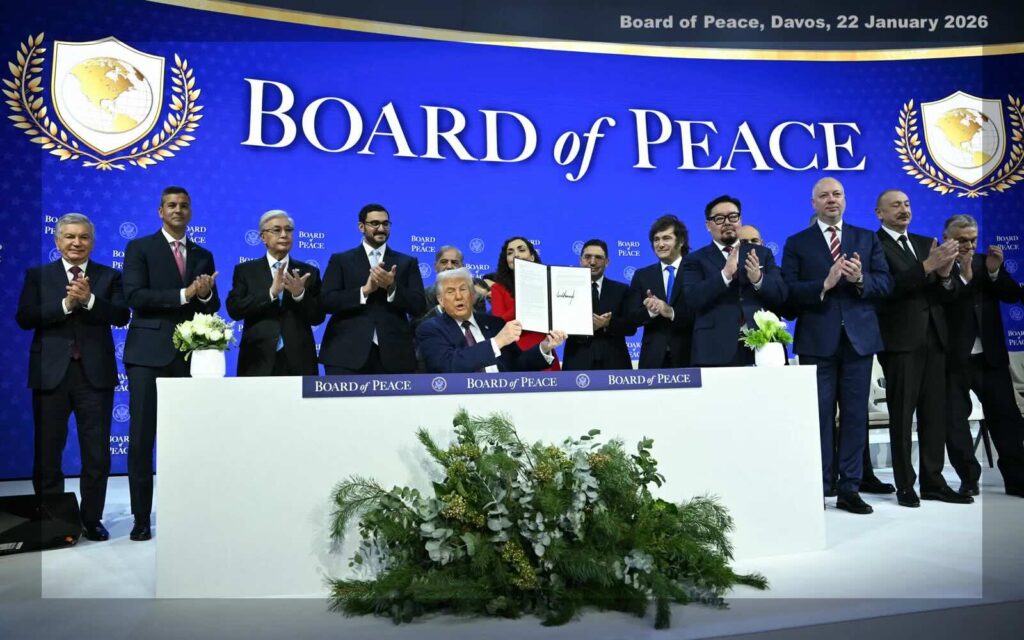
The Board of Peace is neither a harmless vanity project nor a revolutionary replacement for the international system. It is something more specific — and more unsettling: a narrowly scoped peace-building initiative designed around the concentration of authority in a single individual, operating alongside, but not within, established multilateral structures.
What the Board Is — and Carefully Is Not
A close reading of the charter reveals a deliberately constrained mandate. The Board does not claim the defining powers of the UN Security Council. It cannot authorise force, impose sanctions, recognise threats to international peace, or confer legal legitimacy on military action. Nor does it assert supremacy over international law.
In formal terms, it is not a constitutional institution. It establishes no court, no assembly, no permanent bureaucracy accountable to member states. It situates itself, at least textually, beneath the UN Charter rather than above it.
On this basis, claims that the Board constitutes a parallel Security Council or an alternative world order are overstated. Functionally and legally, it is closer to a task-specific international body — one among many.
And yet, this formal modesty masks a profound institutional departure.
An Organisation Designed Around One Man
Where the Board of Peace truly breaks with precedent is not its mandate, but its design.
Unlike virtually all international organisations — which distribute authority across councils, secretariats, voting rules, and term limits — the Board vests all meaningful power in a single office. The chairman is self-appointed, serves for life, controls the agenda, determines membership, and holds unilateral authority to revoke participation.
There are no internal checks and balances. No collective leadership. No rotation. No requirement for consensus.
This is not merely unusual; it is almost without modern parallel. Even informal conventions in global governance — such as US influence over the World Bank or European dominance of the IMF — operate within multilateral consent and institutional restraint. Here, restraint is absent by design.
The closest analogy is not a multilateral body but a privately controlled entity, where governance resembles that of a closely held corporation rather than a public institution. Authority flows downward, not outward. Participation is conditional, not sovereign.
Membership by Invitation, Permanence by Transaction
This personalisation extends directly to membership.
States may join the Board for an initial three-year period without financial obligation — effectively on probation. Continued presence, however, is not automatic. Permanent membership reportedly requires a USD 1 billion contribution, converting status into a financial transaction rather than a political or legal entitlement.
Such an arrangement reframes peace-building as an exclusive club: participation is discretionary, permanence is purchasable, and expulsion is unilateral. This model does not reward legitimacy, capacity, or adherence to norms; it rewards access and acquiescence.
For international governance, this is not merely unconventional — it is conceptually destabilising.
Why This Is Not the UN’s Rival — but Its Shadow
The Board does not meaningfully compete with the UN Security Council. Instead, it overlaps most directly with the UN’s peace-building ecosystem — a lesser-known cluster of commissions, funds, and offices created to manage post-conflict recovery.
Those UN bodies are technocratic, underfunded, and politically marginal. The Board of Peace appears designed as a blunt rebuttal to that failure: replace dispersed responsibility with central command, bureaucratic process with leader-level intervention, and chronic underfunding with large entry contributions.
This trade-off — decisiveness over legitimacy — is the Board’s defining wager.
Whether it delivers results will depend less on institutional coherence than on the continued political relevance of the man at its centre.
Effectiveness Today, Fragility Tomorrow
The Board’s potential strength is also its greatest weakness. Its effectiveness, if any, will rest almost entirely on Trump’s personal authority — his ability to command attention, pressure leaders, and dominate media narratives.
But that authority is not transferable.
The moment Trump’s political centrality fades, the Board’s gravitational pull weakens. There is no guarantee that a future US administration — particularly one from the opposing political camp — would support, recognise, or engage with an institution chaired for life by its predecessor.
For states considering deep financial or political commitment, this creates an obvious dilemma: why invest in an institution whose survival is inseparable from one individual’s relevance?
A Gamble Disguised as Governance
The Board of Peace does not dismantle international law. It does not replace the United Nations. It does not herald the end of multilateralism.
What it does demonstrate is something subtler — and more revealing: a growing impatience with institutional constraint, and a willingness to substitute collective legitimacy with personal authority in the name of speed and effectiveness.
Whether this experiment produces a single durable peace, or collapses under the weight of its own design, remains an open question.
What is already clear is that the Board of Peace is not a system built to outlast its founder — and that fact alone defines both its appeal and its limits.
From India’s Perspective: Why Strategic Distance Is Rational
India’s foreign policy rests on strategic autonomy and institutional multilateralism. A body chaired for life by a single foreign leader, exercising discretionary control over membership and agenda, sits outside those principles. India does not operate within personalised power structures, nor does it subordinate long-term interests to individual authority.
The Board of Peace offers presence without influence. Decision-making is centralised, not representative. For a country that has consistently argued for equitable voice, veto reform, and institutional legitimacy, participation in such a structure would amount to symbolic attendance without strategic weight.
The financial logic is equally weak. A USD 1 billion permanent seat is not an investment; it is a sunk cost in an untested, leader-dependent construct. India already bears substantial responsibility in UN peacekeeping, humanitarian assistance, and South–South cooperation — all within rule-based frameworks that confer credibility, not dependency.
Most decisively, the Board’s relevance is inseparable from Donald Trump himself. India treats Trumpian initiatives as volatile, transactional, and politically non-continuous. Committing diplomatic capital to a platform whose survival hinges on one individual reflects a misunderstanding of India’s risk calculus.
India is not isolated, legitimacy-starved, or institutionally homeless. It does not seek relevance through exclusive clubs. Strategic distance, in this case, is not caution — it is clarity.
Lorem ipsum dolor sit amet, consectetur adipiscing elit. Ut elit tellus, luctus nec ullamcorper mattis, pulvinar dapibus leo.