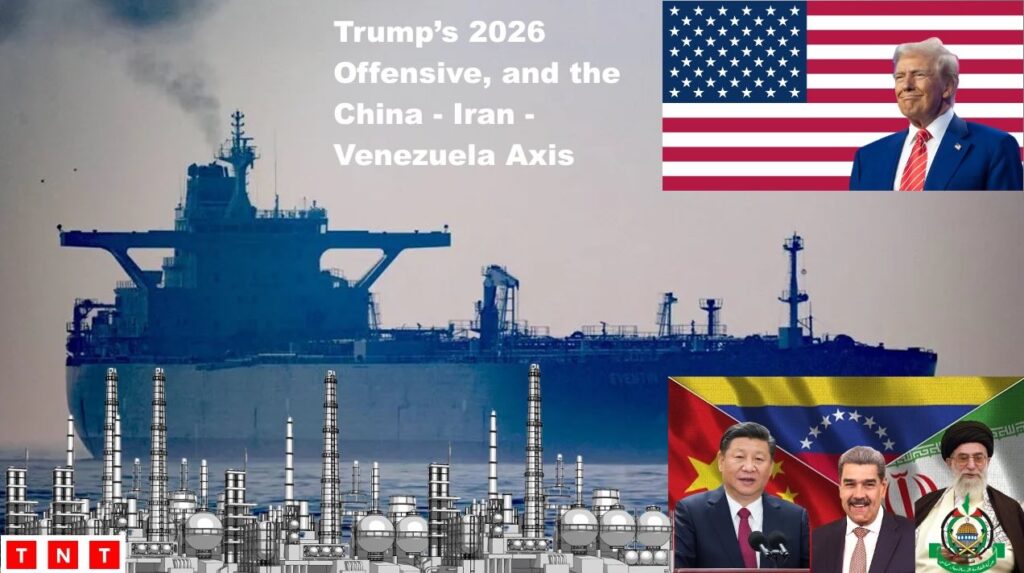
Trump’s 2026 Offensive and the China-Iran-Venezuela-Gaza Axis Explained
In the first week of January 2026, the China-Iran-Venezuela Axis moved from abstract analysis to operational reality. US forces executed a swift and unprecedented operation inside Venezuela, capturing President Nicolás Maduro and his wife. The action, officially described as Operation Absolute Resolve, sent immediate shockwaves through energy markets, diplomatic corridors, and proxy networks stretching from Latin America to West Asia.
This was not an isolated strike. Almost simultaneously, President Donald Trump issued direct warnings to Iran amid widening domestic unrest and reaffirmed unequivocal US support for Israel’s Gaza operations. When viewed together, these actions exposed what security analysts have long described as a quiet but functional axis connecting China, Iran, Venezuela, and Gaza-based militant networks.
This axis does not resemble NATO or Cold War blocs. Instead, it operates through economic necessity, proxy warfare, and narrative coordination. At its core lie two interlinked structures: the Crude Axis, driven by oil and sanctions evasion, and the Gaza Axis, driven by proxies and ideological mobilisation. Understanding this linkage explains why events in Caracas, Tehran, Beijing, and Gaza increasingly move in tandem.
Background: How the China Iran Venezuela Axis Took Shape
The China Iran Venezuela Axis emerged gradually after the early 2000s, as US-led sanctions tightened around Iran and later Venezuela. Isolation forced these regimes to seek alternative systems for trade, finance, and diplomatic legitimacy. China, facing relentless energy demand growth, stepped in as the economic anchor.
Venezuela, under Hugo Chávez and later Maduro, offered geography and oil reserves. Iran contributed military expertise, sanctions-evasion experience, and proxy networks. Gaza, primarily through Hamas, became the ideological and operational flashpoint that converted oil revenues into asymmetric leverage.
This was never a values-based alliance. It was transactional and adaptive. China gained discounted energy and Global South influence. Iran sustained its regional pressure campaign. Venezuela survived economically despite sanctions. Gaza supplied the emotive cause that energised narratives against Israel and the United States.
By 2025, the axis had matured into a functional ecosystem that avoided open war while steadily eroding US influence through economics, energy flows, and information warfare.
Key Players and Their Functional Roles
Within the China Iran Venezuela Axis, each participant plays a defined and complementary role.
China functions as the financial stabiliser. It provides long-term credit, infrastructure investment, and diplomatic cover while avoiding direct military exposure. Its support for Palestinian causes helps consolidate Global South partnerships.
Iran acts as the enforcer. Through its “Axis of Resistance,” Tehran supplies arms, training, and funding to Gaza-based groups while refining oil-for-sanctions evasion techniques.
Venezuela operates as the logistical hub. Its territory enables oil laundering, shadow shipping, and regional connectivity across the Western Hemisphere. Caracas had openly framed itself as a supporter of Palestinian “resistance,” severed relations with Israel in 2009, and facilitated Iranian and Hezbollah presence through intelligence, narcotics, and financial channels.
Gaza, through Hamas, remains the spark. It converts financial flows into geopolitical pressure by creating recurring crises that command global attention.
Together, these roles form a closed loop where oil revenues sustain proxies, and proxy conflicts justify continued economic alignment.
The Crude Axis: Oil as the Economic Backbone
The Crude Axis underpins the entire network. Iran and Venezuela possess vast reserves but face severe export restrictions. Their solution lies in blending, swapping, and disguising crude flows, primarily with Chinese participation.
Venezuelan crude is exceptionally heavy and sulphur-rich. It is difficult to transport and refine without dilution. Iranian condensate, by contrast, is extremely light and low in sulphur. When blended, the resulting crude becomes commercially exportable.
This technical dependency created strategic interdependence. Iranian condensate enabled Venezuelan exports, while Venezuelan infrastructure provided Iran a laundering platform closer to US markets. China absorbed the output at discounted rates, often through opaque contracts.
Refining and Market Constraints
Heavy crude requires advanced refineries equipped with coking and desulphurisation units. The US Gulf Coast remains uniquely suited for such crude, while select refineries in China and India adapted to exploit discounted supplies.
Sanctions forced the axis to rely on a limited buyer pool, inflating reported exports despite stagnant production. This imbalance raised red flags well before the 2026 intervention.
Shadow Fleets and Swap Mechanisms
Transport relied on ageing tankers operating under false flags with transponders disabled. These shadow fleets increasingly overlapped with Russian vessels, sharing evasion techniques.
Iran supplied condensate. Venezuela blended and exported. Payments moved through barter, gold, or discounted oil shipments. By late 2025, Venezuelan exports exceeded realistic production levels, exposing the system’s fragility.
US interdictions in early 2026 abruptly severed these routes, freezing flows to China almost overnight.
China’s Financial Exposure
China’s involvement was not abstract diplomacy. Over two decades, it committed an estimated sixty billion dollars in loans to Venezuela under oil-for-repayment arrangements. By 2025, roughly forty to fifty billion dollars had been recovered through discounted crude deliveries.
Maduro’s capture placed the remaining exposure at risk. It also forced Beijing to lean more heavily on Iranian supplies under the 2021 China-Iran long-term cooperation framework, increasing Iran’s leverage but narrowing China’s flexibility.
The Gaza Axis: Proxies and Narrative Power
While oil sustained the system, Gaza energised it. Iran channelled funds and weapons to Hamas, converting economic resilience into military pressure on Israel. Each escalation reinforced the axis’s ideological narrative.
Venezuela provided diplomatic backing and logistical depth, having severed ties with Israel as early as 2009. China amplified the message through mediation initiatives, humanitarian pledges, and consistent diplomatic criticism of Israeli actions.
Gaza thus functioned as the axis’s moral theatre, allowing economic actors to project influence without direct confrontation.
Trump’s 2026 Disruption Strategy
President Trump’s 2026 actions targeted the axis’s pressure points simultaneously. The capture of Maduro dismantled the Western Hemisphere hub. Warnings to Iran coincided with internal protests, raising the cost of proxy expansion. Firm backing of Israel denied the Gaza axis narrative victories.
Shadow fleet seizures further choked oil flows. Instead of confronting each actor separately, the strategy severed the connective tissue binding them together.
Global Implications and Strategic Risks
For the United States, the immediate gains include energy security and proxy disruption. However, risks remain. Iran may escalate regionally. China may retaliate economically or diplomatically. Residual networks, particularly involving Russia, may attempt adaptation.
For global markets, oil volatility may moderate as opaque flows diminish. Politically, the episode signals that hybrid networks are no longer immune from direct disruption.
The China-Iran-Venezuela Axis illustrates how modern power operates below the threshold of formal alliances. Trump’s 2026 actions exposed its structural weaknesses and forced a recalibration across continents. Whether the axis fractures permanently or evolves into a new configuration will depend on oil flows, internal stability in Iran, and China’s appetite for strategic risk.