Trump Approval Rating 2026 Hits New Low
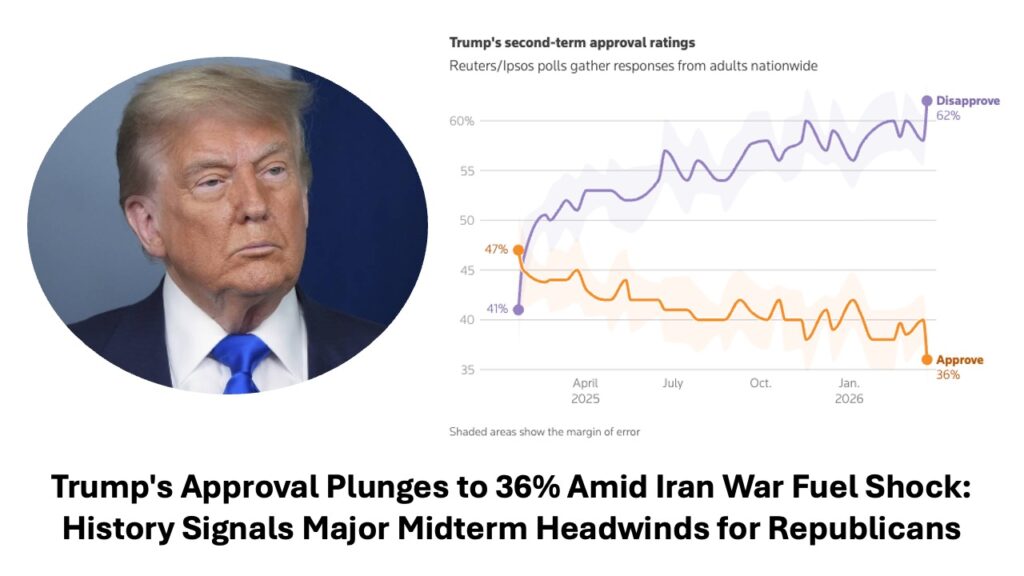
The Trump approval rating 2026 has dropped to 36%, marking a sharp and politically significant decline just over a year into his second term. The latest Reuters/Ipsos poll, released on March 24, reflects a country increasingly uneasy about rising costs and the broader consequences of the Iran conflict.
The decline has been sudden. Within a single week, the Trump approval rating 2026 fell four points, coinciding with a steep rise in gasoline prices—nearly $1 per gallon—after tensions escalated between the United States, Israel, and Iran in late February. For many Americans, this is no longer a distant geopolitical issue; it is a daily financial strain.
Economic confidence, once a cornerstone of Trump’s political appeal, appears to be eroding quickly. Only 29% of respondents approve of his handling of the economy, while just 25% support his approach to the cost of living. These numbers are not just low—they are historically weak for a president at this stage of a term.
Iran Conflict Turns Into Domestic Pressure Point
The Trump approval rating 2026 is increasingly tied to the fallout from the Iran conflict. While military action often brings short-term political consolidation, the opposite seems to be unfolding here. Public opinion is sharply divided, with only 35% backing U.S. strikes on Iran and a clear majority expressing disapproval.
More telling is the long-term perception. Nearly half of those surveyed believe the conflict will make the United States less safe. That sentiment carries weight, especially when combined with economic anxiety. The war is no longer being judged solely on strategic grounds; it is being measured at the fuel pump and grocery store.
This shift matters. Campaign messaging built around economic stability and avoiding new wars now faces a credibility test. The Trump approval rating 2026 reflects that tension, as voters begin reassessing earlier expectations against present realities.
A Historical Pattern Republicans Can’t Ignore
The trajectory of the Trump approval rating 2026 fits into a well-established historical pattern. For decades, presidential approval ratings have served as a reliable indicator of midterm election outcomes. When approval dips below 50%, the president’s party typically faces significant losses.
History is not subtle on this point. Presidents with approval ratings in the 30s and low 40s have consistently led their parties into difficult midterms. The pattern spans multiple administrations and economic conditions, suggesting a structural relationship between public sentiment and electoral outcomes.
The logic is straightforward. Midterms often function as a referendum on the sitting president. When approval is low, voters use the election to express dissatisfaction. The Trump approval rating 2026, now well below the danger threshold, places Republicans in a familiar and precarious position.
Economic Pain and Political Consequences
What makes the current moment particularly challenging is the nature of voter frustration. The Trump approval rating 2026 is being shaped less by abstract policy debates and more by immediate economic pressures.
Fuel prices are among the most visible indicators of economic stress. Unlike broader economic metrics, they are experienced daily and personally. When prices rise sharply and stay elevated, they tend to leave a lasting impression on voters.
This kind of “pocketbook voting” has historically played a decisive role in midterm outcomes. If the current trend continues, the Trump approval rating 2026 may not recover quickly enough to alter the broader political trajectory.
Even if tensions with Iran ease in the coming months, the economic aftershocks could linger. Voters rarely separate cause and effect with precision; they respond to lived experience. Right now, that experience is defined by higher costs and growing uncertainty.
Midterm Outlook: A Narrowing Path
With the Trump approval rating 2026 at 36%, Republicans face an uphill battle heading into the November midterms. While eight months remain, history suggests that large shifts in approval are rare without a major and sustained positive development.
The political math is unforgiving. A president this far underwater typically drags down congressional candidates from his party, particularly in competitive districts. The risk is not just incremental losses but a broader shift in control.
Republican voters remain largely supportive, but cracks are beginning to show even within the base, particularly on cost-of-living issues. That erosion, however small, can have outsized effects in midterm elections where turnout dynamics differ from presidential cycles.
The Trump approval rating 2026 will likely remain the central variable shaping the electoral landscape. If economic conditions stabilize and geopolitical tensions ease, there may be room for recovery. But if current trends persist, the path forward becomes significantly narrower.
A Warning, Not Just a Snapshot
The latest polling is more than a momentary dip; it is a signal. The Trump approval rating 2026 encapsulates a convergence of challenges—foreign policy risk, economic strain, and shifting public sentiment.
For the White House, the immediate task is clear: stabilize fuel prices, address cost-of-living concerns, and reshape the narrative around the Iran conflict. For Republicans in Congress, the challenge is more complex, as they navigate alignment with a president facing declining approval.
Midterms are still months away, but the underlying dynamics are already taking shape. The Trump approval rating 2026suggests that unless conditions improve meaningfully, the election could follow a familiar script—one that has repeatedly punished the party in power.