Tomahawk Burnout: $11 Billion US Missile Blitz Against Iran Lays Bare the Navy’s Hidden Reload Crisis
March 13, 2026 | The Israel–US war against Iran entered its 14th day today, in a campaign Washington has named Operation Epic Fury. The scale of the opening bombardment is already revealing the financial and logistical realities of modern precision warfare. Pentagon briefings to Congress indicate that the United States spent more than $11 billion within the first six days, with the overwhelming share directed toward munitions. A significant portion of this expenditure stems from US Navy long-range precision strikes, particularly the heavy use of Tomahawk cruise missiles against Iranian targets.
At the centre of the debate lies Tomahawk missile depletion, a problem few outside defence circles usually notice. Analysts estimate that the US Navy launched at least 168 Tomahawk cruise missiles within the first 100 hours of the campaign. Each missile costs roughly $3.6 million and carries a 1,000-pound conventional warhead.
These missiles represent one of Washington’s most valuable strike assets. However, the scale of their use now raises serious questions about stockpiles, production capacity, and naval logistics.
The Cost of Precision Warfare
The Tomahawk missile remains the backbone of US naval precision strike capability. The weapon can travel more than 1,600 kilometres, using satellite navigation and terrain mapping to hit hardened targets with high accuracy.
Yet the scale of recent usage has surprised even defence observers.
Pentagon procurement records show the Navy purchased only 322 Tomahawks over the past five years. The defence budget planned to acquire just 57 additional missiles in fiscal year 2026.
Previous military actions had already reduced the available stockpile. Operations against Iranian-backed Houthi forces and other regional targets during 2024 and 2025 consumed at least 124 missiles.
Several defence analysts therefore warn that the current rate of firing represents an unusually heavy burn rate.
One congressional aide described the situation as a “massive expenditure of Tomahawks” that will influence US naval planning for several years.
Political Pressure Mounts in Washington
The financial scale of the operation has triggered intense debate on Capitol Hill.
US Defence Secretary Pete Hegseth insists the United States has sufficient stocks to sustain operations. He told lawmakers that the Pentagon has “no shortage of munitions” and can maintain the campaign as long as necessary.
White House Press Secretary Karoline Leavitt has echoed that position. She stated that American industry will accelerate missile production if required.
However, several lawmakers have demanded deeper scrutiny.
Republican Senator Lisa Murkowski has warned that Congress cannot simply approve unlimited spending without oversight. Meanwhile, Senate leader Mitch McConnell supports a proposed $50 billion emergency defence package, arguing that the funds will address urgent military requirements.
Democratic senators have raised a different concern. Mark Kelly and Ron Wyden point to the stark economic contrast between weapons used by opposing sides.
A single Tomahawk missile costs several million dollars. In contrast, Iranian-supplied Shahed-type drones can cost as little as $30,000. Critics argue that this imbalance raises difficult questions about long-term sustainability.
The economic pressure is compounded by rising global oil prices. Crude has crossed $100 per barrel, fuelling voter frustration over petrol prices during an election year.
The Tomahawk Missile Depletion Problem
Beyond politics and budgets lies a more complex operational issue.
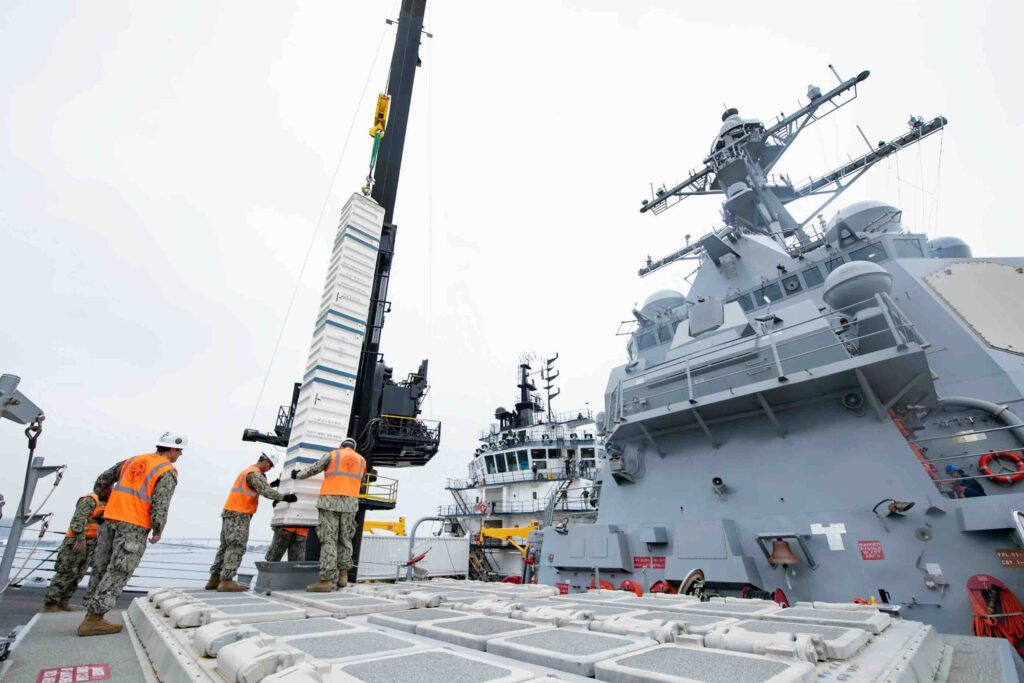
The US Navy’s most powerful warships rely on the Mk-41 Vertical Launch System (VLS). These launch cells hold dozens of missiles, including Tomahawks, anti-air weapons, and anti-submarine rockets.
Destroyers and cruisers can launch large salvos quickly. However, once their launch cells empty, they must replenish them.
That process has long posed a challenge.
Although the Navy has tested a Transferrable Reload At-sea Method (TRAM), the system is not widely operational. Handling a 2.8-ton missile canister nearly 25 feet long in open seas remains extremely complex.
As a result, warships often must return to port for reloading.
Depending on distance, this journey can take five to ten days, reducing the tempo of operations.
Where the US Navy Can Reload
The current strike campaign involves two main naval groups.
One operates from the Arabian Sea and Gulf of Oman. The other operates in the Red Sea and eastern Mediterranean.
This geographical spread forces the Navy to rely on a network of potential resupply points.
Several locations stand out:
Diego Garcia
The remote British-controlled base in the Indian Ocean offers the safest location for missile storage and reloading. The island sits far from Iranian missile range and hosts extensive American logistics facilities.
However, Diego Garcia lies roughly 3,500 km from the operational theatre, meaning ships operating near the Gulf must undertake several days transit to reach the base for reloading.
Djibouti
The United States operates Camp Lemonnier in Djibouti, which supports operations in the Red Sea. The port provides shorter transit times for some vessels.
Yet the location carries risks. The area lies close to Houthi missile activity, and China maintains a naval base nearby.
Israeli Ports
Ports such as Haifa or Eilat offer modern infrastructure and strong security. They are ideal for ships operating in the Mediterranean.
Nevertheless, vessels operating near the Arabian Sea must transit the Suez Canal, which adds significant travel time.
Other Regional Options
Analysts also speculate about logistical support from regional partners.
Ports in Oman, particularly Duqm, offer excellent proximity to operational areas. However, Iranian drone surveillance has increased around these facilities.
Some observers have speculated that Indian ports such as Mumbai or Kochi could theoretically serve as logistical points under bilateral defence cooperation agreements. However, New Delhi has publicly rejected claims that US naval operations against Iran are using Indian ports, describing such reports as “fake and false.” Given India’s careful strategic balancing, domestic political sensitivities, and its longstanding diplomatic ties with Iran, any direct operational involvement remains highly unlikely.
Pakistan’s Karachi port is geographically closer. Yet political sensitivities and security concerns make its use highly controversial.
Most defence experts believe the Navy relies on multiple dispersed reload points to avoid creating a single vulnerable logistics hub.
A Strategic Logistics Challenge
Modern warfare often focuses on advanced weapons and battlefield technology. However, logistics frequently decides how long a campaign can continue.
The current missile usage rate highlights that reality.
Tomahawk missiles provide unmatched precision strike capability. Yet their production and deployment require years of planning and complex supply chains.
If the present tempo continues, the United States may need to accelerate production dramatically.
Congress will soon debate the proposed $50 billion supplemental defence budget. That debate will likely centre on weapons manufacturing capacity as much as military strategy.
Meanwhile, naval planners face a simpler but equally urgent question.
Launching missiles may be easy. Reloading them safely during an active conflict remains the real challenge.