Middle East Evacuation Crisis: How Global Citizens Are Trapped in Rising Tensions
March 3, 2026
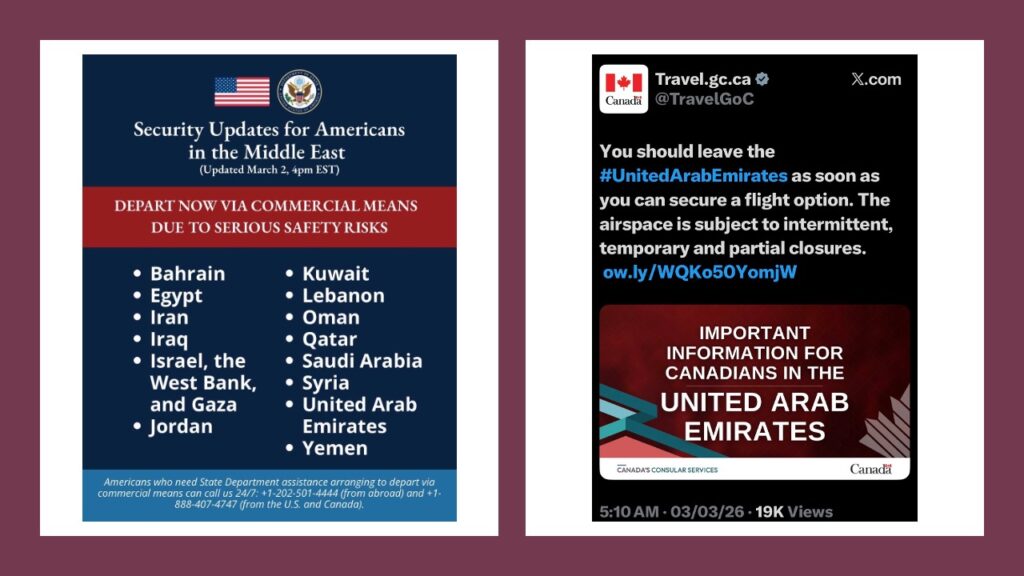
As the Middle East evacuation crisis deepens following U.S. strikes on Iran on 28 February 2026, hundreds of thousands of foreign nationals remain trapped across the region. The U.S. State Department has urged citizens in 14 Middle Eastern countries to depart immediately. Similar warnings have been issued by the Canadian and the European governments.
However, widespread airspace closures, cancelled flights, and security risks have severely restricted movement. As a result, millions of expatriates now face prolonged uncertainty, financial hardship, and personal risk.
From the Gulf states to conflict-adjacent zones, the crisis has exposed the fragile reality of global mobility in times of war.
Pre-Conflict Numbers: A Snapshot Before Escalation
Before tensions peaked on February 28, 2026, official data reflected massive foreign populations across the region. These figures, drawn from late 2025 and early 2026, now serve as baseline estimates.
The United States had between 400,000 and 600,000 citizens living, working, or travelling in affected countries. Israel alone hosted nearly 200,000 Americans. Saudi Arabia accounted for around 80,000, while the UAE had between 50,000 and 70,000. Qatar, Jordan, Lebanon, and Egypt also hosted sizeable numbers. In addition, approximately 45,000 U.S. military personnel were stationed across the region.
European nationals formed another substantial group. France reported nearly 400,000 citizens in the zone, including 221,000 in Israel. The United Kingdom estimated around 300,000 British nationals in Gulf countries. Germany recorded about 30,000, while Italy and Spain together accounted for more than 50,000. When tourists and temporary visitors are included, European numbers likely exceeded one million.
India had the largest presence by far. Between 9 and 10 million Indians resided in Gulf Cooperation Council countries. The UAE alone hosted up to 4.3 million Indians. Saudi Arabia followed with 2.6 million, while Kuwait had over one million. Bahrain, Qatar, and Oman also supported large communities. These workers formed the backbone of sectors such as construction, healthcare, logistics, and retail.
These figures, however, did not account for seasonal tourism or early departures triggered by preliminary alerts.
Evacuations and Remaining Citizens: A Fluid Crisis
As of March 3, 2026, reliable evacuation data remains limited. Security restrictions and operational disruptions continue to affect transparency.
For U.S. citizens, authorities have prioritised self-evacuation. Limited commercial flights have resumed sporadically. A few thousand passengers left the UAE on March 2 through European routes. Nevertheless, the majority remain stranded. Reports suggest that Egypt and Israel alone may each still host nearly 500,000 Americans, including tourists.
European governments have launched emergency coordination units. The United Kingdom reported over 102,000 registrations for assistance. France, Germany, and Italy are planning charter operations. However, airport shutdowns and airspace restrictions continue to delay large-scale departures. Many Europeans remain sheltered in hotels, residential compounds, or workplaces.
India’s Evacuation Challenge: Limited Flights, Massive Constraints
India faces the most complex evacuation challenge in the region due to the sheer size of its diaspora. With nearly 9–10 million citizens residing across Gulf countries, a comprehensive airlift remains operationally impractical under current conditions. The Ministry of External Affairs (MEA) has activated emergency helplines and strengthened consular coordination through Indian missions in the UAE, Saudi Arabia, Qatar, Kuwait, and Bahrain.
In addition, limited repatriation efforts have begun through special and relief flights operated in coordination with commercial carriers such as IndiGo and SpiceJet. These flights resemble the logistical model adopted during the Vande Bharat Mission of the COVID-19 period. However, unlike the pandemic evacuation, current operations are severely restricted by unstable airspace, security risks, and frequent airport shutdowns.
As a result, evacuation capacity remains modest. While several thousand Indian nationals have managed to return through temporary flight windows and indirect routes, the overwhelming majority remain in host countries. The MEA has therefore advised most citizens to shelter in place, stay connected with embassies, and await further instructions.
Officials have acknowledged that until regional airspace stabilises and security conditions improve, a large-scale, government-led evacuation comparable to past operations in Yemen or Ukraine is not feasible. Consequently, India’s response continues to focus on emergency support, selective repatriation, and sustained diplomatic coordination rather than mass evacuation.
Economic consequences are also significant. Indian remittances from the Gulf exceed tens of billions of dollars annually. Prolonged disruption could affect households, state economies, and foreign exchange reserves.
Meanwhile, criticism has grown online. Many expatriates argue that early warnings were ignored. Others highlight gaps in international media coverage of India’s diaspora.
The Broader Expat Crisis: Tens of Millions at Risk
Beyond specific nationalities, the Middle East hosts over 25 million expatriate workers. In countries such as the UAE, Qatar, and Kuwait, foreigners comprise more than 80 per cent of the population.
These migrants power industries ranging from oil and gas to tourism and infrastructure. Their dependence on stable mobility makes them especially vulnerable during conflicts.
Mass evacuation on this scale is logistically impossible. Border closures, limited aircraft availability, and regional instability compound the problem. Consequently, millions remain exposed to economic insecurity, healthcare challenges, and psychological stress.
The present crisis highlights the structural risks of expatriate-dependent economies.
Lessons from History: The 1990–1991 and 2003 Gulf Wars
The current emergency recalls previous Gulf conflicts, particularly for India.
During the 1990–1991 Gulf War, India evacuated over 170,000 citizens from Kuwait and Iraq. Air India operated 488 flights over 59 days. It remains one of the largest civilian airlifts in history. However, today’s numbers are nearly fifty times larger, making repetition impossible.
The 2003 Iraq War produced different consequences. With around 3.5 million Indians in the region, India avoided mass evacuation. Nevertheless, job losses, reduced remittances, and higher oil prices followed. Annual remittances at the time stood at $6–7 billion.
India also declined U.S. requests for troop deployment, maintaining neutrality. Trade with Iraq declined due to sanctions and instability.
These experiences underline how regional wars impose lasting economic and social costs on migrant-dependent nations.
Options for the Stranded: Focus on UAE, Bahrain, Qatar, and Kuwait
In Gulf hotspots, options remain severely limited.
Shelter in Place
Authorities recommend remaining indoors in secure locations. Expatriates are advised to avoid crowded areas, high-profile hotels, and political sites. Registration with embassy systems such as STEP, EU consular portals, and MEA helplines remains essential.
Limited Flight Availability
Brief airspace openings have enabled restricted operations. Etihad Airways has operated selected routes to Paris and London. Passengers are advised to confirm bookings before travelling to airports. Governments are prioritising vulnerable individuals, including elderly citizens and medical cases.
Ground Travel Routes
Land routes provide limited alternatives. UAE residents may travel to Oman or Saudi Arabia via Al Ain. Bahrain and Kuwait allow transit into Saudi Arabia. However, documentation requirements, security checks, and potential air threats increase risk. Qatar’s land access remains restricted.
Dual nationals must also comply with local exit regulations.
A Rapidly Evolving Situation
The Middle East evacuation crisis continues to evolve rapidly. Accurate departure data remains unavailable. Meanwhile, safety and official communication remain paramount.
U.S., European, and Indian citizens are urged to rely on embassy advisories and verified government channels. Speculation and unofficial social media updates may increase risk.
With expatriates forming between 5 and 80 per cent of regional populations, this crisis demonstrates how quickly global mobility can collapse during geopolitical shocks.
For millions, uncertainty remains the defining reality. Until stability returns, vigilance, preparedness, and institutional coordination will remain the only safeguards in an increasingly fragile environment.