NIA Custody Bangladeshi Murder Suspects: Big Break in Dhaka Killing Case
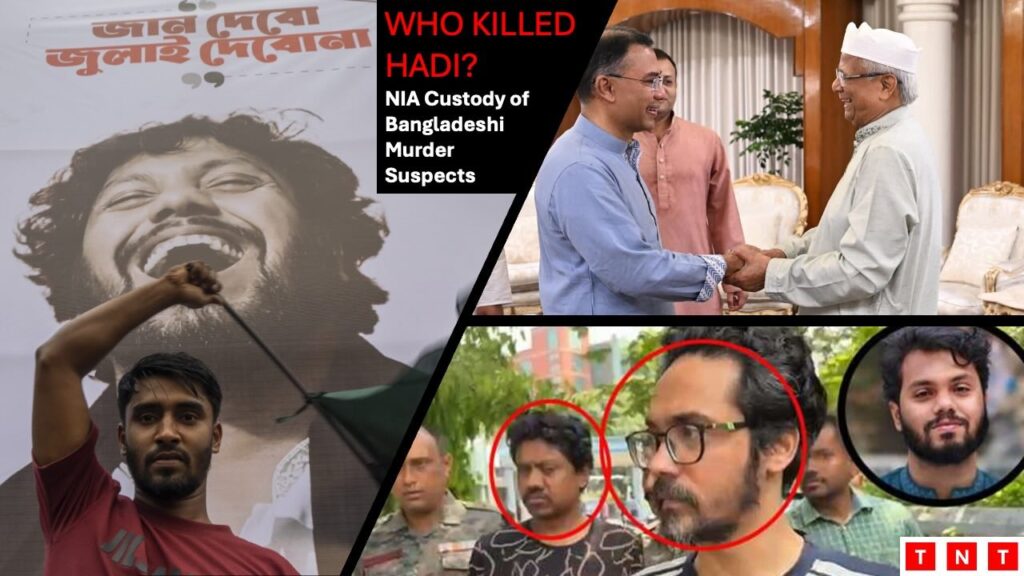
The NIA custody Bangladeshi murder suspects marks a decisive turn in the investigation into the killing of Bangladeshi youth leader Sharif Osman Hadi, with Indian authorities stepping up efforts to unravel the cross-border conspiracy behind the high-profile crime.
India’s National Investigation Agency (NIA) has taken physical custody of two Bangladeshi nationals accused in the December 2025 murder and brought them to New Delhi for sustained interrogation. Officials confirmed that the move was prompted by security concerns and the need for coordinated questioning at the national level. The development has added momentum to both the criminal investigation and the diplomatic process surrounding extradition.
Arrest Near Border Leads to NIA Custody Bangladeshi Murder Suspects
The developments leading to the NIA custody Bangladeshi murder suspects began earlier this month when the West Bengal Police Special Task Force apprehended the two accused near the India-Bangladesh border. Faisal Karim Masud, also known as Rahul, and his associate Alamgir Hossain were arrested in the Bongaon area of North 24 Parganas district during the night of March 7–8, 2026.
Investigators believe the two men had illegally entered India through the Meghalaya border soon after the murder and had been hiding in border districts while attempting to slip back into Bangladesh. Acting on specific intelligence inputs regarding their presence, the STF tracked and detained them in what officials described as a targeted operation involving wanted foreign nationals.
Following their arrest, the case quickly escalated, eventually resulting in NIA custody Bangladeshi murder suspects, reflecting the seriousness and transnational nature of the crime.
Dhaka Killing and Expanding Legal Case
At the centre of the NIA custody Bangladeshi murder suspects case is the killing of Sharif Osman Hadi, a prominent youth activist and spokesperson of the platform Inqilab Mancha. Hadi, who had emerged as a visible figure during Bangladesh’s 2024 mass mobilisation, was attacked on December 12, 2025, in Dhaka’s Paltan-Bijoynagar area.
According to investigators, the attack was carried out in a drive-by shooting while Hadi was travelling in a battery-powered auto-rickshaw. He sustained critical head injuries and was later airlifted to Singapore General Hospital, where he died on December 18. The incident triggered widespread attention in Bangladesh, with authorities swiftly naming Masud and Hossain as the primary suspects.
In India, the legal proceedings against the accused initially began under the Foreigners Act for illegal entry. However, as the probe deepened, more stringent provisions were invoked, including sections of the Unlawful Activities (Prevention) Act. This shift in charges underscored the gravity of the allegations and the possibility of broader criminal links.
The suspects were produced before a court in Bidhannagar on March 22, which remanded them to judicial custody while granting the NIA permission to interrogate them. Shortly thereafter, transit remand was secured, enabling their transfer to Delhi and formalising the NIA custody Bangladeshi murder suspects phase of the investigation.
Transfer to Delhi and Interrogation Under NIA Custody
The shift to Delhi marked a critical step in the NIA custody Bangladeshi murder suspects case. Officials cited logistical and security challenges in conducting detailed interrogations at Dum Dum Central Jail in West Bengal, prompting the decision to move both accused to the national capital on the night of March 23.
Now under NIA supervision, the suspects are expected to be produced before a special court in Delhi in the coming days. Investigators are focusing on reconstructing the sequence of events leading to the murder, tracing possible networks, and examining whether the crime involved wider coordination.
During court appearances, Faisal Karim Masud denied any involvement, claiming he was being politically framed and asserting that there was no conclusive visual evidence linking him to the shooting. Despite these claims, officials maintain that the investigation is backed by substantial intelligence inputs and material evidence.
Adding another dimension to the case, a third Bangladeshi national, Philip Sangma, was arrested separately for allegedly facilitating the illegal movement of the two accused across the border. His role is being examined as part of the broader network supporting the suspects.
Extradition Process and Diplomatic Significance
The NIA custody Bangladeshi murder suspects has also triggered parallel diplomatic engagement between India and Bangladesh. Dhaka has formally sought the extradition of the two accused under the existing bilateral treaty, setting in motion a legal process that will unfold alongside the criminal investigation.
While procedural steps are underway, issues such as consular access and documentation are still being worked out. Officials on both sides have indicated that the case is being handled with due sensitivity, given its legal and political implications.
Observers view the developments as a potential indicator of evolving cooperation between the two countries in tackling cross-border crime. The case comes at a time when bilateral relations are being recalibrated following political changes in Bangladesh, and coordinated action in such high-profile investigations is being seen as a constructive signal.