Middle East Energy Shock Disrupts Major Gulf Oil Network
March 20, 2026 | New Delhi: A fresh wave of coordinated drone and missile strikes targeting critical energy infrastructure across the Gulf has sharply intensified the Middle East Energy Shock, following Israel’s direct attack on Iran’s South Pars gas field.
While Iran’s earlier scattered strikes across the region were largely demonstrative—intended as a strategic warning to Gulf Cooperation Council (GCC) nations for their perceived support to US–Israel military operations—Tehran had explicitly cautioned that any attack on its core oil and gas assets would trigger a far more severe and coordinated retaliation. Despite these warnings, Israeli strikes on South Pars marked a decisive escalation. In response, Iran initiated a calibrated but widening offensive, beginning with strikes on Israel’s Haifa refinery and subsequently expanding to energy installations across the Gulf, briefly disrupting oil exports and injecting volatility into global energy markets.
Escalation Targets Gulf Energy Network
Iran’s retaliatory strategy has focused on refineries, gas plants, and export terminals across Gulf nations perceived as aligned with the United States and Israel. These attacks have caused fires, partial shutdowns, and supply disruptions. Consequently, global oil prices have reacted sharply, with Brent crude briefly crossing $119 per barrel. Liquefied natural gas prices have also surged amid supply concerns.
Most incidents have resulted in limited or contained damage. However, they have significantly heightened fears of broader energy market instability. Concerns have also grown regarding the potential closure of key maritime routes such as the Strait of Hormuz, which remains critical for global oil transit.
Saudi Arabia: Disruption Raises Alarm
Drone Strike on SAMREF and Temporary Halt
A major flashpoint in the Middle East Energy Shock emerged in Saudi Arabia’s Yanbu industrial zone. On March 19, 2026, a drone struck the SAMREF refinery, a joint venture between Saudi Aramco and ExxonMobil. Simultaneously, Saudi air defences intercepted a ballistic missile targeting the port area.
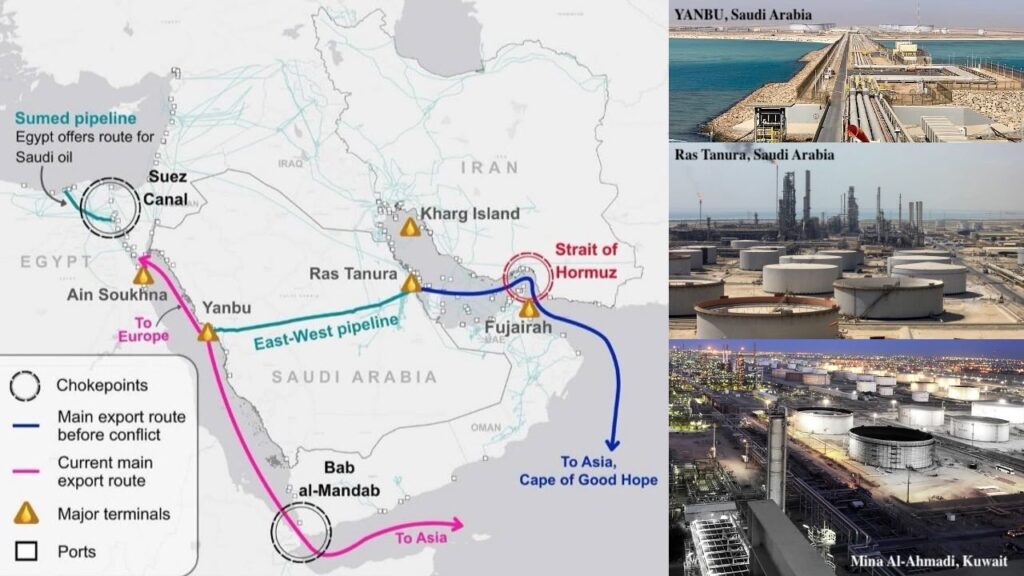
Authorities temporarily suspended crude oil loadings at the Port of Yanbu as a precautionary measure. The halt followed staff evacuations and safety assessments. Yanbu had become a critical export hub after disruptions in the Strait of Hormuz forced rerouting of oil shipments via pipelines to the Red Sea.
Although operations resumed shortly afterwards, the temporary halt caused a spike in global oil prices. Reports indicate minimal damage to infrastructure and no long-term operational impact.
Earlier Impact on Ras Tanura and Riyadh
Earlier in the conflict, Iranian drone strikes targeted the Ras Tanura refinery, Saudi Arabia’s largest domestic refining facility with a capacity of approximately 550,000 barrels per day. The attacks caused limited damage and triggered precautionary shutdowns.
In addition, missile strikes near Riyadh on March 19 led to explosions in areas close to energy installations. While air defences intercepted several projectiles, concerns remain regarding vulnerabilities in critical infrastructure.
Kuwait Refineries Under Repeated Attack
Mina Al-Ahmadi and Mina Abdullah Hit
Kuwait’s energy sector has also come under sustained attack. On March 19, a drone struck an operational unit at the Mina Al-Ahmadi refinery, one of the country’s largest facilities. The strike caused a limited fire, which emergency teams quickly contained.
Around the same time, another drone hit the nearby Mina Abdullah refinery. This incident also triggered a fire, which authorities brought under control without casualties.
Follow-up Strikes Intensify Disruption
On March 20, Iranian drones launched multiple waves of attacks on the Mina Al-Ahmadi refinery. These strikes caused fires across several units and forced partial shutdowns. Emergency response teams acted swiftly, and no casualties were reported.
However, the repeated attacks have disrupted operations and contributed to growing concerns over regional supply stability. The situation remains fluid as authorities assess damage and restore capacity.
UAE Energy Infrastructure Faces Multi-Site Attacks
The United Arab Emirates has witnessed extensive strikes on its energy network. The Ruwais refinery, one of the largest in the world with a capacity of approximately 922,000 barrels per day, experienced drone attacks that triggered fires in its industrial zone. Authorities initiated precautionary shutdowns to contain the situation.
In Fujairah, a key oil trading and storage hub outside the Strait of Hormuz, drone strikes between March 14 and 16 caused significant fires. Reports also indicate damage to offshore vessels, further complicating logistics.
Meanwhile, the Habshan gas facility and the Bab oil field faced overnight attacks, leading to temporary shutdowns. Iranian warnings also targeted the Al Hosn gas field, prompting evacuation measures.
Bahrain and Qatar: Strategic Energy Nodes Hit
Bahrain’s Sitra refinery complex, operated by Bapco Energies, suffered drone and missile strikes around March 9. The attacks caused fires and material damage, forcing the company to declare force majeure. Although no casualties occurred, the disruption affected domestic fuel supply.
Qatar’s Ras Laffan Industrial City, the world’s largest LNG export complex, has faced multiple waves of attacks. Strikes on March 18 and 19 caused extensive damage and halted LNG production. Additional hits targeted the Mesaieed Petrochemical Complex and nearby facilities.
Reports also indicate damage to offshore vessels near Qatar’s coastline. These incidents have raised concerns about prolonged disruption to global LNG supplies.
Israel: Limited Impact but Rising Tensions
In Israel, a missile strike on the Haifa oil refinery on March 19 caused smoke and brief power disruptions. Authorities reported no significant damage. However, the incident underscores the widening geographical scope of the conflict.
Iran’s Islamic Revolutionary Guard Corps claimed responsibility for targeting both energy and military sites. Some reports also referenced attempted strikes near Ashdod, though details remain limited.
Global Energy Markets React to Middle East Energy Shock
The cumulative effect of these strikes has created a volatile environment in global energy markets. Supply disruptions, even when temporary, have triggered price spikes and heightened uncertainty. Market participants remain cautious as the risk of further escalation persists.
European nations and international organisations have called for restraint, particularly in attacks on civilian and economic infrastructure. Analysts warn that continued targeting of energy assets could destabilise global supply chains.
The Middle East Energy Shock now reflects a dangerous convergence of military escalation and economic warfare. The effective blockade of the Strait of Hormuz, followed by sustained attacks on major oil and gas infrastructure across the Gulf, is rapidly evolving into a full-scale global energy crisis. With critical supply routes constrained and production repeatedly disrupted, the world faces the prospect of prolonged volatility in both oil and LNG markets, unless immediate de-escalation efforts take hold.
ALSO READ
Humanity’s Hidden Catastrophe – Irreplaceable Oil & Gas Reserves Burned in Persian Energy Crisis
Iranian Counterattack Surge Challenges US-Israel Claims of Military Success
Persian Gulf Crisis: Winners Behind the War?