Iran Regime Change and the Strategic Fallout After Khamenei’s Killing
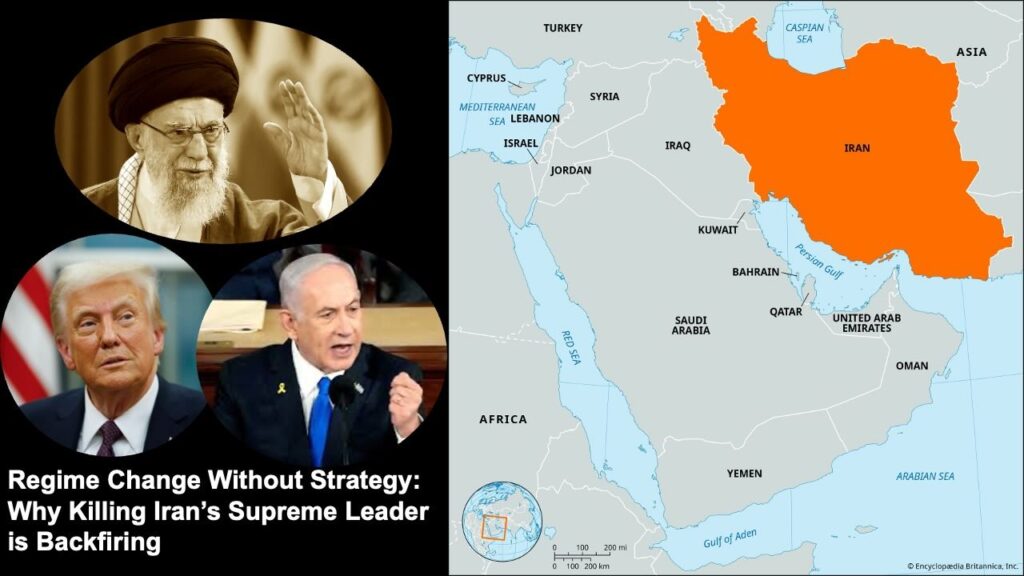
US President Donald Trump pursued a strategy aimed at destabilising Iran’s leadership structure, with an implicit objective of regime change. However, internal assessments by the Central Intelligence Agency had warned that eliminating Supreme Leader Ali Khamenei could produce consequences far more dangerous than anticipated.
According to intelligence evaluations prepared weeks in advance, Khamenei’s death would likely accelerate the rise of hardline commanders from the Islamic Revolutionary Guard Corps (IRGC). These are figures shaped almost entirely by military doctrine, not religious legitimacy or political compromise.
Unlike Khamenei—an elderly cleric who governed through theology, institutional bargaining, and calculated restraint—the IRGC leadership operates primarily through coercive power. Their authority rests on weapons, surveillance, and force, not public consent or clerical symbolism. They face minimal internal pressure to negotiate and possess no religious credibility to protect.
Four Days After Khamenei’s Death: Escalation Across West Asia
The world is now witnessing the consequences nearly 80 hours after the killing of Iran’s Supreme Leader. Clearly, events are not unfolding as anticipated by the US and Israel. The ongoing US-Israel war against Iran has now plunged the Middle East into unprecedented chaos. By March 3, the conflict had escalated into a regional conflagration.
Iranian retaliatory strikes targeted not only Israel and US assets but also key infrastructure across Gulf states. These included Qatar’s energy facilities in Doha, Bahrain’s ports, Kuwait’s airports and military sites, Saudi Arabia’s US embassy in Riyadh, and Dubai International Airport in the UAE. Additional attacks were reported in Jordan and Oman.
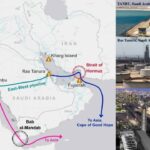
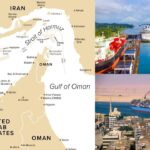
Iran has effectively closed the Strait of Hormuz by declaring it shut, attacking tankers, and vowing to “burn” any vessels attempting passage. As a result, nearly all maritime traffic through this vital chokepoint has halted. The strait carries about 20 per cent of global oil supply and liquefied natural gas (LNG).
This blockade has destabilised the global economy. Brent crude prices surged by over 10 per cent to around $80–82 per barrel. Analysts have warned of possible spikes to $100 or more. Global shipping has been disrupted, flights have been grounded, and shortages of oil, gas, jet fuel, and fertilisers are emerging.
Europe has been particularly affected. It relies on 30 per cent of its jet fuel and significant LNG volumes transiting the strait. Wholesale gas prices may triple, further aggravating cost-of-living pressures amid low energy inventories.
Such an undesired escalation, far beyond initial regime-change objectives, risks prolonged attrition warfare. Iran’s survival strategy relies on enduring sanctions while choking Western energy lifelines and fracturing US-led coalitions through rising economic costs.
What Went Wrong
Israeli and American planners failed to assess that Iran’s regime is not a fragile, one-man dictatorship. It is a deeply institutionalised theocratic-republican system built for survival.
The regime has endured for over 40 years. The IRGC provides parallel military, economic, and security depth, supported by established succession mechanisms. Meanwhile, the constitutional-religious framework—Velayat-e Faqih, the Assembly of Experts, and allied institutions—grants ideological legitimacy to core supporters.
A committed social base, including the Basij, rural conservatives, and patronage networks, reinforces regime stability. The revolutionary culture of martyrdom, rooted in historical memory such as the Battle of Karbala (680 CE), continues to sustain ideological loyalty.
The system relies heavily on IRGC cohesion and repression. In addition, significant public mobilisation was witnessed in protests against the Supreme Leader’s killing. This factor should not be underestimated.
This multi-layered structure explains Iran’s endurance far better than the assumption that eliminating a few leaders would collapse the regime.
Iran Is a System, Not a Personality Cult
Crucially, US intelligence did not argue that targeting Iran’s Supreme Leader was impossible. It was clearly possible, and it was executed on Day One. The CIA had warned, however, against assuming that his removal would collapse the regime—and that assessment has proven correct.
Iran functions as a complex institutional ecosystem.
The Supreme Leader serves as its symbolic and political face.
The IRGC forms its operational backbone.
Khamenei represented continuity, religious authority, and controlled political management. The IRGC represents enforcement, militarisation, and ideological rigidity. One can be replaced. The other cannot be easily neutralised.
In this framework, the Supreme Leader is the façade.
The IRGC is the skeleton.
The Unlearned Lesson from Iraq
This strategic miscalculation echoes a familiar historical pattern. When the United States removed Saddam Hussein, it did not stabilise Iraq. Instead, the vacuum enabled the rise of Islamic State of Iraq and Syria.
The lesson was clear but largely ignored.
Dismantling the apex of an authoritarian system often releases more violent forces beneath it. Removing the “top” does not dissolve the structure. It destabilises it.
The Risk of Encouraging Uprisings Under Militarised Rule
Following the strike, Trump urged the Iranian population to “seize the moment” and rise against the regime. On the surface, this rhetoric aligns with democratic ideals. In practice, however, it risks catastrophic miscalculation.
If Khamenei is removed and IRGC dominance intensifies, popular uprisings will not confront an ageing cleric bound by religious legitimacy and political caution. They will face hardened military commanders with:
No theological constraints
No electoral accountability
No incentive for compromise
Nothing left to lose
Such actors do not negotiate reforms. They suppress dissent.
Strategic Reality
The intelligence community’s warning was not about morality. It was about structure and consequences.
Killing a leader does not dismantle a regime.
It often empowers its most ruthless components.
In Iran’s case, weakening clerical authority risks replacing a complex, restrained system with a purely militarised one—more opaque, more violent, and less predictable.
History suggests that this path does not produce democracy.
It produces prolonged instability.