
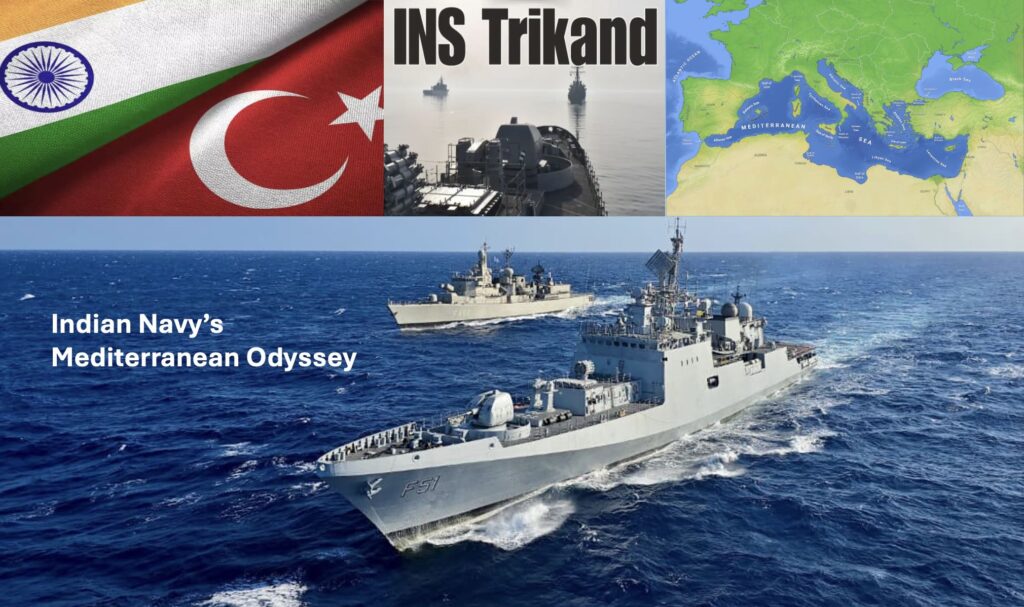
India–Turkey Tensions: INS Trikand’s Mediterranean Gambit Rattles Ankara’s Blue-Homeland Dream
Introduction
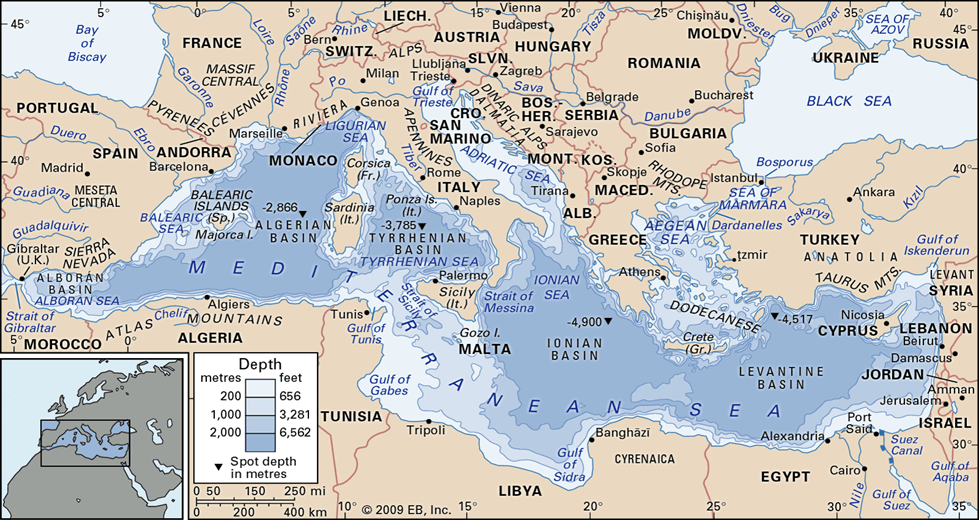
The deployment of INS Trikand to the Mediterranean in September 2025, featuring a port call at Alexandria for Exercise Bright Star 2025, a bilateral drill with the Hellenic Navy at Salamis Bay, and a PASSEX and port call at Cyprus, marks a pivotal shift in India’s maritime outreach. It signals New Delhi’s intent to project power and build deeper security partnerships well beyond its traditional sphere of influence. Official Navy releases and media reports confirm the frigate’s role in these exercises, reflecting an increasingly confident and blue-water-oriented Indian maritime posture.
In the Eastern Mediterranean, an Indian Navy stealth frigate loaded with advanced BrahMos cruise missiles represents a calibrated strategic response to Turkey’s decades-long antagonism towards India—from Ankara’s persistent support for Pakistan’s Kashmir stance to supplying arms, ammunition, and drones reportedly used against India in Operation Sindoor in May 2025. Recent intelligence of Turkish-origin armaments reaching Bangladesh has further strained bilateral trust. Against this backdrop, India’s expanding naval diplomacy, anchored by growing defence cooperation with Greece, Cyprus, and Armenia, signals the emergence of a counter-axis challenging Turkey’s Blue Homeland doctrine and its neo-Ottoman ambitions for leadership in the Muslim world.
A Brief Historical Fault Line: The Ottoman Legacy and India’s Civilisational Continuum
Turkey’s modern geopolitical posture is rooted in its Ottoman heritage. The Ottoman Caliphate, which ended in 1924, symbolised the spiritual and political leadership of the Muslim world. President Recep Tayyip Erdoğan’s AK Party has sought to revive this mantle through an assertive vision described as neo-Ottomanism. This ideology fuses Ottoman nostalgia, Islamic solidarity, and Turkish nationalism, positioning Ankara as the natural leader of global Islam.
Institutions such as the Turkish Cooperation and Coordination Agency (TIKA), the Directorate of Religious Affairs (Diyanet), and the Yunus Emre Institute play central roles in Turkey’s soft-power outreach through culture, education, and religious diplomacy—as Turkey extends its influence across Asia, Africa, and the Balkans in a contemporary form.
India–Turkey tensions, including the recent naval standoff in the Mediterranean and Turkey’s overt support to Pakistan during Operation Sindoor, reflect a deeper historical and ideological divide. While the Ottoman Empire and the Mughal Empire occasionally found common cause in the 16th century, rivalry between these Islamic imperial centres remained unresolved. Since India’s independence in 1947, Turkey’s foreign policy shifted towards Pakistan.
By the 1970s, Ankara openly endorsed Islamabad’s stance on Jammu and Kashmir, symbolically dispatching its ambassador to Muzaffarabad. Relations further soured after India revoked Article 370 in 2019, with Turkey’s state-run Anadolu Agency adopting Pakistan’s terminology for Kashmir, prompting formal protests from New Delhi. In contrast, India’s civilisational identity rests on dharma—a pluralistic and inclusive ethos rejecting singular religious authority—contrasting sharply with Turkey’s Islamic centrality.
Over the past decade, the ideological divergence has deepened, with Ankara’s championing of Islamic causes, particularly Kashmir, seen in New Delhi as part of Turkey’s broader neo-Ottoman quest for global Muslim leadership.
Recent Diplomatic Jabs: UNSC Reform and the Kashmir Dispute
Turkey’s Diplomatic Posturing on UNSC Reforms
Turkey remains a vocal critic in United Nations Security Council (UNSC) reform debates, opposing the veto privilege and advocating broader representation. President Erdoğan has publicly demanded an Islamic country’s inclusion in veto-bearing seats, refraining from acknowledging India’s bid. Turkey co-leads the Uniting for Consensus (UfC) group with Italy and Pakistan, opposing the G4 nations’ quest for permanent seats.
At the 80th UN General Assembly in 2025, Erdoğan’s calls for reform, omitting India, reinforced concerns in New Delhi that Turkey aligns with Pakistan and China to restrain India’s strategic ascent. Many in India perceive Turkey as a persistent obstacle to India’s UNSC aspirations.
Turkey’s Provocations at the UN on Kashmir
In speeches at the 2023 and 2025 UNGA, Erdoğan repeatedly raised Kashmir, offering mediation and echoing Pakistan’s call for UN resolutions implementation. While praising ceasefire efforts post-Operation Sindoor, he ignored Pakistan’s ongoing cross-border terrorism, mirroring Islamabad’s narrative.
India’s position has been firm and consistent, grounded in international law and bilateral agreements. New Delhi insists Jammu and Kashmir, including Pakistan Occupied Kashmir, is India’s integral part, with disputes to be resolved bilaterally under the 1972 Simla Agreement and 1999 Lahore Declaration, excluding third-party mediation.
The Ministry of External Affairs regularly protests Turkey’s involvement, urging Ankara to respect India’s sovereignty and refrain from adopting positions influenced by Pakistan’s narrative.
Erdoğan’s Neo-Ottoman Push: Arms to India’s Neighbours
Erdoğan’s neo-Ottomanism, driving Islamist expansionism, fuels Turkey’s strategic encirclement of India. Ankara supplies arms to India’s regional rivals, forging military dependencies.
According to SIPRI’s March 2025 report, Turkey exported nearly 10% of its total arms from 2020–2024 to Pakistan, including Bayraktar TB2 drones later deployed in Operation Sindoor. In April 2025, six Turkish C-130s reportedly ferried missile consignments before India’s retaliatory strikes, coinciding with Turkish military visits to Islamabad.
Turkey’s deals include F-16 upgrades, naval ships, and $1.6 billion worth of JF-17 jets to Azerbaijan—a diplomatic reciprocation for Ankara’s stance on the 1915 Armenian genocide.
Following a 2024 regime change in Bangladesh, the country became a jihadist battleground. Turkey’s ruling AKP openly supports Jamaat-e-Islami, facilitating surges in Turkish arms deliveries, including tanks, drones, rockets, and armoured vehicles. Military plans for joint production are underway.
Turkey’s influence extends to the Maldives and Myanmar, tightening its strategic presence around India, while banning defence exports to India, favouring Pakistan.
Beyond South Asia, Erdoğan’s interventions in Syria, Libya, and the Black Sea reflect his ambition for a caliphate-style revival, with rhetoric condemning Israel and India. Turkey’s pan-Islamic ideology is propagated by TIKA’s overseas missions and ties with Hamas.
In response, India has deepened strategic and defence cooperation with Turkey’s rivals, signing a $2 billion arms deal with Armenia and expanding partnerships with Greece and Cyprus, effectively encircling Ankara in the Mediterranean theatre.
From Neo-Ottoman Push to Blue Homeland Dreams
Turkey’s Blue Homeland (Mavi Vatan) doctrine, articulated by Admiral Cem Gürdeniz in 2006, claims roughly 462,000 sq km of maritime zones across the Aegean, Mediterranean, and Black Sea. It underpins Ankara’s assertive stance in disputes with Greece and Cyprus, its 2019 maritime deal with Libya, and its expanding naval presence from the Red Sea to the Horn of Africa.
Analysts at Carnegie Europe, Brookings, and SADF Europe consider Blue Homeland the maritime arm of neo-Ottomanism, extending influence through energy exploration, port diplomacy, and military bases. It combines nationalist pride with a faith-based global narrative, positioning Turkey as protector of Muslims and dominant Mediterranean power.
The arms diplomacy complements Ankara’s outreach to Azerbaijan, Pakistan, Maldives, Bangladesh, and Myanmar, forming a network encircling India’s maritime and continental flanks.
Clash of World-views: India’s Plural Maritime Outreach
India’s naval and diplomatic expansion westwards directly challenges Turkey’s vision.
INS Trikand’s Mediterranean Odyssey: Ports, Drills, and Diplomatic Ripples
INS Trikand’s September 2025 deployment included Exercise Bright Star 2025 in Alexandria, Egypt, a US Central Command-led multilateral drill aimed at irregular warfare, interoperability, and hybrid threats. Participating nations included the US, Saudi Arabia, Qatar, Greece, Cyprus, and Italy, with Indian Army and Air Force contingents highlighting tri-service synergy.
The frigate next docked at Salamis Bay, Greece, for a maiden bilateral exercise with the Hellenic Navy, featuring cross-deck visits, professional exchanges, anti-submarine warfare, visit-board-search-seizure operations, and helicopter cross-decking with Greek naval assets. Greek analysts viewed INS Trikand’s presence as a strong message to Turkey against provocative tactics.
By late September, it reached Limassol, Cyprus, for a Passage Exercise (PASSEX) that strengthened the June 2025 India-Cyprus pact emphasising maritime security and intelligence sharing. Later calls at Taranto, Italy, fostered Italy-India naval ties.
Unverified Standoffs: Fact vs Fiction in the Aegean
Social media buzzed with claims of a naval standoff where Turkish warships allegedly encircled INS Trikand, triggering missile readiness. Videos claimed destruction of Turkish ships and drones.
However, official Indian Navy statements and reliable sources confirmed all exercises took place in international waters, complying fully with UNCLOS, with no such incidents occurring.
Turkish Reaction: Naval Patrols and Media Outcry
Ankara responded with intensified Turkish patrols in the Aegean. Turkish media criticised INS Trikand’s drills as provocative, accusing India of encirclement through ties with Greece, Cyprus, and Armenia.
Erdoğan’s office saw the drills as retaliation for Turkey’s $5 billion arms exports to Pakistan in 2024-2025 and active support during Operation Sindoor.
Fractured NATO: Turkey’s Rift with France and the West
Turkey’s foreign policy under Erdoğan has caused repeated confrontations within NATO, especially with France. In 2020, a naval encounter exposed deep fissures, prompting France to suspend its participation in NATO’s Sea Guardian mission after Turkish radar locked on French warships.
Subsequent regional tensions escalated with contested territorial claims in the Mediterranean, involving Turkish exploration vessels and Greek-Cypriot opposition backed by France and the EU.
Erdoğan’s Islamism and neo-Ottoman rhetoric clashed with European secularism, leading to diplomatic spats with Germany, Netherlands, Italy, and Nordic countries over espionage allegations and Islamist influence.
Notably, Turkey’s 2019 acquisition of Russian S-400 defence systems led the U.S. to expel Turkey from the F-35 program and impose sanctions, affecting alliance cohesion.
Turkey selectively aligns with NATO, balancing ties with Russia and Western powers based on strategic interests.
Cyprus, though not in NATO, is an EU member and backed by the EU in maritime disputes with Turkey. This has left Ankara isolated between Western institutions it once sought to join and its present revisionist ambitions.
Broader Implications: NATO’s Shadow and Global Trade Stakes
NATO features peripherally in INS Trikand’s Mediterranean deployment, with Greek engagements including NATO representatives. However, NATO’s Article 5 excludes conflicts outside the North Atlantic region, such as South Asia.
Strategically, Mediterranean chokepoints are critical; tensions risk disruptions in the Suez Canal, through which 12% of global trade passes, including a significant portion of India’s $120 billion annual exports to the EU.
The India-Middle East-Europe Corridor (IMEC), supported by Cyprus and Greece, bypasses Turkey, linking India to Europe via UAE and Saudi Arabia.
INS Trikand’s BrahMos integration, while not live-fired, served as a deterrent against threats including Turkey’s S-400 systems, signalling a strategic message to Ankara.
Charting the Future: De-escalation or Escalation?
India-Turkey naval tensions remain contained below open conflict thresholds. New Delhi’s strict adherence to international law and respect for Exclusive Economic Zones frustrates Ankara’s attempts to escalate.
India-Greece-Cyprus trilateral naval drills are expected to expand through 2026, aligned with EU-India Free Trade Agreement timelines. This axis strengthens India’s strategic posture, securing enhanced export routes, maritime corridors, and deterrence capabilities.
Nonetheless, excessive assertiveness risks proxy confrontations, underscoring that in the Mediterranean theatre, presence itself conveys power.











2 Responses
1. It is quite insightful Editorial on Bharat’s firm response to Turky’s repeated misadventure against Bharat – be it Turkey ‘s speech in UNGA against Bharat , or supporting Terror state of Pakistan with supply of arms & Training during op Sindoor . It is rightly pointed out that Turkey has been siding with Pakistan and opposing Bharat since 1947 but this has been more vocal since Erdogan came to power . Bharat , under current Govt has been giving befitting reply to Turkey by openly siding with Cyprus , Greece & Armenian. Which earlier Govts refrained doing so .
2. If Turkey has ambition to be the leader of Muslims all over the world as neo Ottoman Empire , so why it fears to raise its voice on open atrocities committed by China on Eugher Muslims in xinzhou province of China ??!!
3. It is mentioned that Turkey alongwith Italy & Pakistan has formed a group in UN , opposing any expansion of Security council with Veto . I have my doubts that Italy opposes Bharat’s veto and permanent membership to UNSC .
On your query (3.): The Uniting for Consensus (UfC) group, formed in the 1990s and formally established in 2005, includes Turkey, Italy, Pakistan, and others opposing the expansion of permanent UN Security Council seats with veto power. While G4 countries—India, Germany, Japan, and Brazil—claim permanent seats, UfC rejects adding new permanent members with veto rights, advocating instead to expand non-permanent seats for more equitable, democratic representation. Unlike Turkey and Pakistan, Italy (a founding UfC member), does not oppose India specifically but opposes any Security Council expansion that entrenches veto power, aiming instead to dismantle or limit the veto to make the Council more accountable and representative of all UN member states. This stance reflects a broader push for reform that balances regional interests and ensures transparency.