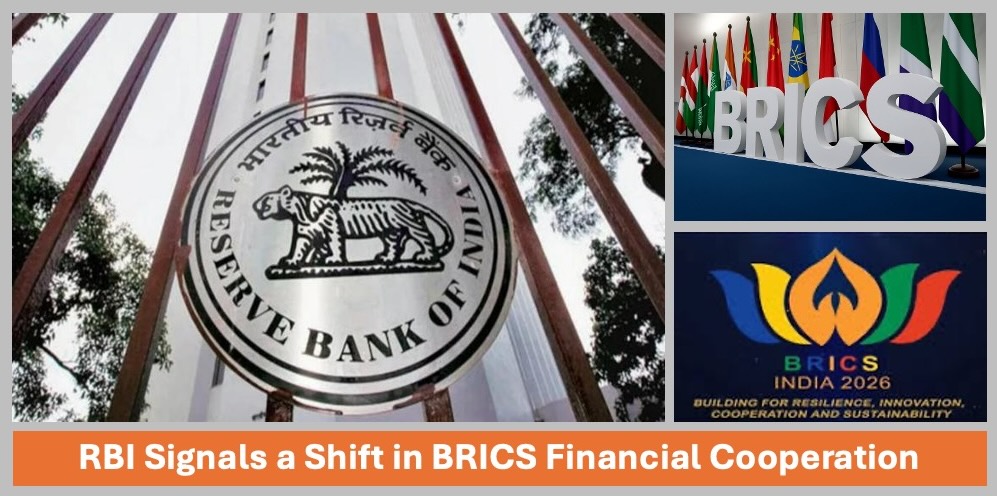
RBI Proposes Linking BRICS Digital Currencies Ahead of 2026 Summit
RBI Signals a Shift in BRICS Financial Cooperation
India’s central bank has proposed a coordinated mechanism to link BRICS digital currencies, marking a significant move towards deeper financial integration among emerging economies. The proposal, initiated by the Reserve Bank of India (RBI), aims to simplify cross-border payments for trade and tourism while reducing friction in currency settlements between member nations.
The idea has been conveyed to the Indian government with a recommendation that it be formally discussed at the 2026 BRICS Summit, which India is set to host. According to officials familiar with the discussions, the initiative focuses on interoperability rather than the creation of a single common currency.
Why BRICS Digital Currency Linkage Matters Now
All five original BRICS members—Brazil, Russia, India, China, and South Africa—are at varying stages of central bank digital currency development. While none has completed a full national rollout, pilot programmes have advanced steadily.
India’s digital rupee, launched in late 2022, has already seen domestic adoption across retail and wholesale segments. The RBI views cross-border usability as the next logical phase. Linking BRICS digital currencies would allow participating countries to conduct transactions directly in their sovereign digital units without routing payments through intermediary banking systems.
As a result, transaction time and costs could fall sharply, especially for trade settlements that currently rely on dollar-based correspondent banking networks.
Interoperability, Not a Common Currency
Officials involved in the proposal have clarified that the RBI is not advocating a single BRICS currency. Instead, the focus remains on creating interoperable rails that allow national digital currencies to communicate securely.
This distinction is crucial. A common currency would require shared monetary policy, which remains politically unviable. Interoperability, however, allows each country to retain full monetary sovereignty while still benefiting from faster settlements and improved liquidity management.
Such an approach mirrors ongoing global experiments led by the Bank for International Settlements, where multi-CBDC platforms are being tested for cross-border use cases.
Technical and Regulatory Challenges Ahead
Despite its promise, linking BRICS digital currencies presents complex challenges. Each member country has developed its CBDC architecture independently. Differences exist in ledger design, transaction validation methods, and cybersecurity frameworks.
In addition, regulatory alignment remains a major hurdle. Cross-border digital currency use would require harmonised standards on data protection, anti-money-laundering compliance, and dispute resolution. Without a shared governance structure, operational risks could undermine trust in the system.
To address imbalances in trade flows, policymakers are also examining bilateral currency swap arrangements. These would help manage settlement mismatches when one country consistently runs a surplus against another.
Strategic Implications Beyond Payments
The proposal carries implications that extend well beyond payment efficiency. Over time, a functioning BRICS digital currency linkage could reduce partial dependence on the US dollar for intra-bloc trade.
Although Indian officials have avoided framing the move as de-dollarisation, the strategic subtext is clear. Emerging economies have long expressed concern over exposure to external monetary tightening and financial sanctions.
Notably, political sensitivities remain high. The United States has previously criticised BRICS initiatives that appear to challenge dollar dominance. Any progress on digital settlement alternatives will therefore be closely monitored by Western financial institutions.
India’s Broader Digital Currency Strategy
For India, the initiative aligns with a broader ambition to position the digital rupee as a credible settlement instrument in regional trade. The RBI has consistently stated that internationalisation will be gradual and controlled.
By pushing interoperability rather than dominance, India aims to balance innovation with stability. Hosting the 2026 BRICS summit gives New Delhi a unique opportunity to shape the agenda and steer discussions towards pragmatic outcomes rather than ideological positioning.
If consensus emerges, pilot corridors between selected BRICS economies could follow before wider adoption.
What Comes Next
The proposal now awaits political endorsement at the BRICS level. Working groups are expected to examine technical feasibility, governance models, and phased implementation strategies.
Progress is likely to be incremental. However, even limited success could redefine how emerging economies approach digital payments and financial cooperation in a rapidly evolving global order.