Sikorski’s Delhi Visit Highlights Growing Friction in India–Poland Relations
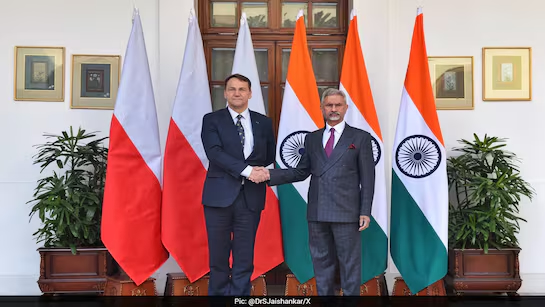
New Delhi, January 20, 2026 – A high-profile diplomatic engagement in the Indian capital has triggered an unusually public debate on geopolitical equivalences, strategic sensitivities, and the limits of diplomatic messaging. Polish Deputy Prime Minister and Foreign Minister Radosław Sikorski met India’s External Affairs Minister S. Jaishankar in New Delhi on Monday amid growing scrutiny of Poland’s recent foreign policy conduct in South Asia.
The meeting formed part of Sikorski’s official visit to India from January 18 to 20, aimed at strengthening bilateral cooperation in trade, defence, and global security issues, including terrorism and the ongoing Ukraine conflict. However, the discussions quickly revealed underlying frictions linked to Poland’s positioning on India’s core national concerns and its evolving diplomatic posture in the region.
How the Meeting Unfolded
Bilateral Engagement and Emerging Friction
The talks at Hyderabad House extended for over an hour and focused on expanding economic and technological cooperation. Poland expressed interest in attracting Indian investments into its technology and green energy sectors, while Jaishankar reiterated India’s commitment to a rules-based international order and strategic autonomy.
According to sources familiar with the discussions, Jaishankar raised India’s unease over Poland’s recent diplomatic engagements in South Asia, particularly actions perceived in New Delhi as infringing upon India’s sovereign matters. Sikorski responded by reiterating Poland’s strong support for Ukraine and urged India to reconsider aspects of its military engagement with Russia. He specifically referenced India’s participation in the Zapad-2025 military exercises conducted in Russia last year.
While the meeting concluded with a joint statement emphasising cooperation on counter-terrorism and climate initiatives, tensions became evident during the subsequent press briefing.
The Press Briefing Flashpoint
The post-meeting interaction with the media turned contentious when Indian journalists questioned Sikorski on what they described as inconsistencies in Poland’s diplomatic stance. When asked why Poland criticised India’s participation in Zapad-2025—a multilateral exercise that included observers from NATO countries such as the United States, Turkey, and Hungary—Sikorski drew an analogy with India’s “regional sensitivities”.
He remarked that just as India has concerns about its neighbourhood, Poland has its own concerns regarding military exercises near its borders. This comparison was widely viewed within Indian diplomatic circles as evasive and inadequate, particularly given Zapad-2025’s non-threatening character and multinational observer presence.
Observers noted that Sikorski appeared unprepared for the intensity of the questioning, often reverting to broad references to European security without directly addressing the substance of India’s objections. The briefing ended on an awkward note, with India’s side stressing that such equivalences are misguided and counterproductive for bilateral relations.
The Pakistan Visit and India’s Strategic Objections
October 2025 Islamabad Visit
The backdrop to the New Delhi meeting lies in Sikorski’s controversial visit to Islamabad in October 2025. During his two-day trip from October 23 to 24, Sikorski held talks with Pakistani Foreign Minister Ishaq Dar, resulting in a joint statement that drew sharp reactions in New Delhi.
Paragraph six of the statement recorded an exchange of briefings on “regional concerns”. Poland briefed Pakistan on the Ukraine war, while Pakistan briefed Poland on the “Jammu and Kashmir dispute”. Both sides emphasised peaceful resolution in line with international law and the UN Charter and condemned terrorism, stating that no state should harbour terrorists.
Why New Delhi Saw Provocation
From India’s perspective, the reference to Jammu and Kashmir as a “dispute” crossed a red line. New Delhi has consistently maintained that Jammu and Kashmir is an integral part of India and that any international characterisation of the issue constitutes interference in its internal affairs.
The timing intensified the fallout. The statement followed a deadly terror attack in Pahalgam, Jammu and Kashmir, in April 2025, which India attributes to Pakistan-backed militants. By appearing to place Kashmir alongside Ukraine, Poland was seen as implicitly endorsing Pakistan’s narrative, provoking strong reactions from Indian policymakers and public opinion alike.
India’s Ministry of External Affairs summoned the Polish chargé d’affaires in October to register a formal protest, viewing the move as bad-faith diplomacy from a NATO member seeking solidarity on Ukraine while disregarding India’s counter-terrorism concerns.
Calling Out “Phony” Equivalences
Former Foreign Secretary Kanwal Sibal offered one of the sharpest critiques of Sikorski’s remarks. In a widely shared social media thread posted after the Delhi meeting, Sibal accused the Polish foreign minister of employing “phony” reasoning during the press briefing.
He argued that equating India’s observer role in Zapad-2025 with Poland’s acceptance of Kashmir language in the Pakistan joint statement was intellectually dishonest. Sibal described the Kashmir reference as a “serious provocation”, particularly in light of the Pahalgam terror attack.
Zapad-2025 and the Credibility Gap
Sibal further noted that Zapad-2025 posed no threat to Poland’s sovereignty and included observers from NATO countries, undermining claims that India’s participation was destabilising. By contrast, Russia’s actions in Ukraine represented active territorial aggression, making the analogy fundamentally flawed.
He characterised Poland’s approach as emblematic of a broader Western tendency to lecture India on its Russia ties while disregarding India’s strategic realities. His comments gained wide traction on X, amplifying domestic criticism of what many Indians perceive as European double standards.
Sikorski’s Profile and Diplomatic Style
A Hawk Shaped by Transatlantic Alignments
Radosław Sikorski’s personal and professional background offers context to his uncompromising tone. A veteran politician born in 1963, Sikorski has served as Poland’s Defence Minister and Foreign Minister in previous governments before returning to the foreign affairs portfolio.
He relinquished British citizenship in 2006 to comply with Polish legal requirements, having acquired it during his exile in the UK under communist rule. His transatlantic orientation is reinforced by his marriage to Anne Applebaum, a prominent American-Polish journalist and historian known for her critiques of authoritarian regimes, particularly Russia.
NATO Advocacy and Russia Policy
Sikorski’s family connections further reflect his Atlanticist worldview, with one of his sons serving as a junior officer in the US Army’s Cyber Corps. A staunch advocate of NATO expansion and robust military support for Ukraine, Sikorski has frequently accused Russian President Vladimir Putin of war crimes.
While this positioning has made him a leading voice in Europe’s eastern flank, critics argue that his hawkish rhetoric can alienate partners such as India, which continues to pursue balanced relations with Russia as part of its strategic autonomy.
Diplomatic Implications Going Forward
The Delhi meeting did not derail India-Poland relations, but it highlighted the growing difficulty of managing diplomatic messaging in a multipolar world. Bilateral trade currently stands at around three billion dollars, with scope for expansion in information technology, defence manufacturing, and clean energy cooperation.
However, as Indian officials and commentators have underlined, sustainable engagement requires sensitivity to core national concerns. Equivalences that conflate fundamentally different geopolitical contexts risk provoking resistance rather than fostering understanding.