India Overtakes Japan to Become World’s Fourth-Largest Economy
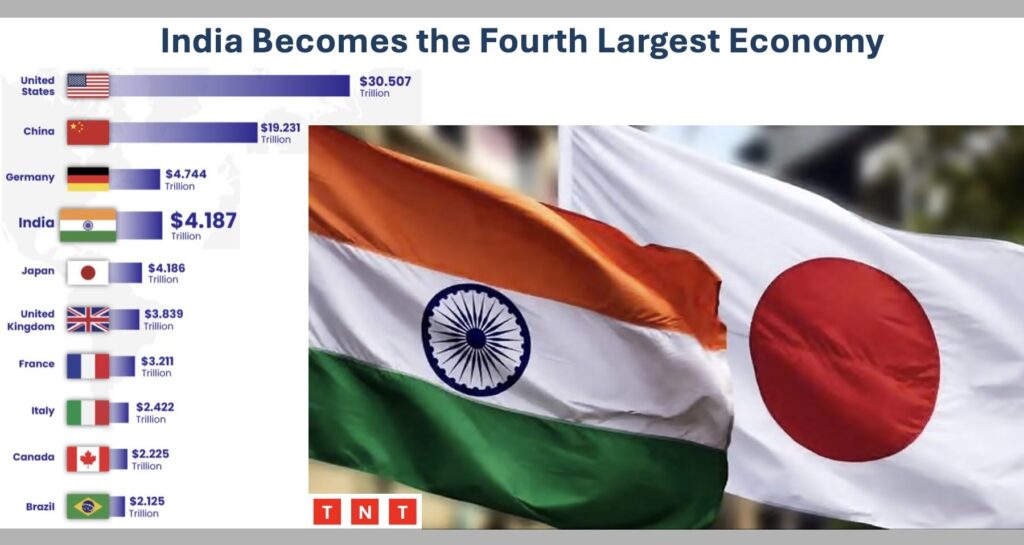
India overtakes Japan economy to claim the position of the fourth-largest economy in the world by nominal GDP, marking a historic shift in global economic rankings. According to the Indian government’s year-end economic review released on December 30, 2025, India’s GDP reached $4.187 trillion, narrowly surpassing Japan’s $4.186 trillion. The slim margin underlines how exchange rates, inflation dynamics, and quarterly output swings now decisively shape global standings.
The development reflects India’s sustained growth momentum. Real GDP expanded by 8.2% during the July–September quarter of FY 2025–26, far ahead of Japan’s 1.5 per cent growth in the same period. A decade ago, Japan’s economy was more than twice the size of India’s. That gap has now decisively closed.
From Projection to Reality: How the Overtake Happened
The overtake came sooner than many global institutions had anticipated. The International Monetary Fund, in its October 2025 World Economic Outlook, had projected India’s nominal GDP at $4.13 trillion, still below Japan’s $4.28 trillion. However, revised domestic estimates, especially in services and manufacturing output, pushed India ahead before the end of the calendar year.
Government officials described the milestone as a defining economic moment. They attributed it to a decade of structural reforms, infrastructure expansion, and policy stability. India had already surpassed the United Kingdom in 2022, a development earlier analysed by TNT in its coverage of shifting global GDP rankings.
Despite the achievement, stark contrasts remain. India’s per capita GDP stands at $2,694 (World Bank, 2024), compared to Japan’s $32,487, highlighting significant disparities in income levels and living standards.
Why Japan Slipped as India Accelerated
Japan’s relative decline in nominal GDP terms has been shaped by long-term structural challenges. An ageing population, stagnant wage growth, and persistent deflationary pressures have constrained expansion. In addition, yen depreciation has reduced Japan’s GDP valuation in dollar terms.
Once the world’s second-largest economy until China overtook it in 2010, Japan now slips to fifth place. Its economy has grown at an average of just 1 per cent annually over the past five years. India, in contrast, benefits from a median age of 28, compared to Japan’s 49, providing a vast labour force and a growing consumer base.
The IMF now estimates India’s real GDP growth at 6.8 per cent for 2025, more than three times the global average of 2.1 per cent.
Domestic Engines Driving India’s Economic Surge
Several domestic factors have powered India’s rise. Structural reforms introduced since 2014, including the Goods and Services Tax, insolvency reforms, and labour law rationalisation, have improved India’s business climate. India’s global ease of doing business ranking rose from 142 to 63 during this period.
Manufacturing and services remain the principal growth engines. According to the Ministry of Statistics and Programme Implementation, exports grew 12 per cent year-on-year, led by electronics, pharmaceuticals, and software services. Private consumption now accounts for nearly 60 per cent of GDP, reinforcing demand-led growth.
Government capital expenditure has played a catalytic role. The 2025 Union Budget allocated $120 billion for infrastructure, railways, and digital connectivity. Over the past decade, cumulative infrastructure investments have crossed $1.5 trillion, modernising supply chains and attracting sustained foreign capital.
India’s Growing Weight in the Global Economy
India’s share of global GDP has doubled from 1.6 per cent in 2000 to 3.4 per cent in 2023. With the latest figures, it now approaches 4 per cent. Foreign direct investment inflows reached $85 billion in 2025, reflecting investor confidence in long-term prospects.
Multinational firms are increasingly viewing India as a supply-chain alternative to China. Companies such as Apple and Tesla have expanded manufacturing and sourcing operations, adding an estimated $50 billion in value chains since 2020. This trend aligns with global diversification strategies highlighted by institutions such as the World Economic Forum.
India’s enhanced economic scale also strengthens its voice in global institutions like the IMF and World Bank, where it is pressing for reforms in voting shares and governance structures.
What Lies Ahead for India’s Economic Trajectory
Looking forward, projections suggest India could overtake Germany, currently at $5.01 trillion, as early as 2026, becoming the world’s third-largest economy. Estimates place India’s GDP at $5.5 trillion by then, provided growth remains near current levels.
However, challenges persist. Nearly 20 per cent of the population remains below the poverty line, and only 5 per cent of the workforce is formally skilled. Private capital stock, at 30 per cent of GDP, lags behind China’s 45 per cent, limiting productivity gains.
Sustaining momentum will require deeper reforms in education, labour mobility, and private investment. Even so, India’s rise marks a decisive rebalancing of global economic power. As 2026 begins, the focus shifts to ensuring that headline growth translates into broad-based prosperity for India’s 1.4 billion citizens.