India–EU Security Pact Signals Strategic Convergence at a Shifting Global Moment
A Security Pact Framed by Global Flux
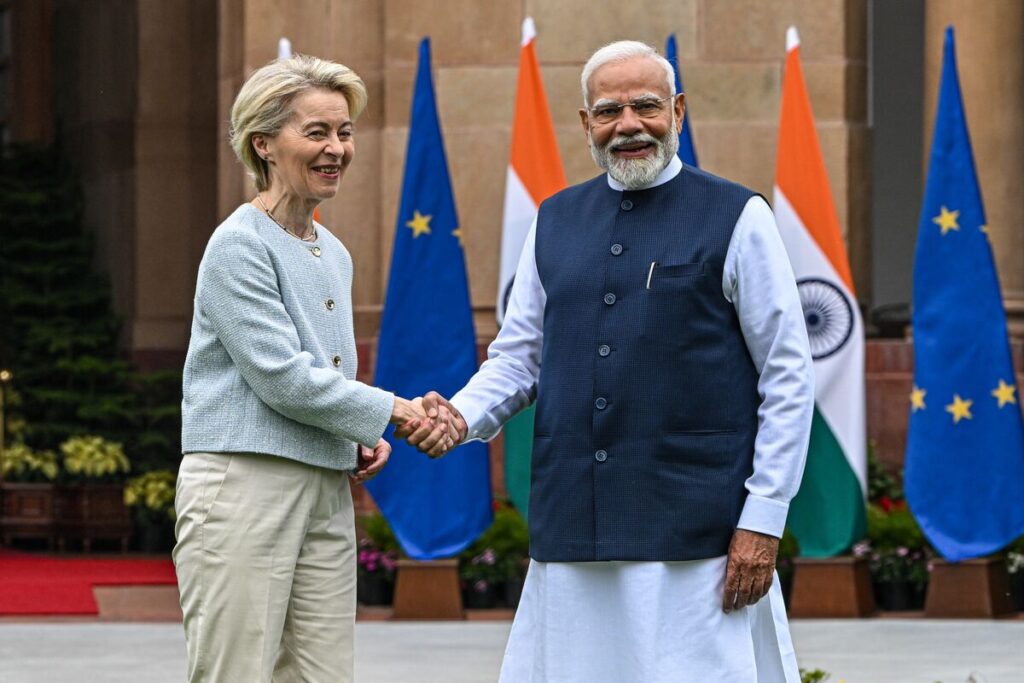
As New Delhi prepares to host the 16th India–EU Summit on January 27, 2026, the forthcoming India EU Security Pact has emerged as the summit’s most consequential deliverable. The agreement, expected to be signed by EU High Representative Kaja Kallas and Indian Defence Minister Rajnath Singh, reflects a strategic recalibration rather than a ceremonial diplomatic exercise.
The timing is not incidental. Global geopolitics is undergoing renewed volatility, shaped by uncertainties in transatlantic politics, prolonged conflict in Europe, and intensifying competition in the Indo-Pacific. Against this backdrop, India and the European Union are signalling intent to move beyond transactional engagement towards structured strategic cooperation.
However, the pact should not be mistaken for immediate establishment of defence manufacturing units, technology transfers, or capital investments by the EU in India. Instead, it establishes an institutional framework designed to enable deeper cooperation over time. This distinction is critical to understanding both its limitations and its strategic value.
From Strategic Dialogue to Institutional Framework
The roots of the India EU Security Pact lie in discussions that began in the early 2020s, when both sides identified overlapping security interests. Momentum gathered pace through EU strategy documents on India and was reinforced by joint leaders’ statements in 2025. This week’s confirmation by EU officials effectively positions the pact as a centrepiece of the upcoming summit.
EU leaders have described the agreement as part of a “powerful new agenda” for bilateral relations. That language reflects an effort to institutionalise cooperation across security domains rather than rely on ad-hoc consultations. The pact also aligns with the EU’s broader push for strategic autonomy and diversification of partnerships beyond the Atlantic framework.
Importantly, this becomes only the third comprehensive security partnership the EU has signed in Asia, following Japan and South Korea. That fact alone underscores India’s elevated standing in European strategic thinking.
What the India EU Security Pact Actually Covers
At its core, the India EU Security Pact focuses on coordination rather than procurement. The framework prioritises cooperation in maritime security, counter-terrorism, cyber defence, hybrid threats, and intelligence sharing. The Indo-Pacific occupies a central place, reflecting shared concerns over sea lane security and freedom of navigation.
The agreement also opens pathways for joint exercises, structured policy dialogue, and collaborative research in security-related technologies. Cyber resilience and hybrid warfare feature prominently, mirroring the EU’s own threat assessments and India’s evolving multi-domain security doctrine.
Notably absent are binding commitments on technology transfer, joint weapons production, or EU-led defence manufacturing in India. Those elements, if they emerge, will do so through subsequent bilateral arrangements with individual EU member states rather than through this bloc-level pact.
Why the Pact Matters for India
For New Delhi, the India EU Security Pact offers strategic diversification rather than immediate material gain. India already maintains defence-centric partnerships with countries such as France, the United States, and Russia. Engagement with the EU adds a multilateral dimension to that portfolio.
The framework positions India as a participant in European security dialogues, particularly on maritime and cyber domains. Over time, this could ease market access for Indian defence exports and facilitate participation in European defence supply chains.
The pact also complements India’s broader economic objectives. EU officials have explicitly linked security cooperation with expanded trade and investment ties. In that sense, the agreement acts as a confidence-building measure ahead of a potential breakthrough in long-stalled Free Trade Agreement negotiations.
European Calculus and Strategic Autonomy
From the European perspective, India represents both a strategic partner and an industrial opportunity. The EU is actively seeking to diversify defence supply chains while reducing over-dependence on a narrow set of partners. India’s manufacturing capacity, technological talent pool, and commitment to multilateralism align with that objective.
Kaja Kallas has framed the pact against the backdrop of a shifting global order. Her remarks during her New Delhi visit pointed to the need for reliable partnerships outside traditional alliances. In this context, India offers geopolitical balance without the constraints of alliance politics.
The partnership also extends beyond defence. Clean energy, innovation, and secure technology supply chains form part of the broader strategic agenda, reinforcing the EU’s interest in long-term engagement.
Beyond the Empty Critique
Sceptics often dismiss framework agreements as diplomatic rhetoric devoid of tangible outcomes. That criticism is not entirely unfounded. However, the India EU Security Pact is embedded within a comprehensive agenda that spans more than 100 areas of cooperation through 2030.
Recent milestones, including the 2025 Leaders’ Statement, suggest continuity rather than episodic engagement. Institutional trust, once established, tends to lower barriers for more concrete cooperation. Defence collaboration, particularly at a multilateral level, rarely begins with factories and contracts. It begins with alignment of threat perceptions and strategic intent.
As one analyst succinctly observed, this is about building the foundations of “guns, technology, and trust”, in that order.
Where the Real (and Tangible) Gains Lie
Gains For India
Market access for Indian defence exports: Europe is increasingly viewing India as a potential supplier. The partnership is expected to expand opportunities for Indian firms (e.g., under Make in India initiatives) to sell military equipment to EU countries and participate in EU defence programmes (like the ~$200 billion Security Action for Europe initiative).
Industrial cooperation boost: It promotes a Defence Industry Forum and dialogue on joint R&D, co-development, and potential future co-production. This could lead to technology partnerships, but these would likely come through bilateral deals with individual EU countries (e.g., France, Germany) rather than the EU bloc as a whole.
Diversification and leverage: Helps India reduce over-reliance on traditional suppliers (Russia/US) by building trust and frameworks for future ToT-heavy deals.
Geopolitical positioning: Strengthens India’s role in global security architecture, especially in the Indo-Pacific, giving it more bargaining power.
Gains For the EU
- Diversifies supply chains away from over-dependence on certain partners.
- Gains a strategic partner in Asia for maritime security and rules-based order issues.
- Access to India’s growing defence manufacturing ecosystem for potential sourcing or collaboration.
FTA Talks and Strategic Linkages
Running parallel to the security pact is renewed momentum on the India–EU Free Trade Agreement. Negotiations stalled for nearly two decades are now closer to resolution, driven by geopolitical imperatives and supply chain realignments.
EU officials view security cooperation as complementary to economic integration. For India, access to European markets carries implications for high-technology sectors, including defence electronics, aerospace components, and advanced manufacturing.
While the FTA remains separate from the security pact, the political signalling at the summit suggests both tracks are mutually reinforcing.
A Signal in a Multipolar World
The India EU Security Pact does not transform the defence landscape overnight. It does not deliver technology transfers or immediate industrial gains. What it does deliver is strategic clarity.
In a world marked by competing power centres and fragile alliances, India and the European Union are signalling convergence based on shared interests rather than dependency. That signal matters, particularly at a time when established global frameworks are under strain.
The New Delhi summit, therefore, is not merely about signing documents. It reflects a calculated alignment between two actors navigating an increasingly multipolar international system with pragmatism rather than rhetoric.