PART – 3: Narratives of Convenience – Selling Suffering and Shaping Shame in the Global Media
From Mahmudiyah to Nirbhaya: Inside the Narrative Game
When we discuss sexual violence and impunity, few Indians can forget Nirbhaya — whose brutal gang rape and murder in December 2012 ignited nationwide protests, overhauled laws, and led to the rare execution of her attackers. Yet, how many of us know about the 2006 Mahmudiyah atrocity in Iraq, where American soldiers committed a similar gang rape and murders? For most, Mahmudiyah’s tragedy remains unseen, buried in the shadows of public memory.
Why bring up Mahmudiyah nearly two decades later? Is it just a defensive ‘whataboutism’ to deflect Western criticism? These are valid questions needing honest answers. This is not to deny India’s ongoing struggle with gender violence — which demands fierce, independent reckoning. The real issue is why stories of suffering and shame are so unevenly told — skewed by global media, Western leaders, and sometimes our own press. Are warnings about safety in India about genuine concern, or part of a larger narrative game? As millions of Indians abroad absorb these stories, we must urgently examine who controls these narratives and the damage they inflict.
Framing India: Western Gaze, Narrative Control, and the Politics of Portrayal Series contains
PART – 1: The BBC and the Origin of Exploitative Documentary Making
PART – 2: Through the Western Lens: Slumdog Millionaire, and the Politics of Media Portrayal
PART – 3: Narratives of Convenience – Selling Suffering and Shaping Shame in the Global Media
PART – 4: BBC’s Fraught Relationship with India – Bans, Documentaries, and Debates
PART – 5: Slums and Shadows – Poverty in the West and Its Sanitised Cinematic Language [Status: In Progress]
PART – 6: Reclaiming the Lens – Toward Narrative Sovereignty and Self
A Forgotten Crime in Mahmudiyah
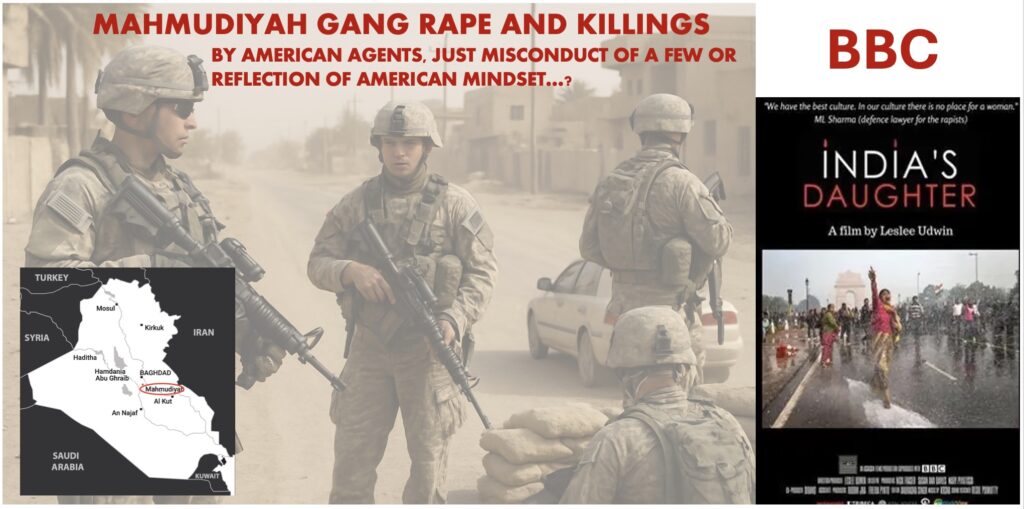
In March 2006, five U.S. soldiers in Iraq brutally gang-raped 14-year-old Abeer Qassim al-Janabi, murdered her and her family — including her 6-year-old sister — and burned her body to hide the crime. Many readers are learning this for the first time. This premeditated atrocity was carried out by state agents armed with weapons and tasked, purportedly, with spreading democracy.
Yet in America — often called the “land of the free,” where the death penalty is more common than in India — none of the perpetrators were executed. Court-martials handed down long prison sentences, but never the death penalty. Western media barely covered the story: no global debates about American morality, no front-page outrage, no campaigns condemning U.S. soldiers or Americans broadly. The crime was framed as an isolated wartime failure, not a reflection of the nation. The Western conscience quickly moved on.
Meanwhile, India and its people faced a very different reality.
Why is this relevant today? Because selective memory shapes not only global perceptions of India but also how Indians see themselves.
In the last decade [2015–2025], India executed only about 5 people (i.e., including 4 accused on Nirbhaya Case), averaging one execution every two years.
In contrast, the United States executed around 250–300 people, averaging 25–30 executions yearly. This highlights that the US carries out the death penalty roughly 50 times more frequently than India.
The Narrative Divide, The Politics of Shame – And Its Casualties
The world’s reaction to Nirbhaya’s 2012 gang rape and the 2015 BBC documentary India’s Daughter were both powerful — but fundamentally different in tone and impact.
When Nirbhaya’s assault hit headlines on December 17, 2012, the focus was on the appalling cruelty of the crime, the culture of impunity for sex offenders, and the groundswell of public outrage — the massive protests and escalating demands for legal reform captured the world’s attention.
Two years later, the BBC’s documentary revisited the tragedy but shifted the narrative. Instead of focusing on the crime, societal response, legal reforms and the death sentence to the accused, it went on to examine the cultural attitude of the Indians that enable such violence – most notably through an unfiltered interview with convicted rapist Mukesh Singh. His shocking, unapologetic and misogynistic statements were presented as emblematic of Indian society — turning a horrific crime into a sweeping indictment of the entire Indian culture itself.
Although banned in India, the film aired internationally despite government protests. Global media quickly embraced its narrative, spawning op-eds and panel discussions that generalized its grim portrayal.
A young Indian studying abroad, after watching the film, posted on her social media:
“I feel ashamed… I feel no patriotism for the country I love. I’m scared to return to a place where rape is seen as a ‘lesson.’ I feel violated, angry, and sad. When will we get the justice, we should never have had to demand?”
Her feelings were genuine — reflecting the fear and shame many young Indians, especially abroad, felt after seeing India’s Daughter.
The Nirbhaya case was deeply shocking worldwide. For a young woman already aware of gender issues and exposed to intense media coverage of the crime, followed by the unrepentant words of the convicted rapist in India’s Daughter, the natural reaction was fear, shame, and anger. Yet this shame stemmed less from facts and more from the narratives shaped by Western media.
What many didn’t realize was that India’s Daughter wasn’t simply recounting a single crime. It let the rapist’s voice stand in for the mindset of a whole nation, overlooking the massive public outrage, swift legal reforms, and the decision to execute the perpetrators. It omitted the voices of millions who demanded justice, those who faced water cannons, tear gas, and police brutality in Delhi’s streets.
Let’s unpack this — by examining how India’s Daughter shaped media narratives that sway public perception and individual feelings.
If she had watched an equally raw documentary about the Mahmudiyah Gang Rape, the Brock Turner Rape Case, Epstein’s Trafficking Ring or Peña – Ertman Case, would she feel the same about the United States?
Likely not — because those incidents are not narrated and framed as indicative of American society at large.
Emotional Reactions Are Real — But Framed
The emotional responses triggered by India’s Daughter — ranging from outrage to shame — were genuine and valid, yet a direct consequence of how the story was framed. The film ignored the fact that this crime was among the “rarest of the rare” in Indian law. It overlooked the massive protests, swift legal reforms, and death sentences handed down by a fast-track court — outcomes rarely achieved even in the West for similar crimes.
Instead, the film gave disproportionate space to a convicted rapist’s unapologetic words, allowing his mindset to be interpreted as representative of Indian society at large. The absence of balancing voices — those of protestors, reformers, or even legal experts — made the narrative not just incomplete, but misleading.
What The Film Left Out — And Why It Matters
Overlooking these legal milestones is to erase India’s democratic and judicial response. BBC’s documentary India’s Daughter was released in March 2015, more than two years after the crime, and nearly a year after the Delhi High Court upheld lower court’s death sentences for the convicts.
By then, this was no longer an evolving story about a recent crime, but it was a concluded legal chapter — a fact the film should have emphasized. Instead, it amplified the rapist’s voice as if it represented an entire society, causing international audiences to mistake one criminal’s mindset for the nation.
This begs the question: Was the film meant to inform or to indict? When Western media selectively curate facts, they do more than sway opinions — they embed lasting perceptions, especially among global and diasporic audiences. The result is a moral imbalance: shame is deeply felt in one part of the world, while others rationalize or ignore similar issues.
Yes, BBC succeeded — not just in telling a story, but in reframing a nation. It made the world, and even Indians, internalize shame without balance.
A Case in Contrast: Mahmudiyah, Iraq
Consider the 2006 Mahmudiyah rapes and murders by U.S. soldiers in Iraq. This wasn’t a crime of opportunity or chaos — it was premeditated. Soldiers planned for days to assault a 14-year-old girl, kill her entire family, and burn her body to cover their tracks. These were trained military personnel acting as agents of the state.
Despite this brutality — also “rarest of the rare” — not one perpetrator was executed, even though the U.S. frequently uses the death penalty, more so than India. Crucially, the narrative was shielded: there was no major documentary, no BBC or Netflix exposé, no global outrage demanding American moral reckoning. Mahmudiyah never became shorthand for American cultural decay.
If this had happened in India — say, in Kashmir or Manipur — global condemnation would be swift and fierce. India’s institutions, culture, and human rights record would face relentless scrutiny, and its armed forces would be grilled on every major platform.
At the time of the Mahmudiyah crimes, Leslee Udwin was nearly 50 — an accomplished producer of award-winning films like East is East. She had the professional network, global reach, and the means and drive, and as a champion of human rights, she possessed the moral agency to highlight the heinous crime.
Nearly a decade later, she directed India’s Daughter, a documentary on the 2012 Delhi gang rape case, interviewing convicted rapists in Tihar Jail, and earning global acclaim for portrayal of Indian society’s mindset to sexual violence.
But Mahmudiyah crimes remained untouched – absent from the screen, absent from the awards, absent from the radars of so-called human rights activists of the West, and absent from public conversations,
Why was there never Iraq’s Daughter made for the world to assess the Americans (rapists)?
The hard truth is that India’s Daughter was never neutral; it was Udwin’s chosen story, her framing, designed to spotlight Indian shame while leaving Western crimes like Abeer’s horrific fate shrouded in silence. If Udwin could boldly walk into Tihar Jail to confront convicted rapists, why not turn her camera toward the war crimes within her own sphere? The choice to internationalise Indian horror while ignoring Western atrocity is a silence as damning as the crimes themselves.
If the objective is truly to battle gender violence, we must ask: why did Udwin’s lens only choose to focus in one direction?”
Crime Is Universal — Narratives Are Not
All societies struggle with gender violence. The difference is how crimes are framed and amplified.
India — vast and complex — is often boiled down to caricatures of a broken society. Meanwhile, similar or worse crimes in Western countries are portrayed as isolated tragedies, not reflections of a cultural flaw.
This selective framing upholds civilizational hierarchies. India is expected to wear its worst episodes as national identity, while the West preserves the privilege of exception. The West claims to lead women’s rights advocacy even as its own crimes receive scant scrutiny.
Who Owns the Narrative?
Millions of Indians — at home and abroad — absorb international portrayals tinged with shame. But this shame isn’t always fact-based; it’s shaped by framing. Feelings like “I feel ashamed” or “I feel no patriotism” aren’t character flaws — they reveal how global media, like the BBC, can colonize the moral imagination of educated, mobile youth.
For many, love for India coexists with anxiety fueled by curated content designed more to indict than to reform. This creates an identity crisis not shaped by lived reality, but by what the world highlights — and ignores.
That demands urgent questions:
- How is global storytelling constructed?
- Whom does it serve?
- Who is the real beneficiary—monetarily or otherwise?
- What scars does it leave?
From Outrage to Opportunity
The question about India’s Daughter isn’t just why it was made — but who benefited. Was it a narrative strategically pushed by Western media, especially the BBC? Or was it mainly filmmaker Leslee Udwin’s pursuit of recognition and reward? Either way, the film was less a moral reckoning and more a calculated media opportunity.
When Udwin and the BBC released the documentary in March 2015, India had already experienced a seismic shift: massive protests, broad legal reforms, and the conviction and sentencing of the attackers. The legal chapter was closed, but emotions still ran high. The producers knew that anything associated with the name “Nirbhaya” would guarantee maximum visibility.
The stage was set. Udwin and the BBC recognized a perfect storm: a hurting nation of over 1.2 billion, global hunger for stories of gender violence in the Global South, and a narrative guaranteed instant attention, awards, and controversy. This wasn’t journalism seeking justice — it was content crafted for global consumption.
And it delivered: fame, high viewership, and international acclaim. Udwin received numerous awards. India, meanwhile, was left with a lingering stain — a distorted global image that served Western interests more than India’s reality.
Conclusion: Justice Needs Balance — In Courts and Cameras
Recent U.S. travel advisories, echoing statements from leaders like Trump, have once again portrayed India as particularly unsafe for foreigners — warnings influenced as much by old stereotypes as by recent headlines. These advisories carry a psychological weight that must be challenged — by holding up a mirror. We need to reflect not only on our own flaws but also on the world’s tendency to forget.
The Nirbhaya tragedy was neither the first nor the last instance of brutal sexual violence in India. But the issue isn’t about whether a crime is brutal or not — any act of sexual violence against women is a fundamental violation. The struggle for women’s safety is ongoing, and it is not unique to India.
Similar atrocities have happened worldwide: from Abeer Qassim al-Janabi in Iraq to Anita Cobby in Australia; Junko Furuta in Japan; Peña and Ertman in the United States; and the Grooming Gangs scandal in the UK, where about 1,400 girls aged 10–16 were abused between 1980 and 2013. Yet, the BBC, Udwin, and much of Western media have not shown the same moral passion exposing the misogyny behind these crimes as they did with India’s Daughter.
Only certain stories get to define a nation’s character. Only some receive global condemnation. This asymmetry isn’t accidental — it’s editorial. And editorial imbalance, by nature, will never solve the problems it highlights.
India, unlike many nations, has shown it can protest, reform, and ensure justice. What India now needs is narrative sovereignty — the right to be recognized not only for its flaws but also its resistance and progress. Not to deny pain, but to reject distortion. And to demand the world view India with the same fairness, balance, and accountability expected of itself.