PART – 2: Through the Western Lens: Slumdog Millionaire, and the Politics of Media Portrayal
Between Applause and Unease - Witnessing a Misunderstood India in a Foreign Theatre
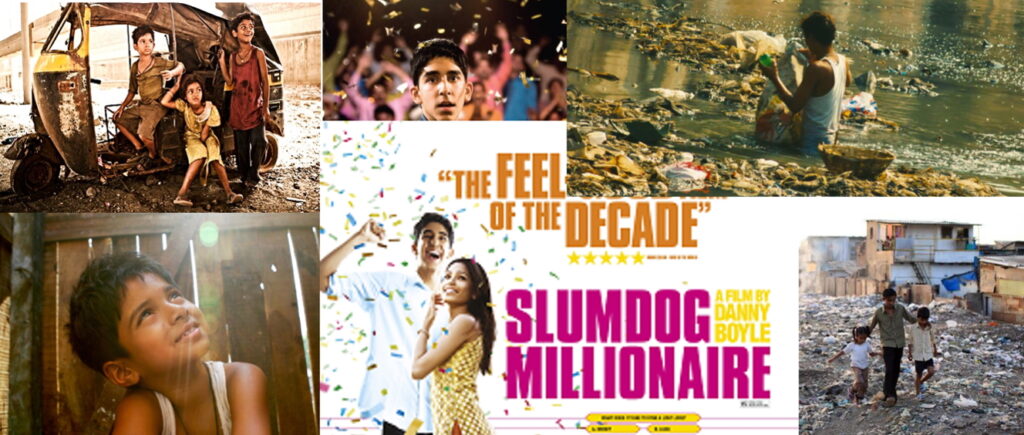
When Slumdog Millionaire swept the 2009 Academy Awards — winning eight Oscars, including Best Picture and Best Director — I happened to be in Malaysia, watching the film with friends from that part of the world. Yes, we all enjoyed the film. But as an Indian, I couldn’t shake off a lingering question: “Is this how the world sees us? A child diving into excreta, chasing a mirage?”
What kind of impression, I wondered, would my friends now carry about India?
The Western world applauded what it saw as an uplifting rags-to-riches fairy tale set in the heart of Mumbai’s slums. But for many Indians like me, the film — especially the infamous scene of a child plunging into a pit of excreta — did not evoke pride. Instead, it stirred deep discomfort: a sense of being paraded, pitied and ultimately misunderstood on the global stage.
The film’s success laid bare an uncomfortable truth: that global cinema — especially from Western creators — often chooses to portray India not as it is, but as it is useful to them: a symbol of exotic misery.
The Oscar sweep was not just a celebration of cinematic merits; it was also a reaffirmation of a familiar Western narrative — one that flattens India into a backdrop for someone else’s moral triumph.
Framing India: Western Gaze, Narrative Control, and the Politics of Portrayal Series contains
PART – 1: The BBC and the Origin of Exploitative Documentary Making
PART – 2: Through the Western Lens: Slumdog Millionaire, and the Politics of Media Portrayal
PART – 3: Narratives of Convenience – Selling Suffering and Shaping Shame in the Global Media
PART – 4: BBC’s Fraught Relationship with India – Bans, Documentaries, and Debates
PART – 5: Slums and Shadows – Poverty in the West and Its Sanitised Cinematic Language [Status: In Progress]
PART – 6: Reclaiming the Lens – Toward Narrative Sovereignty and Self
The Scene That Crossed the Line
In the now-notorious scene, a young boy jumps into a pit filled with human faeces just to obtain a film star’s autograph. While the film is based on the novel ‘Q & A’ by Indian author Vikas Swarup — which does explore hard-hitting social themes such as poverty, crime, and child exploitation — this particular scene does not appear in the book. It was created specifically for the film adaptation, seemingly to cater to Western sensibilities, and is widely credited to screenwriter Simon Beaufoy and director Danny Boyle, both British.
Defenders of the film may argue that the scene symbolizes innocence, obsession, or determination. But the visceral image of a brown child, gleefully covered in filth and framed with cinematic flourish, was not art. For many Indians, it felt like a symbolic violation of human dignity.
There are countless other ways to portray innocence, obsession, or determination. This was not an honest depiction of hardship — it was humiliation masquerading as storytelling. It was not bravery — it was degradation. And it raised a troubling question:
Would a Western child ever be shown in such a demeaning situation in a major studio production?
The answer, conspicuously, is ‘no, never.’
Poverty as Spectacle, Not Reality
The critique of Slumdog Millionaire is not that it depicted poverty — poverty exists and deserves honest representation. The issue lies in how it was depicted: without nuance, without agency, and without the context of resilience and community that defines slum life far more than filth and crime. The film reduced the complexities of Mumbai’s working-class neighbourhoods to a sequence of grotesque visual clichés — exploitation, violence, child mutilation, and excreta — all wrapped in fast-paced editing and rousing music designed to make suffering palatable for foreign audiences.
As many Indian critics rightly observed, it was ‘poverty porn‘ — a sensationalised package crafted not to inform, but to evoke pity, to titillate, and, most insidiously, to reinforce Western preconceptions of the “Third World.”
That, ultimately, is how it won the Oscars.
Narrative Colonialism: The Hidden Agenda
Let us not pretend this is a new phenomenon. From the early days of colonial ethnography to modern BBC documentaries and now Oscar-winning films, there exists a consistent narrative thread: portray India as dirty, chaotic, and tragically beautiful — always in need of help, always a subject to be filmed, never a narrator of its own story.
The director of Slumdog Millionaire, Danny Boyle, is a British filmmaker. The script was based on an Indian author’s novel, yet the creative control and cinematic gaze remained Western. Coincidence? Hardly. This film fits perfectly into a lineage of visual propaganda that stretches back decades — a form of narrative colonialism, where the Western world gets to tell our stories, through their lenses, for their audiences, with little regard for how these portrayals affect the people and places involved.
And the timing, too, invites scrutiny. At a time when India was emerging as a global economic force, poised to challenge old hierarchies, this film conveniently reminded the world of India’s “real” face — its dirt, its depravity, its desperation.
Where Are Their Slums?
Slums exist in London, New York, Paris, and Los Angeles – Skid Row in LA, council estates in London, the South Bronx in New York. Yet these are never depicted with the same theatrical misery that defines portrayals of Indian slums. Western poverty is often reframed in narratives of struggle, redemption, or systemic critique. Indian poverty, by contrast, becomes a canvas of revulsion and pity – sanitized of dignity and context.
Moreover, the language itself is telling. Western media avoids terms like “slum” when discussing their own urban squalor. Instead, they use euphemisms: “inner city,” “projects,” “tent encampments.” In contrast, Indian communities are labelled unambiguously – and with implied inferiority.
What the West Rewards, and What It Ignores
That Slumdog Millionaire was lauded at nearly every major Western film award show while simultaneously sparking protests in Mumbai is revealing. Western institutions seem to reward films that affirm their worldview: that the developing world is tragic, backward, and occasionally beautiful in its suffering. Stories of Indian innovation, intellect, resilience, or spirituality rarely receive similar acclaim – unless, of course, filtered through Western eyes.
As writer Arundhati Roy once observed, the poor in India are not merely suffering – they are made to suffer in narratives, so that others may applaud their perseverance. This isn’t just misrepresentation. It’s exploitation.
Conclusion: Cinema as Cultural Weaponry
The international success of Slumdog Millionaire was not a cinematic accident—it was a strategic confirmation of narrative expectations. It reaffirmed, for Western audiences and institutions, that India is still the land of human squalor and magical suffering. That a British director helmed it, that Hollywood awarded it, and that its most degrading scenes became its most memorable ones—these are not coincidences. They are symptoms of a deeply embedded narrative economy, where power lies not just in what is shown, but in who gets to do the showing.
As we continue to challenge the media constructions imposed upon India, Slumdog Millionaire must be recognised not as an isolated insult, but as part of a coordinated aesthetic—one that reinforces India’s place in the global imagination not as a leader or equal, but as a backdrop for others’ validation.
It’s time to reclaim the lens…!