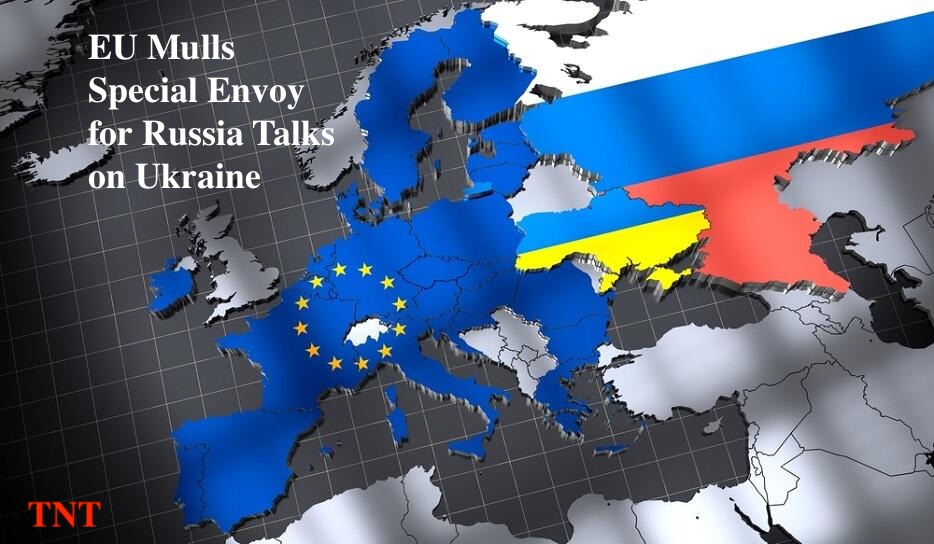
EU Mulls Special Envoy for Russia Talks on Ukraine
European Union capitals are increasingly backing a renewed push to re-engage Russia on a potential Ukraine settlement. EU Russia Ukraine talk gains traction amid growing concern that Europe is being sidelined from key diplomatic efforts. According to Politico, discussions have revived around appointing a special EU envoy to engage Moscow alongside Kyiv, ensuring that European security interests are not marginalised as US–Russia talks proceed without formal EU participation.
The initiative is being driven primarily by French President Emmanuel Macron and Italian Prime Minister Giorgia Meloni. Both leaders argue that Europe must have a direct voice in negotiations shaping the continent’s long-term security architecture. European Commission spokesperson Paula Pinho acknowledged that dialogue with Russian President Vladimir Putin would eventually be unavoidable, although she stressed that the timing was not yet appropriate.
Macron and Meloni Drive Renewed Momentum on EU Russia Ukraine Talk
Macron has repeatedly warned that US-led diplomatic formats, particularly those involving former President Donald Trump’s envoys, risk excluding European perspectives on issues that directly affect EU security. He has described Europe’s current absence from core discussions as strategically “suboptimal,” especially given the war’s impact on NATO, EU borders, and long-term defence planning.
Italian Prime Minister Giorgia Meloni echoed this position during her New Year press conference. She argued that a unified European envoy would prevent fragmented national initiatives and reduce the risk of uncoordinated outreach to Moscow. Meloni stressed that any engagement should strengthen Europe’s collective position rather than weaken it.
French officials have privately noted a growing acceptance across EU capitals that isolation alone has failed to deliver results. This shift mirrors comments from Russian Foreign Minister Sergey Lavrov, who has stated that Moscow remains open to dialogue with “polite” and respectful counterparts.
Debate Over the Role and Mandate of an EU Envoy
The proposal to appoint a special envoy is not new. It was first raised at a March 2025 European summit but failed to gain consensus at the time. With diplomatic dynamics now shifting, the idea has resurfaced with renewed urgency.
The envoy could operate either as a formal EU representative or as part of a broader “coalition of the willing,” potentially including non-EU partners such as the United Kingdom. Italy has floated former Prime Minister Mario Draghi as a potential candidate, citing his economic credibility and international standing. Finland’s President Alexander Stubb has also been mentioned, given his experience managing relations with Russia and his perceived rapport with Trump.
EU foreign policy chief Kaja Kallas is viewed as a strong advocate for Ukraine, though some capitals question whether her stance would allow for flexible engagement. Critical details, including the envoy’s rank, reporting lines, and mandate, remain unresolved. Critics warn that premature engagement could risk legitimising Moscow without tangible concessions.
Strategic Anxiety Over Europe’s Marginalisation
European officials are increasingly uneasy about being excluded from talks led by Trump’s envoy Steve Witkoff, whose efforts have reportedly stalled. There is concern that Europe’s core red lines, including Ukraine’s long-term security guarantees and its NATO aspirations, could be diluted without EU representation at the table.
Macron has argued that Europe cannot afford to be a passive observer in negotiations determining the endgame of the four-year conflict. At the same time, Russia has signalled that it would only engage under conditions of diplomatic decorum, a position reiterated by both President Putin and Foreign Minister Lavrov.
The EU’s evolving stance reflects a significant recalibration. While sanctions and diplomatic isolation have defined policy since 2022, Brussels is now weighing controlled engagement as a means to assert influence, manage escalation risks, and safeguard European security interests.