Delhi Excise Policy Corruption Case: Court Discharge Kejriwal and Sisodia, Rebukes CBI
Delhi Excise Policy Case Verdict Sends Strong Message
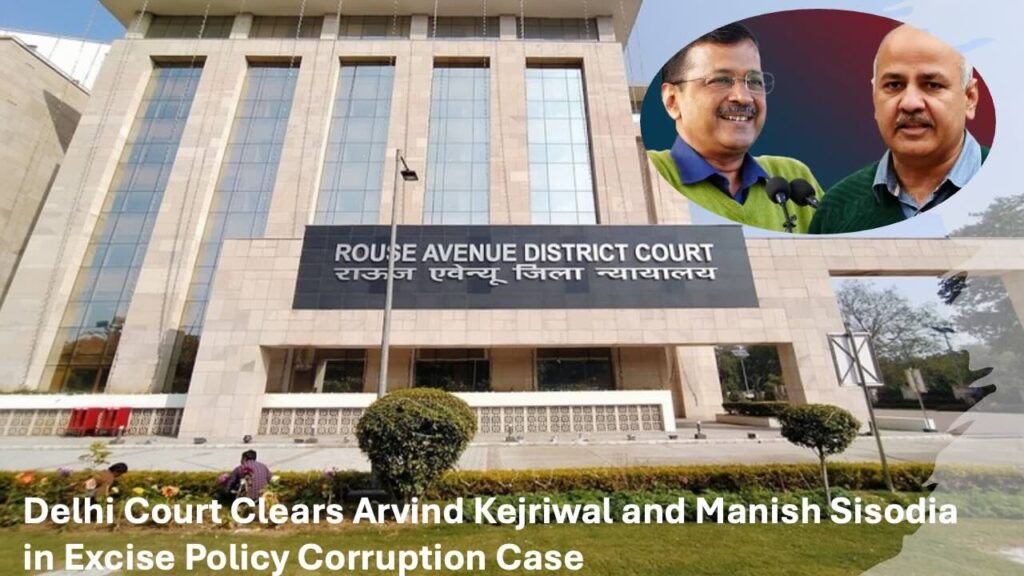
New Delhi, February 27, 2026 – In a major legal and political development, a Delhi court has discharged all 23 accused in the high-profile Delhi excise policy case, including former Chief Minister Arvind Kejriwal and former Deputy Chief Minister Manish Sisodia.
The ruling was delivered by Special Judge Jitender Singh at the Rouse Avenue Courts. The court refused to take cognisance of the chargesheet filed by the Central Bureau of Investigation, citing serious procedural and evidentiary lapses.
As a result, the decision marks a decisive moment in the long-running Delhi liquor policy case. It also represents a major relief for leaders of the Aam Aadmi Party, who have faced sustained political and legal scrutiny since 2022.
Origins of the Delhi Liquor Policy Controversy
The Delhi excise policy for 2021–22 was introduced in November 2021. The stated objective was to modernise the liquor trade by shifting from government-run outlets to private licensing. The policy aimed to improve transparency, boost revenue, and curb illegal practices.
Initially, the reform received cautious approval. However, allegations soon surfaced regarding cartelisation, selective benefits, and kickbacks to private operators. Critics alleged that certain business groups had gained undue advantages during licensing.
By July 2022, mounting pressure forced the Delhi government to withdraw the policy. Subsequently, the Lieutenant Governor recommended a CBI investigation, which led to the registration of an FIR and a comprehensive probe.
CBI Investigation and Chargesheet Under Judicial Scrutiny
Following the FIR, the CBI launched a large-scale investigation. The agency questioned dozens of officials, businessmen, and political figures. It also filed a voluminous chargesheet running into thousands of pages.
However, during preliminary hearings, the court found major weaknesses in the prosecution’s case. Judge Singh described the chargesheet as containing “lacunae”, “misleading averments”, and “internal contradictions”.
The court observed that the prosecution failed to establish a coherent conspiracy. In addition, witness statements did not corroborate core allegations. Financial trails also remained inconclusive.
As a result, the judge concluded that the material on record did not justify criminal proceedings.
Court’s Observations on Kejriwal and Sisodia
In its detailed order, the court examined the roles attributed to Kejriwal and Sisodia. The prosecution had portrayed Sisodia as the principal architect of the policy and Kejriwal as the political authority behind it.
However, the court rejected these claims.
Regarding Sisodia, the judge noted:
- No direct evidence of illegal gratification
- No recoveries linked to corruption
- No corroborated witness testimony
Similarly, in Kejriwal’s case, the court held that allegations against a constitutional authority must rest on solid material. Speculation and inference, it ruled, cannot substitute evidence.
The court also clarified that administrative deliberations appeared routine. There was no proof of criminal intent or collusion.
Key Timeline of the Delhi Excise Policy Case
- November 2021 – New excise policy introduced
- July 2022 – Policy withdrawn; CBI probe begins
- February 2023 – Sisodia arrested
- March 2024 – Kejriwal detained
- February 2026 – All accused discharged
This timeline highlights how the controversy unfolded over nearly four years, involving prolonged investigations and repeated court proceedings.
Parallel ED Probe and Supreme Court Proceedings
Alongside the CBI case, the Enforcement Directorate initiated a money laundering probe under the Prevention of Money Laundering Act. Several accused were subjected to custodial interrogations.
Multiple bail petitions reached the Supreme Court of India, where interim relief and procedural directions were issued from time to time.
Although the present ruling concerns the CBI case, parallel ED proceedings may continue. However, legal experts believe that the discharge weakens the foundation of related prosecutions.
Political Reactions Across Party Lines
The verdict triggered strong political reactions nationwide.
Kejriwal, addressing the media, became emotional. He stated that the judgment restored his dignity and affirmed his commitment to honesty. He described the ruling as proof that truth ultimately prevails.
Sisodia called the decision a victory for democratic values. He thanked supporters who stood by him during his imprisonment.
Leaders of AAP termed the case a “politically motivated witch hunt”. They accused the central government of misusing investigative agencies.
Opposition parties, including the Congress, echoed concerns about selective targeting. Meanwhile, spokespersons of the Bharatiya Janata Party maintained that legal remedies remained open.
On social media platform X, the ruling trended for several hours, with journalists and commentators analysing its wider implications.
Implications for Law Enforcement and Federal Politics
The judgment has significant institutional implications. It reinforces the principle that criminal prosecutions must rest on verifiable evidence rather than political narratives.
Legal analysts suggest that investigative agencies may now face stricter judicial scrutiny. Arbitrary arrests and weak chargesheets could attract stronger judicial rebuke.
Politically, the verdict strengthens AAP’s claim of being unfairly targeted. It may also influence future electoral narratives in Delhi and beyond.
At the same time, it raises broader questions about federal balance, institutional autonomy, and accountability mechanisms.
What Lies Ahead for the CBI and the Accused
The CBI is expected to examine the order closely before deciding on an appeal. However, given the detailed reasoning, legal experts believe that overturning the ruling may prove difficult.
For Kejriwal and Sisodia, the discharge offers an opportunity to rebuild their political standing. Nevertheless, the shadow of past investigations may continue to shape public discourse.
As Delhi’s governance landscape evolves, the Delhi excise policy case stands as a reminder of the delicate line between accountability and political contestation.
The episode also underscores the judiciary’s central role in safeguarding due process within India’s democratic framework.