Highlights from Davos 2026: A World in Flux
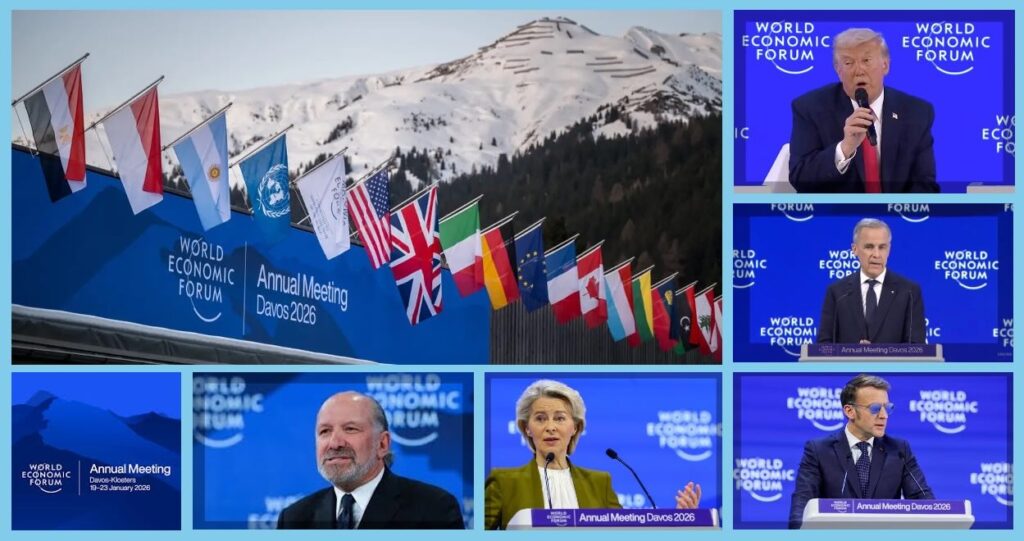
The Davos 2026 highlights underscored a world grappling with fractured alliances, economic uncertainty, and disruptive technological acceleration. The World Economic Forum’s Annual Meeting, held in Davos, Switzerland, from January 19 to 23, unfolded under the theme “A Spirit of Dialogue”—a phrase that contrasted sharply with the tense global mood.
Nearly 3,000 participants attended the gathering, including more than 400 political leaders, 65 heads of state or government, and around 850 chief executives from the world’s largest companies. Discussions focused on geopolitical instability, economic reinvention, and the urgent challenge of governing artificial intelligence. From energy diplomacy to defence autonomy and AI ethics, Davos 2026 reflected a global order in visible transition.
Geopolitics — Navigating Alliances, Conflicts and Power Shifts
Defence Dependence and European Autonomy
Geopolitics dominated the early days of Davos, with leaders openly questioning long-standing security arrangements. Finnish President Alexander Stubb sparked debate when he said, “We can’t even use our F-35s without America’s permission.” His remarks exposed export-control constraints that affect NATO allies, especially newer members like Finland.
Stubb later added that Europe could defend itself without American forces, while still valuing transatlantic cooperation. He pointed to more than €50 billion in EU defence investments since 2022. According to him, integration rather than isolation must define Europe’s security future.
United States, Arctic Interests and Alliance Reset Signals
U.S. President Donald Trump addressed the forum with a transactional tone. He ruled out military action over Greenland, stating, “Negotiations only.” However, he reaffirmed America’s strategic interest in the Arctic and signalled further renegotiation of NATO burden-sharing.
Trump highlighted U.S. energy exports as geopolitical leverage. His remarks reinforced the idea that economic power and security commitments would remain closely linked under Washington’s foreign policy approach.
Multilateralism Versus Unilateral Power
French President Emmanuel Macron struck a contrasting note. “We prefer respect to bullies and rule of law over brutality,” he said, criticising unilateral actions in Ukraine and other conflict zones. Macron urged stronger multilateral institutions and proposed a European Sovereignty Fund to protect strategic industries.
He warned that the world was drifting towards a rules-free order. Therefore, unity among democratic states was essential, particularly in defence and advanced technology projects such as the Future Combat Air System.
Global Voices and Conflict Fatigue
Canadian Prime Minister Mark Carney described the current phase as “a rupture, not a transition.” He argued that the old global order had already collapsed. As a result, alliances must adapt to de-globalisation and Indo-Pacific realities.
EU Commission President Ursula von der Leyen emphasised dialogue while announcing progress on the EU–INC single entity framework for founders. She linked innovation policy with cyber defence and confirmed EU support for Ukraine exceeding €100 billion.
Chinese Vice-Premier He Lifeng rejected unilateralism, urging nations to “board the giant ship of globalisation together.” He defended inclusive growth models, including the Belt and Road Initiative.
Argentine President Javier Milei called for a return to Western liberal values. He promoted deregulation and criticised state-heavy economic models across the Americas.
A Rare Diplomatic Opening
One unexpected outcome was the signing of a “Board of Peace” pact focused on Gaza reconstruction. Leaders, including Pakistan’s Prime Minister Shehbaz Sharif, supported humanitarian corridors and ceasefire monitoring. While limited in scope, the move reflected growing global fatigue with prolonged conflicts.
Trade, Business and the Global Economy
Protectionism Versus Open Markets
Economic debates at Davos 2026 highlighted growing tensions between protectionism and inclusive growth. U.S. Commerce Secretary Howard Lutnick stated bluntly, “Globalisation has failed the West.” He outlined tariff measures, expanded CHIPS Act incentives, and domestic manufacturing support to reverse job losses.
However, critics warned that aggressive reshoring could fragment global supply chains further.
Trade Ruptures and Climate-Linked Finance
Mark Carney argued that broken trade systems required diversification rather than decoupling. He stressed partnerships in critical minerals for electric vehicles and renewable energy. In addition, he linked climate goals with reforms in net-zero financing.
Macron called for safeguards against dumping while highlighting France’s hydrogen investments. He supported structured EU-China dialogue to maintain fair competition in solar and electric vehicle markets.
European Competitiveness and Innovation
Von der Leyen expanded on the EU–INC initiative, designed to simplify cross-border operations for startups. She said regulatory fragmentation hurt Europe’s competitiveness. Therefore, talent mobility and innovation funding were now priorities.
Alexander Stubb returned to the theme of technological dependence, advocating Nordic cybersecurity investment as an economic resilience tool.
Emerging Market Perspectives
He Lifeng rejected protectionism and promoted the Digital Silk Road. He highlighted green-technology investments, including battery recycling, as stabilising forces in global trade.
Milei linked economic liberty with deregulation. He criticised agricultural trade barriers and argued that open markets were essential for global food security.
Across panels, speakers called for WTO reform, Scope 3 emissions reductions, and responsible capital deployment. Investor commitments towards sustainable finance neared the $1 trillion mark.
Technology and Innovation — Scaling AI Amid Power Plays
AI as the Defining Global Competition
Technology emerged as one of the strongest Davos 2026 highlights, with artificial intelligence dominating discussions. Sessions such as “AI Power Play, No Referees” and “Scaling AI: Now Comes the Hard Part” explored infrastructure gaps, governance failures, and ethical dilemmas.
Donald Trump linked AI leadership directly to energy capacity. “We needed more than double the energy currently in the country just to take care of the AI plants,” he said. He proposed fast-tracking nuclear approvals for data centres within weeks.
Industry Leaders on AI Deployment
Microsoft CEO Satya Nadella urged restraint and practicality. “Do something useful,” he said, warning that AI adoption remained uneven due to capital and infrastructure disparities.
NVIDIA CEO Jensen Huang encouraged Europe to act quickly. According to him, AI-driven manufacturing offered a chance to leapfrog legacy systems. Early infrastructure investment, he said, would define competitiveness.
Jobs, Ethics and Governance Challenges
Demis Hassabis of Google DeepMind and Dario Amodei of Anthropic acknowledged early labour market impacts. Entry-level coding and internships already faced disruption. Therefore, rapid upskilling was critical.
In ethics-focused sessions, speakers including Max Tegmark, Meredith Whittaker, and Rachel Botsman debated accountability, AI personhood, and governance frameworks. They stressed that unchecked systems could deepen inequality.
Brad Smith of Microsoft and IMF chief Kristalina Georgieva warned of a “race without rules.” Estimates suggested that AI could transform or disrupt up to 40% of jobs globally.
Beyond AI: Quantum and Data Foundations
Broader technology discussions included quantum computing, with the EU announcing investments nearing €20 billion. Speakers highlighted agentic AI in healthcare and commerce. Many stressed that data foundations, not just GPUs, would shape long-term progress.
Calls for inclusive AI adoption echoed throughout Davos. Without it, leaders warned, technology could widen global divides rather than close them.
As Davos 2026 concluded, the limits of dialogue became clear. Power dependencies persist, trade systems strain under protectionism, and artificial intelligence accelerates faster than governance structures. Yet, the conversations also reflected urgency. Whether through defence autonomy, economic reform, or responsible innovation, global leaders acknowledged that adaptation is no longer optional. Tattvam News Today will continue tracking these shifts as the world navigates its next uncertain chapter.