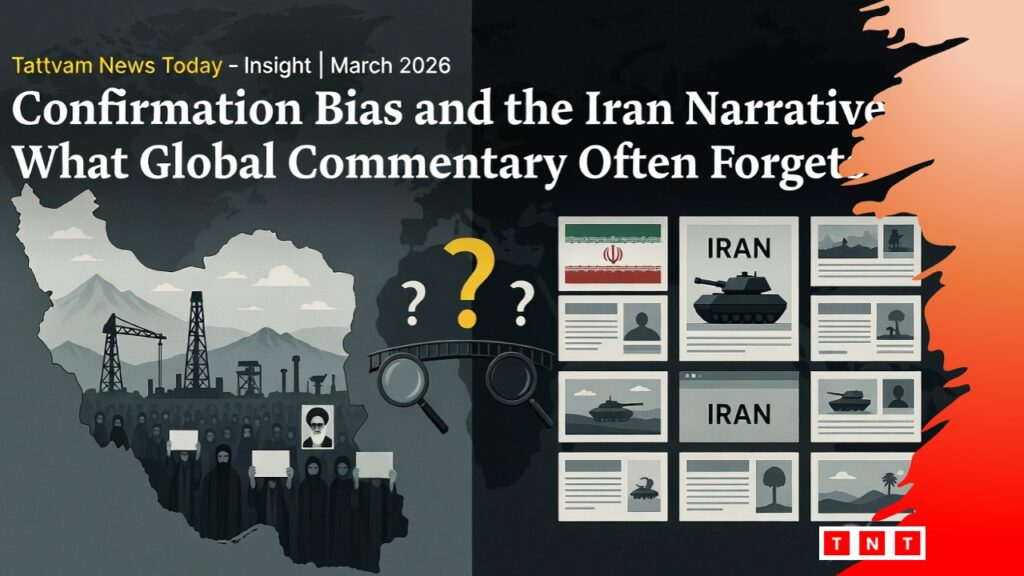
Confirmation Bias and Iran: What Global Narratives Often Ignore
15 March 2026 | Delhi
Public opinion about Iran is rarely formed in a vacuum. It is shaped by media narratives, social media posts, political interests, and psychological tendencies that influence how societies interpret global events.
One of the most powerful of these tendencies is confirmation bias—a concept in psychology that describes the human inclination to search for, interpret, and recall information in ways that reinforce pre-existing beliefs while disregarding contradictory evidence. Often operating subconsciously, it leads people to highlight facts that support their assumptions and overlook those that challenge them.
When applied to geopolitics, this bias frequently produces simplified narratives. If a country is already perceived as an adversary, its actions are interpreted as proof of hostility. When an ally behaves in similar ways, the same actions are reframed as strategy, security, or necessity.
Iran has long been caught in this interpretive divide.
For many observers in the West, the country is portrayed almost exclusively as a rigid theocracy ruled by unpopular clerics. Yet this portrayal often overlooks historical moments and social realities that complicate that picture.
The Soleimani Paradox
When Qasem Soleimani was killed in a U.S. drone strike near Baghdad in January 2020, Western commentary largely framed the event as the elimination of a dangerous military strategist.
But the scenes that followed inside Iran told a different story.
Massive funeral processions filled cities across the country. Crowds stretching for kilometres gathered in Tehran, Mashhad, and Kerman. Millions reportedly participated in mourning ceremonies.
For critics of Iran’s government, these images were uncomfortable. They did not align with the assumption that the Iranian leadership lacked public legitimacy.
For supporters of the regime, however, Soleimani symbolised resistance—particularly against extremist groups like ISIS and foreign intervention in the region.
The same figure was therefore seen through two entirely different lenses.
A Revolution Seen Through Two Worlds
A similar divergence surrounds Ruhollah Khomeini, the architect of the Iranian Revolution.
In much Western discourse, Khomeini is remembered primarily as a hardline cleric who replaced one authoritarian system with another.
Inside Iran, however, many still remember him as the leader who mobilised a nation against the monarchy and decades of perceived foreign domination.
Whether one agrees with his ideology or not, the scale of public mobilisation during the revolution remains undeniable.
Reducing such a figure to a dismissive label often obscures the historical forces that propelled him to power.
The War That Shaped Iranian Identity
Another overlooked chapter is the Iran–Iraq War of 1980–1988.
Led by Saddam Hussein, Iraq launched an invasion of Iran in a conflict that quickly escalated into one of the longest wars of the twentieth century.
Throughout the war, Iraq received varying degrees of military, financial, and intelligence support from several global powers.
Iran, meanwhile, faced heavy bombardment, economic pressure, and enormous casualties.
Yet the country held out for eight years.
The war ended without a decisive victory for either side, but it left behind something more enduring—a deeply embedded national narrative of resistance and survival.
That experience still shapes how many Iranians view external threats today.
The Memory Gap in Global Conflicts
Selective memory is not limited to Iran’s internal history. It also shapes how the world remembers tragedies in the region.
Consider the Iran Air Flight 655 shootdown in 1988, when a U.S. Navy cruiser shot down a civilian airliner over the Persian Gulf, killing all 290 passengers and crew, including 66 children. For many Iranians, the incident remains a painful symbol of injustice. In Western discourse, however, it is often remembered primarily as a tragic mistake during a tense military confrontation.
Similar controversies continue to emerge in the current conflict. Iranian authorities have alleged that during the early phase of recent U.S.–Israeli operations in February 2026, missile strikes near the southern port city of Minab struck Shajareh Tayyebeh Elementary School, killing large numbers of students and staff. Iranian sources reported up to 180 casualties, many of them schoolchildren, while U.S. officials described the incident as a possible targeting error involving a nearby military site.
Such episodes highlight how civilian tragedies are often interpreted differently depending on political perspective, media framing, and the availability—or absence—of independent verification.
In such environments, confirmation bias does not merely shape opinion—it determines which tragedies remain visible and which quickly fade from global attention.
Why Direct War With Iran Has Always Been Risky
For decades, American presidents—from Ronald Reagan through successive administrations—avoided direct invasion of Iran despite severe tensions.
Strategists understood the risks. Iran’s mountainous terrain, its large population, and its extensive regional alliances make it one of the most difficult countries in the Middle East to subdue militarily.
Any large-scale conflict would almost certainly extend beyond Iran’s borders, threatening global energy supplies and destabilising the wider region.
That calculation explains why confrontation with Iran has historically remained limited to sanctions, proxy conflicts, and covert operations rather than full-scale war.
The Regional Fear of Escalation
Countries across the Persian Gulf—including Oman, Saudi Arabia, and the United Arab Emirates—have repeatedly warned against escalation between Iran and Western powers.
Their concern is simple.
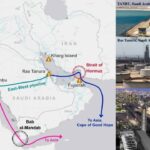
Any war involving Iran would not remain confined to a single battlefield. It would threaten shipping routes, oil infrastructure, and cities across the region.
In an interconnected global economy, the consequences would ripple far beyond the Middle East.
Questioning the Narrative
None of this means Iran’s government should be immune from criticism. The country’s political system, human rights record, and regional policies remain subjects of legitimate debate.
But understanding Iran requires confronting the parts of history that do not easily fit established narratives.
Confirmation bias encourages us to remember only what supports our existing beliefs.
History, however, is rarely that convenient.
And if global audiences are to understand the realities of conflict in the Middle East, they must be willing to examine not just the stories that confirm their views—but also the ones that challenge them.