Kashmir India Economic Integration: A Pragmatic Path to Prosperity
A Turning Point Rooted in Economic Reality
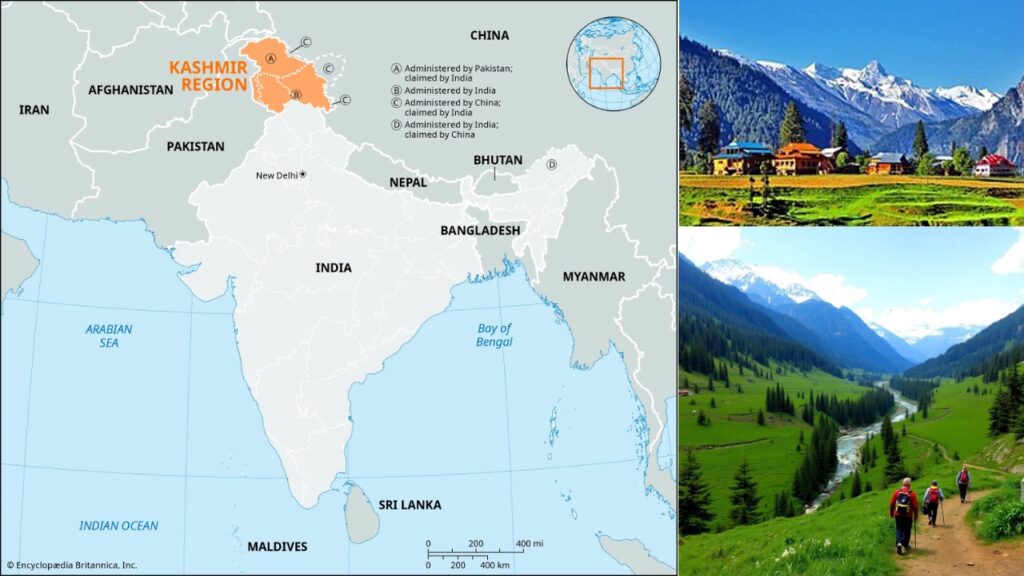
Kashmir India economic integration is not merely a political proposition—it is fundamentally an economic question grounded in long-term sustainability, growth potential, and regional stability. When examined through the lens of economic data, infrastructure capability, and global positioning, the contrast between India and Pakistan becomes stark and difficult to ignore.
The debate around Kashmir’s future has often been dominated by emotion, identity, and geopolitics. Yet, beneath these layers lies a simpler and more enduring question: which path offers Kashmiris a stable, prosperous, and globally connected future?
Economic Divergence: A Tale of Two Trajectories
The economic asymmetry between India and Pakistan is no longer subtle—it is structural and widening.
Pakistan today operates under significant financial strain. With total external debt and liabilities hovering around $138 billion and total debt nearing $290 billion, the country faces rising debt servicing obligations, persistent fiscal pressures, and dependence on external bailouts. Economic growth is often driven by population expansion rather than productivity gains, creating a fragile foundation.
In contrast, India is positioned on a dramatically different trajectory. Long-term projections suggest that India could reach a nominal GDP of $26 trillion by 2047, with some estimates extending beyond $30 trillion by 2050. Even more ambitious scenarios place it higher under sustained reforms and technological advancement.
Kashmir India economic integration, therefore, is not just about geography—it is about aligning with an economy that is expanding, diversifying, and integrating into global value chains at scale.
From Dead-End to Gateway: Reviving Kashmir’s Historic Role
Historically, Kashmir was never meant to be isolated.
For centuries, it served as a vibrant corridor connecting the Indian subcontinent to Central Asia, Tibet, and beyond. Trade routes through Ladakh passes and Silk Road linkages enabled the flow of goods, culture, and ideas. This natural advantage was lost after 1947, when borders hardened and connectivity collapsed.
Kashmir India economic integration has the potential to reverse this historical disruption.
With improved infrastructure, stable governance, and peaceful borders, Kashmir could once again emerge as a strategic trade node. It could link India’s massive domestic market and ports with Central Asian energy resources, while also providing shorter access to Eurasian trade routes.
This vision aligns with broader connectivity initiatives such as the International North-South Transport Corridor, positioning Kashmir not as a contested frontier but as a thriving economic bridge.
The Pakistan Model: Structural Limitations and Dependency
A closer look at Pakistan-administered regions offers critical insights into what integration with Pakistan realistically entails.
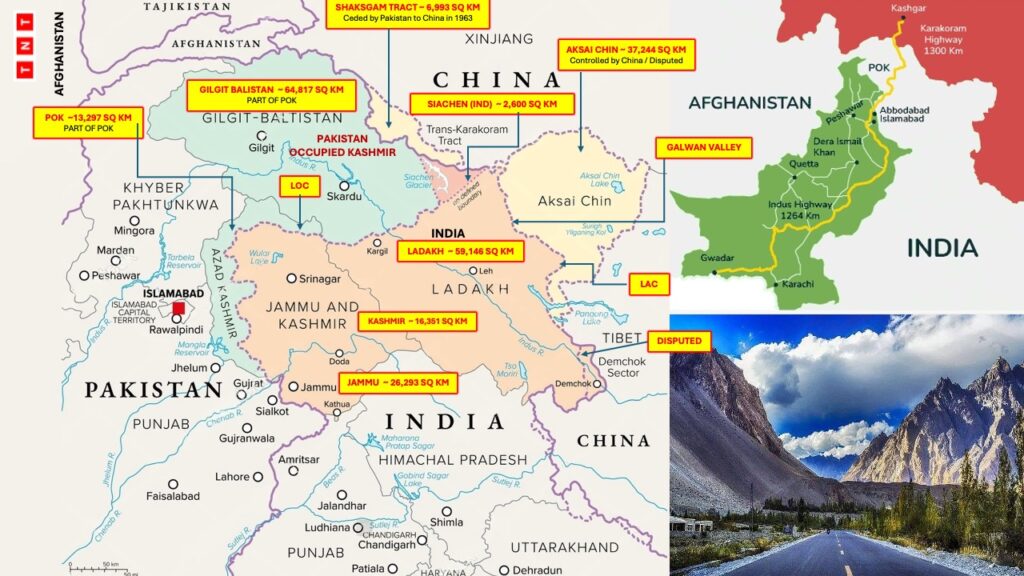
So called Azad Jammu & Kashmir (i.e., Pakistan Occupied Kashmir – POK) operates in a constitutional grey zone. While it has nominal autonomy, key powers—including defense, finance, and foreign policy— remain controlled by Islamabad. Fiscal dependence exceeds 80%, and local representation at the national level is absent.
Recent unrest and governance instability underscore deeper structural issues. Economic development remains limited, infrastructure is uneven, and opportunities are constrained by Pakistan’s broader economic struggles.
Kashmir India economic integration offers a fundamentally different model—one where integration into a large federal economy can provide access to capital, markets, and institutional frameworks necessary for sustained development.
China Factor: Strategic Risks of the Alternative Path
Any discussion about Kashmir’s future must also consider the growing influence of China in the region.
Through projects linked to the China-Pakistan Economic Corridor (CPEC), Beijing has expanded its footprint in areas such as Gilgit-Baltistan. Historical precedents, such as the 1963 agreement ceding the Shaksgam Valley to China, highlight the risks of diminished local agency in such arrangements.
If the entire region were to align with Pakistan, the likelihood of deeper Chinese strategic and economic control would increase. This could transform Kashmir into a geopolitical buffer rather than an empowered economic region.
Kashmir India economic integration, by contrast, offers a pathway where sovereignty, infrastructure development, and economic participation are not outsourced to external powers.
The Independence Illusion: A Difficult Reality
The idea of an independent Kashmir often carries emotional appeal, rooted in aspirations of self-determination and neutrality. However, its practical viability in today’s geopolitical environment remains highly questionable.
A landlocked state surrounded by three nuclear powers—India, Pakistan, and China—with limited industrial capacity and heavy reliance on imports would face severe structural constraints. Economic sustainability would be fragile, with chronic trade deficits and dependence on external routes controlled by neighbors. Militarily, the absence of a credible deterrent would leave it exposed in one of the world’s most militarized regions.
Tibet’s Historical Example
History offers sobering parallels. The case of Tibet is particularly instructive. Once functioning with a degree of autonomy, Tibet lacked the military strength, international guarantees, and institutional depth to preserve its position when faced with a rising power. Following the Chinese annexation of Tibet, the region was gradually absorbed into the People’s Republic of China. Agreements that initially promised autonomy gave way to tighter political and administrative control, fundamentally altering Tibet’s status and limiting local agency.
This precedent underscores a critical reality: buffer regions without strong protection or strategic backing rarely remain independent for long. In Kashmir’s case, the risks would be amplified by its proximity to multiple competing powers, each with vested strategic interests. External influence—whether political, economic, or military—would not be a distant possibility but an immediate and persistent pressure.
In this context, Kashmir India economic integration emerges not as a compromise, but as a pragmatic pathway to stability, protection, and long-term growth. It offers not just economic opportunity, but also the institutional strength and security guarantees necessary to withstand the complex geopolitical forces that define the region.
Strategic and Economic Upside for Kashmir
Kashmir India economic integration presents multiple tangible advantages.
It ensures access to one of the world’s fastest-growing major economies, opens doors to large-scale infrastructure investment, and connects Kashmir to national and global markets. Tourism, horticulture, handicrafts, and hydropower sectors could expand significantly under stable conditions.
Equally important is political inclusion. Within India’s federal structure, Kashmir has the potential to evolve into a significant economic and political voice, rather than remaining in perpetual limbo.
Kashmir India economic integration also strengthens regional security by stabilizing borders and reducing the risks associated with proxy conflicts and geopolitical competition.
Beyond Economics: The Role of Trust and Stability
While economic logic strongly favors integration, it is not sufficient on its own.
Sustainable progress requires trust-building, responsive governance, and meaningful local participation. Kashmiris themselves hold diverse views, shaped by history, identity, and lived experience. Any long-term solution must respect this complexity.
Kashmir India economic integration will succeed not through force or speed, but through consistency, development, and inclusion.
Choosing a Future, Not Just a Side
At its core, the question is not simply political—it is civilizational and economic.
Kashmir stands at a crossroads between two contrasting futures: one tied to a debt-stressed, constrained economy, and another linked to a rapidly expanding global powerhouse. The difference is not abstract—it translates into jobs, infrastructure, education, and quality of life.
Kashmir India economic integration represents a forward-looking choice—one that seeks to transform geography into opportunity, history into momentum, and aspiration into reality.
Yet, the path forward must remain grounded in pragmatism, empathy, and long-term vision. Because in the end, prosperity is not imposed—it is built, sustained, and shared.
ALSO READ:
Shaksgam Valley Dispute and CPEC: Why India Rejects China’s Claim