Daniel Stephen Courney: A Viral Video That Reignited Old Warnings
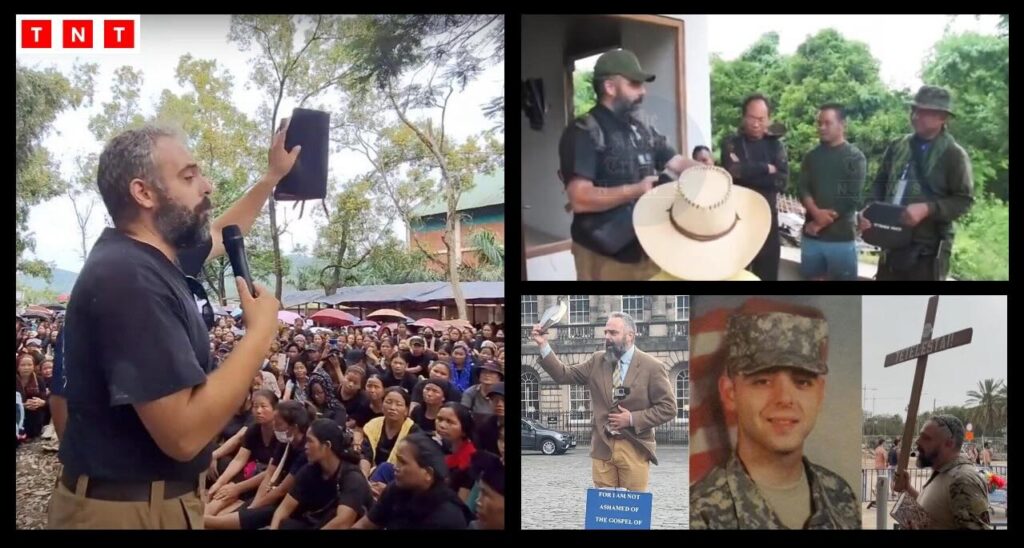
The Daniel Stephen Courney controversy has erupted into a major national issue after a video surfaced showing the American evangelist distributing tactical equipment in the middle of Manipur’s ethnic conflict. The footage, believed to have been recorded during the peak of violence in 2023, does not stand in isolation. Instead, it has reopened serious questions about how a previously deported and blacklisted foreign national managed to re-enter India and operate in one of its most sensitive regions.
In the video, Courney is seen interacting with individuals identified as Kuki-linked armed elements, handing over items that go beyond basic humanitarian aid. A drone, described in the footage as useful for monitoring opponents, and protective gear such as bulletproof vests are presented as support tools. The tone of the interaction, coupled with the nature of the equipment, has drawn sharp reactions, with many viewing it as direct interference in an ongoing conflict rather than neutral assistance.
A Long History of Violations in India
The Daniel Stephen Courney case becomes more troubling when placed against his past record in India. Courney, a US national who portrays himself as a missionary, had been active in the country for years before authorities first took action. His activities were repeatedly flagged for violating visa conditions, as he allegedly engaged in religious outreach and conversion efforts while on a tourist visa, something strictly prohibited under Indian law.
By 2017, complaints had escalated to the point where Indian authorities intervened. Courney was deported from the country and formally blacklisted, effectively barring him from re-entry. The action was not the result of a prolonged criminal trial but an administrative enforcement of immigration and visa regulations. However, the reasons cited—illegal missionary activity and concerns about communal tensions—were serious enough to justify a long-term ban.
At that point, the expectation was clear: Courney would no longer be able to operate within India. The Daniel Stephen Courney developments, however, suggest that this expectation did not hold.
Return Despite Blacklist Raises Alarms
One of the most critical aspects of the Daniel Stephen Courney controversy is the manner in which he appears to have returned. Reports indicate that he re-entered India despite being blacklisted, allegedly using a tourist visa and possibly exploiting porous border routes through Myanmar.
This raises a fundamental question about enforcement. A deportation and blacklist are meant to be definitive barriers, yet in this case, they appear to have been circumvented. His presence in Manipur, a state already under strain from ethnic violence, adds a layer of urgency to concerns about how such lapses occur.
The Northeast’s geography, with its difficult terrain and extensive international borders, has long been a challenge for security agencies. The Daniel Stephen Courney episode has brought those vulnerabilities back into focus, particularly the possibility of individuals moving across borders with minimal scrutiny.
Nepal Arrest and Another Ban
Courney’s activities were not limited to India, and the pattern seen in the Daniel Stephen Courney case extends into Nepal as well. In 2025, authorities in Nepal detained him in Lalitpur for engaging in religious activities that violated the terms of his visa. Much like in India, he had entered under one pretext but was found to be conducting proselytizing work, which is tightly regulated.
The Nepalese authorities imposed a fine and deported him, along with an 11-year ban on re-entry. This marked yet another instance where Courney’s activities led to official action, reinforcing the perception of a repeated pattern rather than isolated missteps.
The similarity between the India and Nepal cases is striking. In both countries, he entered on restricted visas, engaged in activities that went beyond permitted limits, and ultimately faced deportation. The Daniel Stephen Courney controversy now ties these episodes together into a broader narrative of persistent violations.
Manipur Conflict and the Impact of External Involvement
The backdrop to the Daniel Stephen Courney video is one of the most sensitive internal conflicts India has faced in recent years. Since May 2023, Manipur has witnessed intense violence between Meitei and Kuki-Zo communities, leading to large-scale displacement, destruction of property, and deep social divisions.
In such a fragile environment, even small external interventions can have significant consequences. The introduction of equipment like drones and protective gear, even if commercially available, takes on a different meaning when placed in the hands of actors within an active conflict zone.
This is why the Daniel Stephen Courney footage has generated such strong reactions. It is not merely about what was distributed, but about who was distributing it, where, and under what circumstances. A foreign national, previously deported and blacklisted, appearing in a conflict zone and providing tactical items inevitably raises concerns about escalation and influence.
Public Anger and Questions for Authorities
The Daniel Stephen Courney issue has triggered widespread anger, particularly online, where many have questioned how such a situation was allowed to develop. The focus of criticism has largely been on enforcement gaps—both in terms of preventing re-entry and monitoring activities within sensitive regions.
There is also a broader concern about foreign involvement in internal matters, especially in areas with a history of insurgency and ethnic tension. The case has become a flashpoint for debates about sovereignty, security, and the effectiveness of existing safeguards.
A Pattern That Demands Attention
What makes the Daniel Stephen Courney case particularly significant is the consistency of the pattern it reveals. Deportation from India did not prevent further activity. Action in Nepal did not end his involvement in the region. Each step appears to have been followed by re-emergence elsewhere.
This is why the controversy has moved beyond the individual. It now points to systemic issues—how bans are enforced, how borders are monitored, and how repeat violations are tracked across jurisdictions.
As the video continues to circulate and scrutiny intensifies, the Daniel Stephen Courney case stands as a stark reminder of the challenges involved in managing foreign actors in sensitive geopolitical environments.