Hormuz Toll Debate Amid Global Maritime Double Standards
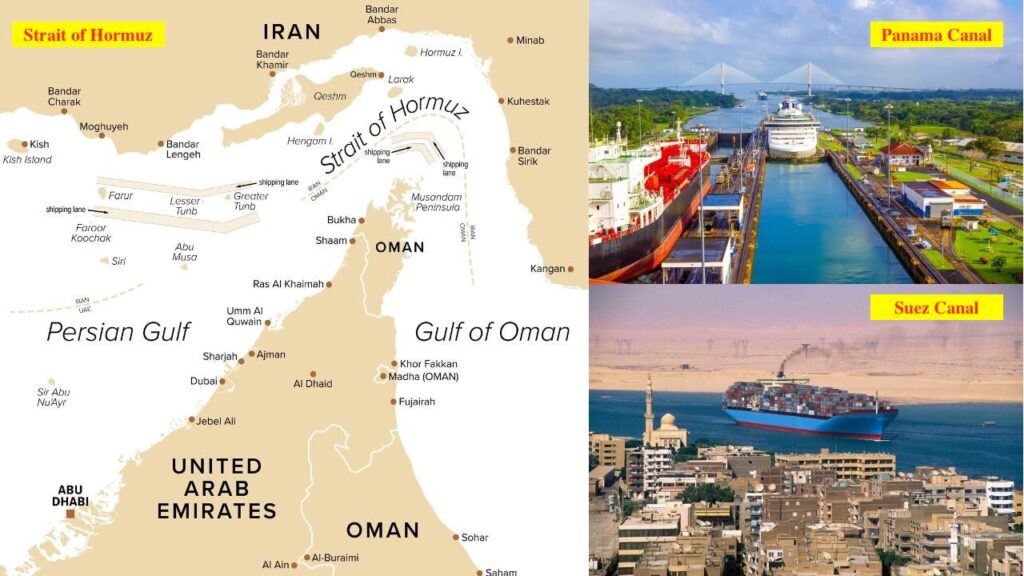
March 20, 2026 | New Delhi: A growing Hormuz Toll Debate is now shaping global discourse, as analysts question inconsistencies in maritime narratives and transit fee structures. The discussion contrasts Iran’s long-standing navigation approach in the Strait of Hormuz with established fee regimes in major waterways such as the Suez Canal and the Panama Canal.
Moreover, detailed mapping and comparative assessments have intensified the focus on international maritime law and strategic restraint. As tensions rise in the region, the debate over control, legality, and economic leverage over key sea routes has gained urgency.
Debate on Global Fee Structures
The Hormuz Toll Debate has gained traction as comparisons around transit costs become more prominent. Ships passing through the Suez Canal and the Panama Canal pay substantial charges. These often range from hundreds of thousands to over a million dollars, depending on vessel size and cargo.
In addition, comparisons extend to the Bosporus Strait in Turkey. This strait runs through Istanbul and connects the Black Sea to the Sea of Marmara. It serves as a vital maritime link between Europe and Asia. Similarly, the St. Lawrence Seaway, jointly managed by Canada and the United States, stretches from the Atlantic Ocean through the St. Lawrence River into the Great Lakes. It enables deep inland shipping into North America.
In both these routes, authorities impose structured charges. These include pilotage, navigation assistance, and transit service fees. Maritime agencies and industry data consistently support these figures.
Canal Fees vs Natural Strait: Legal Distinction
At the core of the Hormuz Toll Debate lies a clear legal distinction. The Suez Canal and the Panama Canal are artificial waterways. Egypt and Panama exercise full sovereignty over them. Therefore, they impose transit fees based on commercial and operational parameters.
However, the Strait of Hormuz functions differently. It is a natural maritime corridor that links the Persian Gulf to the Arabian Sea. International maritime law governs it, especially the transit passage regime under the United Nations Convention on the Law of the Sea. As a result, ships enjoy uninterrupted navigation rights through such straits.
Strait of Hormuz and the Question of Tolls
For decades, no formal toll system has operated in the Strait of Hormuz. This position aligns with the principle of transit passage, which restricts coastal states from charging fees solely for navigation.
Although Iran has not ratified UNCLOS, most nations treat transit passage as customary international law. Consequently, the strait has continued to function as a key global shipping corridor without formal toll structures.
However, developments in March 2026 indicate a potential shift. Iranian lawmakers are now considering proposals to introduce transit fees or taxes. They present these proposals as compensation for providing maritime security in a volatile region.
Conflict Context and Emerging Restrictions
The Hormuz Toll Debate has intensified amid escalating regional conflict. Military activity has increased sharply in recent weeks. As a result, shipping traffic through the strait has dropped significantly, with estimates suggesting a decline of nearly 85 per cent.
Western-linked vessels have faced the most disruption. Meanwhile, some vessels linked to Russia and China continue to transit with fewer restrictions. In certain cases, reports indicate that ships have made ad-hoc payments to secure safe passage. One such instance suggests a payment of approximately $2 million.
However, these developments do not represent a formal toll regime. Instead, they reflect conflict-driven pressures and coercive leverage rather than structured commercial policy.
Territorial Waters and Transit Rights Explained
Geographically, the Strait of Hormuz lies within the territorial waters of both Iran and Oman. At its narrowest point, it measures approximately 21 nautical miles. Therefore, the territorial seas of both countries overlap, leaving no central high seas corridor.
Despite this, international law guarantees transit passage. Ships can move continuously and without obstruction through the strait. Coastal states cannot suspend or restrict this right, even within their territorial waters.
Iran has often argued for a more restrictive interpretation known as innocent passage. However, major maritime powers, including the United States, continue to support the broader transit passage regime.
Legal Limits on Imposing Tolls
The Hormuz Toll Debate ultimately centres on legality. International law does not permit coastal states to impose tolls on transit through such straits.
Therefore, any unilateral attempt to introduce fees would likely face strong global opposition. It would also challenge established maritime norms and freedom of navigation principles.
Nevertheless, discussions within Iran suggest a possible policy shift. Lawmakers have proposed formal transit charges as part of a broader strategic framework. However, authorities have not implemented these proposals so far.
Debate Reflects Broader Geopolitical Tensions
The Hormuz Toll Debate reflects deeper geopolitical tensions. Supporters argue that global reactions to transit fees lack consistency. They point out that the international community widely accepts canal tolls. However, similar discussions around the Strait of Hormuz attract sharper scrutiny.
In contrast, critics emphasise legal distinctions between artificial canals and natural straits. They argue that such comparisons overlook the framework of international maritime law.
As tensions continue to rise, the Strait of Hormuz remains central to global energy security. Therefore, the debate over tolls, legality, and control is likely to intensify further, especially if disruptions persist and reshape maritime dynamics.