Echoes of Ashoka: How China Replicates Ancient India’s Soft Power Model
Ashoka: Power Without Perpetual War
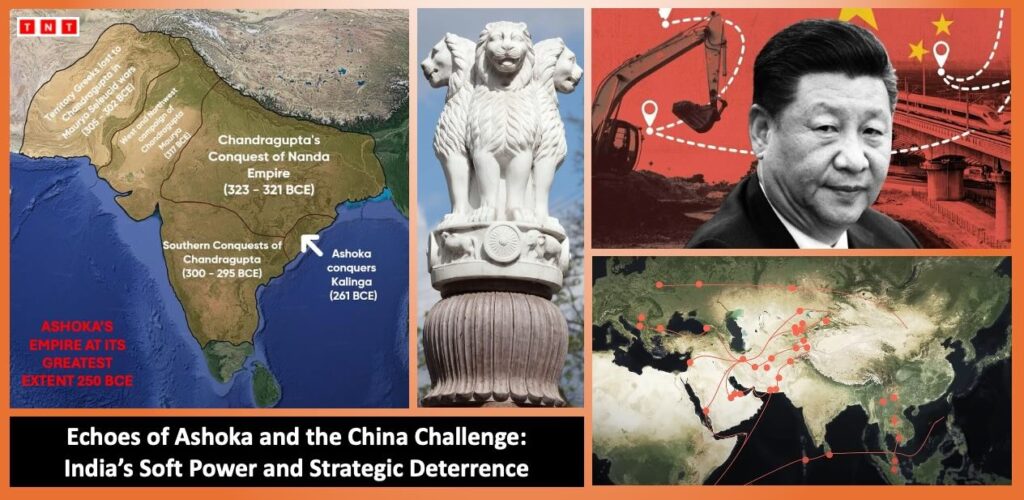
Few rulers transformed their strategy as radically as Ashoka after the Kalinga War in 261 BCE. The carnage of Kalinga ended Mauryan expansion. However, it did not weaken the empire.
Ashoka retained a massive standing army. It served as a symbol of strength and a tool of deterrence. Yet, he stopped using it for conquest. Military power became a background guarantee, not a daily instrument of policy.
His real innovation lay elsewhere. Through Dhamma, welfare measures, diplomatic missions, and moral governance, Ashoka exported influence without annexation. Southern kingdoms and western neighbours aligned with him voluntarily. Loyalty was cultivated through credibility, not fear.
The Mauryan Empire thus reached its peak not through further wars, but through persuasion backed by visible strength.
This was one of history’s earliest and most successful soft power systems.
China’s Post-1979 Strategy: The Modern Ashokan Model
A similar pattern defines China after the Sino-Vietnamese War. Since 1979, Beijing has avoided major interstate wars. Instead, it has focused on deterrence, economic expansion, and political influence.
The People’s Liberation Army today is technologically advanced and numerically strong. Yet, its main function is signalling power and preserving regime authority. Like Ashoka’s army, it projects dominance without being routinely deployed for conquest.
China’s equivalent of Dhamma is economic integration.
Through the Belt and Road Initiative, Beijing finances ports, highways, railways, and energy projects across Asia, Africa, and Europe. These projects do more than build infrastructure. They bind recipient countries into long-term dependence.
Trade routes replace marching routes. Loans replace tribute. Contracts replace annexation.
Influence is achieved without occupation.
Just as Ashoka used moral authority to shape neighbouring states, China uses capital, connectivity, and markets.
Debt, Dependence, and Political Alignment
Critics often describe BRI as “debt-trap diplomacy”. The reality is more complex. Many countries have gained tangible assets and improved connectivity. Pakistan and Bangladesh are examples where infrastructure has translated into strategic closeness.
However, the deeper impact lies in political behaviour.
BRI participants tend to align with Beijing in multilateral forums. Voting patterns at international institutions often reflect economic dependence. Non-democratic regimes show higher participation, indicating ideological comfort with China’s governance model.
This mirrors Ashoka’s era, where kingdoms aligned not because they were conquered, but because alignment brought stability, trade, and legitimacy.
In both cases, influence flows through incentives, not invasion.
Where the Mauryans Fell—and China May Falter
The Mauryan system collapsed after Ashoka. The reasons were structural.
Weak successors, excessive administrative costs, fiscal pressure, and declining central authority eroded cohesion. Provincial governors became autonomous. Legitimacy weakened. Loyalty faded.
By 185 BCE, the empire disintegrated.
The lesson is clear: soft power empires are stable only while economic and political balance holds.
China faces comparable risks today. Rising debt stress among partners, slowing domestic growth, and increasing geopolitical resistance threaten the BRI ecosystem. If projects begin to be seen as burdens rather than benefits, alignment will weaken.
Influence built on economics is durable—but not permanent.
Strategic Signalling Along the Indian Border
Along the Line of Actual Control, China applies the same philosophy.
Instead of full-scale invasion, it uses calibrated pressure—small incursions, infrastructure build-up, and legal assertions. This “salami slicing” avoids major war while steadily altering facts on the ground.
This fits the Ashokan logic: demonstrate power, avoid total conflict, expand influence incrementally.
Beijing understands that Himalayan logistics make large offensives costly. Sustaining major operations would require enormous resources. Therefore, controlled escalation is preferred.
Pressure without war.
Presence without annexation.
Influence without occupation.
The Core Parallel: Deterrence Plus Persuasion
At their core, Ashoka’s empire and modern China operate on the same strategic formula:
- Maintain overwhelming military credibility
- Avoid frequent wars
- Build dependence through non-military tools
- Convert material benefits into political loyalty
Ashoka used Dhamma and welfare.
China uses finance and infrastructure.
Ashoka exported moral authority.
China exports economic ecosystems.
Both models reduce resistance by making alignment appear rational.
A Caution from History
Ashoka’s system worked brilliantly—until it did not.
Once economic pressure mounted and legitimacy weakened, the structure collapsed quickly. Soft power could not compensate for internal decay.
China’s model remains effective today. However, history suggests that such systems demand constant recalibration. When partners feel exploited, or when domestic capacity weakens, influence evaporates.
Power sustained through attraction is fragile when attraction fades.
Why the Comparison Matters Today
The Ashoka-China parallel is not symbolic. It is strategic.
It shows that China’s rise is not built primarily on conquest. It is built on a carefully managed blend of strength, restraint, and inducement—exactly what made Ashoka successful.
Understanding this helps policymakers and observers avoid simplistic interpretations of Chinese behaviour.
Beijing is not imitating Western imperialism.
It is closer to replicating Asia’s oldest soft power empire.
Whether it avoids Ashoka’s fate will depend on one question:
Can economic influence be sustained without becoming economic burden?
History suggests the answer will decide everything.
Caveat
This is not an “apples-to-apples” comparison between the Mauryan Empire of Ashoka and modern China, nor between Ashoka and Xi Jinping. Their historical, political, and moral contexts are fundamentally different.
The comparison is not about ethics or ideology. It focuses only on strategy and outcomes. In both cases, large armies served mainly as show of might and acted as deterrents, while influence expanded through non-military tools—Dhamma and diplomacy in Ashoka’s time, and trade and the Belt and Road today.
The parallel lies in sustainable expansion through soft power backed by credible strength, not conquest.