Top Chinese General Accused of Nuclear Espionage, Sharing Secrets with the US
A Shockwave Through China’s Military Elite
China’s tightly controlled political system has been jolted by an investigation that
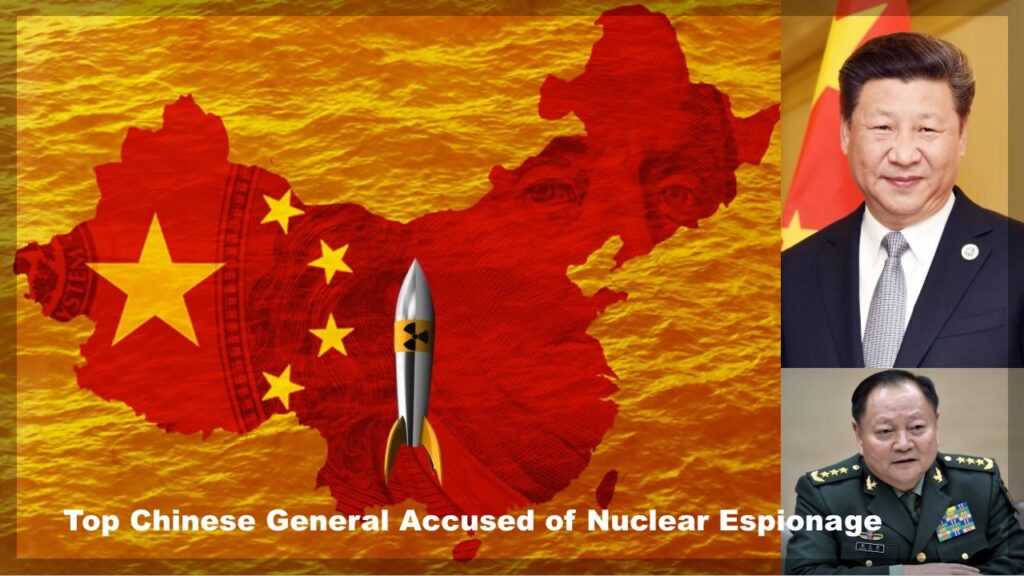
strikes at the heart of President Xi Jinping’s inner circle. The Ministry of National Defense has confirmed a probe into General Zhang Youxia, the highest-ranking uniformed officer in the People’s Liberation Army and vice chairman of the Central Military Commission.
The allegations are extraordinary even by the standards of Xi’s decade-long anti-corruption drive. Zhang stands accused of leaking highly sensitive information relating to China’s nuclear weapons programme to the United States, accepting large bribes for military promotions, and fostering political cliques that undermined Communist Party unity. The announcement follows a confidential briefing to senior officers, underscoring the gravity of the charges.
Allegations That Cut to the Core of National Security
Investigators allege that Zhang passed “core technical data” linked to China’s nuclear arsenal to American intelligence agencies. While official details remain classified, the accusations reportedly involve warhead design elements, delivery systems and aspects of command-and-control architecture. Within China’s political lexicon, such conduct is described as nothing short of nuclear treason.
Alongside espionage claims, Zhang is accused of monetising his influence within the Central Military Commission. Authorities allege he accepted substantial bribes in exchange for fast-tracking promotions and manipulating procurement decisions. His purported role in the rise of former defence minister Li Shangfu, himself purged in 2023, has drawn particular attention.
Chinese officials have also accused Zhang of forming illicit political networks, a charge frequently deployed in high-level purges to signal disloyalty to the party leadership.
A Trusted Ally Turned Liability
Zhang’s fall is especially destabilising because of his proximity to Xi Jinping. A fellow “princeling,” Zhang inherited revolutionary credentials through his father, who fought alongside Xi’s father during the Chinese Civil War. That shared lineage translated into decades of political trust.
Zhang joined the PLA in 1968 and gained rare combat experience during clashes with Vietnam in 1979 and 1984. His rise accelerated after Xi assumed power in 2012, culminating in his appointment to the Central Military Commission. He became a central figure in modernising the PLA, overseeing sweeping reforms in training, force structure and weapons development.
Retained beyond the customary retirement age, Zhang was widely regarded as Xi’s most dependable military lieutenant. His disappearance from public view after a meeting with Russia’s defence minister in November 2025 triggered months of speculation now confirmed by the investigation.
An Anti-Corruption Drive That Consumes Its Own
The probe into Zhang represents the most dramatic phase of Xi’s anti-corruption campaign within the PLA. Since 2023, the focus has intensified on the Rocket Force, which controls China’s nuclear missile arsenal. More than fifty senior officers and defence industry executives have been removed over the past three
years.
The purge has already claimed two former defence ministers, senior commanders across all service branches, and another Central Military Commission vice chairman expelled in October 2025. With Zhang under investigation, the once seven-member CMC has been reduced in effect to Xi himself and the discipline chief, General Zhang Shengmin.
Analysts warn that such concentration of authority creates an operational vacuum in a military of more than two million personnel.
Power Consolidation or Institutional Breakdown
Official narratives portray the purge as a zero-tolerance campaign to restore discipline and loyalty. State media editorials accuse Zhang of undermining the authority of the CMC chairman, an unmistakable reference to Xi Jinping.
However, foreign analysts view the developments through a more sceptical lens. Former intelligence officials describe Zhang’s removal as unprecedented, signalling what some call the near-total annihilation of the PLA’s senior command. Others argue that the accusations reflect a dual strategy: removing potential rivals while reinforcing Xi’s dominance.
The scale of the purge has sparked debate over whether institutional integrity is being strengthened or hollowed out.
Strategic Fallout Beyond Beijing
The implications extend well beyond internal politics. China’s nuclear arsenal has expanded rapidly under Xi, with estimates placing the stockpile above 500 warheads and projections of 1,000 by 2030. Any compromise of nuclear secrets would undermine strategic deterrence at a time of heightened tensions with the United States over Taiwan, the South China Sea and technological competition.
Procurement disruptions caused by the purge have already slowed weapons development and dented defence industry confidence. Some analysts suggest the leadership turmoil reduces the likelihood of near-term military adventurism, even as it reinforces Xi’s grip on power.
A Message Without Ambiguity
International observers are watching closely as interim commanders fill critical gaps and Beijing attempts to project stability. No official response has emerged from Washington, but the allegations, if substantiated, would mark a major intelligence coup.
For now, Zhang Youxia’s fate remains unresolved. Under Chinese law, charges of treason carry the possibility of the death penalty. Yet the broader message of the purge is unmistakable. In Xi Jinping’s China, revolutionary pedigree, personal loyalty and decades of service offer no immunity.
As the leadership tightens control at home while projecting strength abroad, this episode exposes the fragility beneath China’s authoritarian facade, with consequences that could reverberate across the Indo-Pacific security landscape for years.