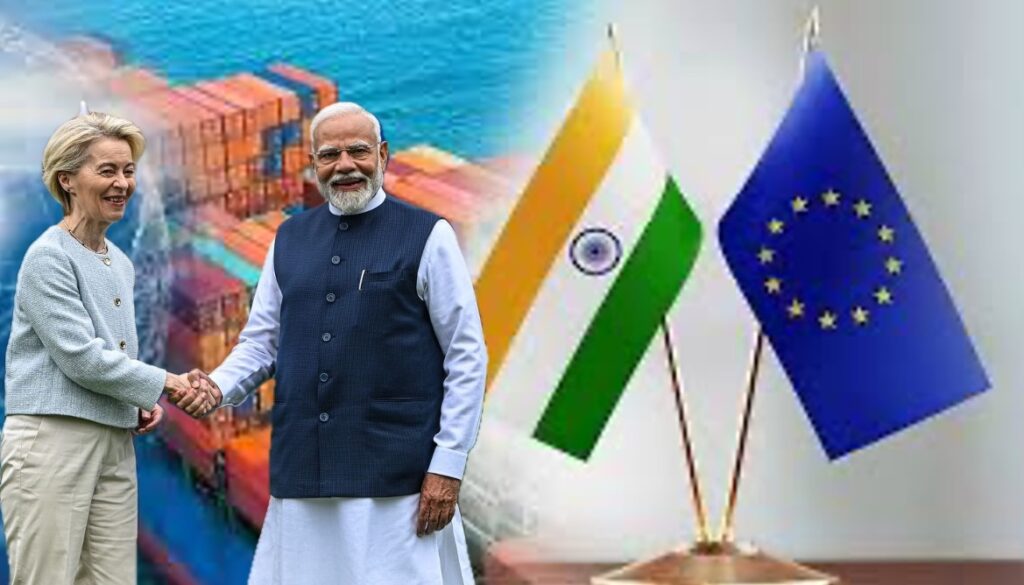
EU-India FTA Signing Faces a Long and Uncertain Ratification Road
Signing Hype Builds Ahead of the Summit
As New Delhi prepares to host the India-EU Summit on January 26-27, 2026, headlines across print and social media are framing the EU India FTA as a historic breakthrough. Projections of bilateral trade expanding from roughly $120 billion to $200 billion dominate public discourse. Tariff reductions on European automobiles, wines, and spirits are being highlighted alongside expanded market access for Indian textiles, jewellery, pharmaceuticals, and services.
“There is still work to do. But we are on the cusp of a historic trade agreement. Some call it the mother of all deals. One that would create a market of 2 billion people, accounting for almost a quarter of global GDP.” — Ursula von der Leyen, World Economic Forum, Davos, 20 January 2026
The political optics are powerful. After nearly two decades of stalled negotiations, the agreement is being projected as a landmark economic reset. However, the celebratory tone glosses over a critical distinction. Signing an FTA and enforcing it are two very different stages. In the case of the EU India FTA, the latter may prove far more complicated.
India’s Ratification Path: Swift and Centralised
From New Delhi’s perspective, the ratification process presents few institutional obstacles. India operates under a centralised parliamentary system for international treaties. Once signed, the agreement requires approval by both Houses of Parliament under Article 253 of the Constitution, which empowers the Union government to implement international agreements.
State legislatures play no formal role in this process. With the ruling coalition enjoying a working majority, parliamentary approval could be secured within months. Past precedents reinforce this assessment. The India-UAE Comprehensive Economic Partnership Agreement was signed in February 2022 and entered into force by May of the same year.
If political consensus holds, India’s domestic ratification timeline is unlikely to be the bottleneck.
Why the EU Ratification Process Is Different
The European Union presents a very different institutional reality. The EU India FTA is categorised as a “mixed agreement”. This means it covers areas under exclusive EU competence, such as trade in goods and services, as well as shared competences, including investment protection and sustainability provisions.
The process unfolds in multiple stages. First, the European Commission must submit the agreed text to the Council of the European Union, which authorises the signature through a qualified majority. Following this, the European Parliament must grant its consent after committee scrutiny and debate.
Even under smooth conditions, this phase can take several months. If political disagreements surface, the timeline can stretch well beyond a year.
Provisional Application and Its Limits
Once the European Parliament gives its consent, the EU can move towards provisional application of the agreement’s core trade elements. These typically include tariff reductions, customs facilitation, and market access commitments.
This “split architecture” allows businesses to benefit from trade liberalisation without waiting for full ratification by all member states. For the EU India FTA, provisional application could realistically begin in late 2026 or 2027.
However, provisional application excludes investment protection and certain regulatory commitments. Those elements remain frozen until national ratifications are complete. This distinction matters, particularly for sectors such as technology, infrastructure, and green energy, where investor certainty is critical.
National Parliaments: The Real Test
The most unpredictable phase lies with the EU’s 27 member states. Each country must ratify the mixed components of the agreement through its national parliament. In some cases, regional legislatures also hold veto power.
History offers a sobering precedent. The EU-Canada Comprehensive Economic and Trade Agreement was signed in 2016 and provisionally applied in 2017. As of 2026, it remains unratified in several EU states.
A single national veto can block the investment and sustainability chapters indefinitely. Domestic politics, sectoral lobbies, and election cycles all influence outcomes. The EU India FTA will be no exception.
Agriculture and Sustainability as Flashpoints
Agriculture remains the most sensitive fault line. India has drawn firm red lines around agriculture, dairy, and fisheries, sectors that support nearly half its workforce. Full market opening in these areas has been avoided, with limited concessions structured through phased tariff reductions.
Dairy remains particularly contentious. Regulatory issues surrounding animal-derived inputs, such as rennet, intersect with India’s dietary norms and political sensitivities. On the European side, powerful farm lobbies in countries like France, Ireland, and the Netherlands may push back during national ratifications.
Environmental conditionalities also pose risks. Sustainability clauses linked to mechanisms such as the Carbon Border Adjustment Mechanism could become rallying points for opposition, especially amid ongoing farmer protests across Europe.
The Mercosur Parallel Europe Cannot Ignore
The EU-Mercosur agreement offers a cautionary comparison. Signed on January 9, 2026, after 25 years of negotiations, it was immediately celebrated as a geopolitical win. Yet within weeks, the European Parliament voted to refer it to the European Court of Justice, potentially delaying ratification by years.
Concerns over deforestation, agricultural imports, and enforcement standards drove the backlash. The parallels with the EU India FTA are evident. Strategic ambitions may collide with domestic political constraints, regardless of diplomatic enthusiasm.
Strategic Logic Still Favourable
Despite these hurdles, the strategic rationale for the EU India FTA remains strong. For India, deeper engagement with Europe provides diversification amid uncertain trade relations with the United States. Provisional application alone could deliver measurable export gains.
For the EU, India offers scale, demographic advantage, and a hedge against supply chain over-concentration. However, expectations must be tempered by institutional reality.
The agreement’s success will depend less on summit-stage declarations and more on sustained political management across European capitals.
Between Promise and Process
The EU India FTA is not an illusion, but it is not an instant economic transformation either. The gap between signing and full implementation is wide, and history suggests patience will be essential.
Public discourse benefits from realism rather than hyperbole. The deal may yet justify its billing as transformative, but only if ratification politics do not unravel its most consequential chapters.