Chabahar Port Controversy: Exit Rumours, Sanctions Pressure and India’s Strategic Calculus
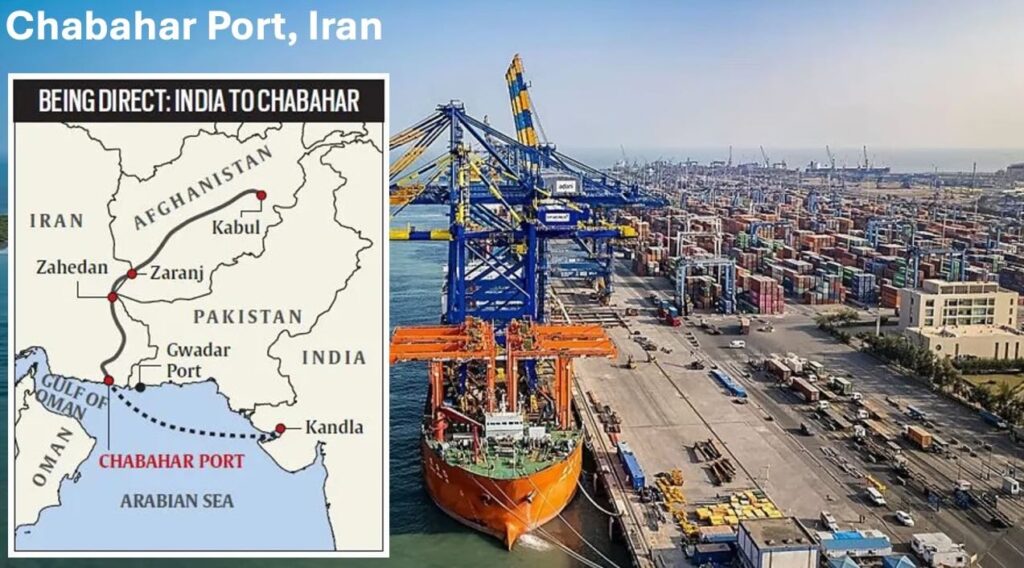
January 17, 2026, New Delhi | In the high-stakes arena of geopolitics, the Chabahar Port Controversy has reignited fierce debate over India’s foreign policy choices. What began as a report by The Economic Times widh title ‘India’s Turbulent Involvement In Iran’s Chabahar Port All But Collapse‘. The said report basically alleges India’s “quiet exit” from Iran’s Chabahar port which quickly escalated into accusations of diplomatic failure under Prime Minister Narendra Modi. Opposition voices framed it as surrender to American pressure. Government sources, however, insist there is no withdrawal, only calibrated engagement amid tightening US sanctions.
As political narratives clash and social media amplifies speculation, the core question remains unresolved: Is Chabahar a fading strategic gamble or a resilient asset being tactically protected?
The Economic Times Bombshell: What Was Said and On What Basis?
On January 15, 2026, The Economic Times published article claimed India was effectively exiting operations at the Shahid Beheshti terminal of Chabahar port.
The report stated that India had transferred approximately USD 120 million to Iran to liquidate outstanding commitments related to port equipment such as cranes. It also claimed that Indian directors resigned from India Ports Global Ltd (IPGL) and that the company’s website was taken offline to shield stakeholders from potential US sanctions.
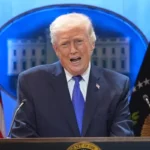
According to the report, these steps indicated a “full exit” unless Washington eased restrictions. The article linked this to the re-imposition of US sanctions on Iran in September 2025 and President Donald Trump’s January 12, 2026 warning of a 25 per cent tariff on Iran-linked business.
The foundation of the claim rested on unnamed government sources and references to documents linked to a six-month conditional sanctions waiver issued by the US Office of Foreign Assets Control (OFAC). This waiver, valid from October 29, 2025 to April 26, 2026, reportedly required India to “wind down” activities to avoid penalties.
While the timelines cited were verifiable, the report extrapolated risk-mitigation measures into a permanent withdrawal, without any formal confirmation from Indian authorities.
How the Story Exploded: Media Amplification and Political Weaponisation
The report quickly escaped business pages and entered the political bloodstream. By January 16, senior journalists and commentators shared the story on social media, presenting it as evidence of a “quiet exit” under US pressure. Television debates followed, while several digital outlets reproduced the claim without independent verification.
Opposition political handles amplified the narrative aggressively. Graphics portraying Prime Minister Modi as weak on foreign policy circulated widely. The Chabahar Port Controversy was linked to a broader critique of India’s engagement with the United States, often framed under the phrase “hugs diplomacy”.
Critics portrayed Chabahar as another strategic loss, alleging that India had ceded ground to China and Pakistan by allowing Beijing’s influence to expand in Iran. Predictably, Pakistani social media accounts echoed these claims,
though domestic political mobilisation remained the dominant force.
Early counter-arguments and fact-checks were largely drowned out. Speculation hardened into perceived fact, exposing once again how fragmented information ecosystems magnify geopolitical anxieties.
MEA’s Pushback: ‘No Exit, Only Engagement’
The Ministry of External Affairs countered the narrative. On January 16, MEA spokesperson Randhir Jaiswal clarified during a press briefing that India has not exited Chabahar port.
He confirmed the existence of the US Treasury’s conditional waiver issued in October 2025. However, he emphasised that India remains engaged with both Iran and the United States to extend the arrangement. The 10-year agreement signed with Iran in 2024, he said, remains valid.
Government sources reiterated that withdrawal from Chabahar “is not an option”. They described current steps as compliance adjustments under a special sanctions framework, not abandonment of the project. External Affairs Minister S. Jaishankar is expected to raise the issue directly with US Secretary of State Marco Rubio in upcoming bilateral discussions.
Notably, the MEA avoided addressing specific operational claims made by The Economic Times, choosing instead to focus on continuity and diplomacy.
Not Entirely Wrong, But Not Fully Substantiated
A balanced assessment suggests that the Economic Times report was not entirely unfounded, yet clearly overstated.
The sanctions timeline aligns with official statements. The conditional nature of the waiver does require risk-reduction measures. Adjustments in corporate exposure are consistent with OFAC compliance norms.
However, there is no documentary or official evidence confirming a permanent or strategic withdrawal. Labelling the situation a “collapse” or “exit” relies heavily on anonymous sourcing. The MEA’s categorical denial and continued negotiations strongly indicate de-risking rather than retreat.
Several independent fact-checkers have since described claims of a full exit as misleading, noting the absence of any formal announcement or treaty reversal.
What to Expect from the US: Another Waiver or Hardline Sanctions?
Under a second Trump administration, Washington’s Iran policy remains largely uncompromising. The rollback of broader sanctions exemptions and the renewed threat of secondary sanctions have undeniably narrowed India’s operational space at Chabahar. At the same time, history suggests that US policy towards the port has never been entirely rigid and has often accommodated strategic exceptions when wider regional interests were at stake.
India has previously secured Chabahar-specific exemptions by positioning the port as a humanitarian and regional connectivity corridor, particularly for Afghanistan and Central Asia. The current diplomatic engagement follows the same logic, with New Delhi seeking continuity rather than confrontation. However, whether this results in another extension or a policy hardening will depend on how Washington weighs its Iran strategy against its partnership with India.
Current Status: Conditional Waiver, Ongoing Diplomacy and Ground Reality
As of now, India continues to operate under a six-month conditional sanctions waiver granted by the United States, valid until April 26, 2026. Indian officials have confirmed that this exemption allows continued engagement at the Shahid Beheshti terminal, provided activities remain within clearly defined parameters. Crucially, this arrangement has not been treated by New Delhi as a stop-gap surrender, but as a negotiated space for sustained dialogue.
Operationally, India has adopted a cautious approach aimed at minimising sanctions exposure while keeping the project functional. Adjustments in corporate structures and financial exposure are part of this compliance strategy, not signals of disengagement. Diplomatic channels with Washington remain active, and discussions on extending or refining the waiver are ongoing. In effect, Chabahar is neither frozen nor abandoned; it is being carefully insulated while negotiations continue.
If the US Bars India: Strategic Costs for Washington
A decision by the United States to deny further waivers and effectively bar India from Chabahar would carry consequences extending beyond India-Iran relations.
First, it would weaken regional connectivity initiatives that bypass Pakistan and reduce dependence on China-centric corridors. Chabahar remains a critical node in linking Afghanistan and Central Asia to the Indian Ocean. Curtailing India’s role risks pushing these regions further towards Chinese or alternative logistical networks, counter to long-term US strategic objectives.
Second, Afghanistan’s access to regional trade would suffer. For years, Chabahar has been positioned as a practical economic lifeline for Afghan commerce. Removing India from the equation would shrink viable trade routes and reduce Western influence over economic stabilisation efforts in the region.
Finally, a hardline stance against India could complicate broader US-India strategic cooperation. India’s foreign policy has consistently emphasised strategic autonomy. Forcing a binary choice between sanctions compliance and long-term regional engagement may be viewed in New Delhi as disproportionate, potentially eroding diplomatic goodwill at a time when Washington relies on India as a key Indo-Pacific partner.
In this context, continued flexibility on Chabahar may serve US interests as much as India’s.
Is the Criticism of Modi and the Government Fair?
Opposition critics have branded the Chabahar project a “big failure” of Modi’s foreign policy. They argue that India has wasted money, lost access to Central Asia, and surrendered strategic autonomy.
However, such claims ignore context. Chabahar predates the Modi government and has always operated under sanctions risk. The 2024 agreement itself demonstrated political will to pursue long-term strategy despite uncertainty.
Current challenges stem primarily from global geopolitical shifts, not diplomatic negligence. India continues to operate its only overseas port project while balancing relations with both Tehran and Washington.
Calling it a failure at this stage appears politically motivated and premature.
Buzz Debate: Strategy Under Pressure
The Chabahar Port Controversy underscores a deeper question about India’s strategic autonomy in a multipolar world. Is this pragmatic diplomacy under constraint, or a slow erosion of independent policy space?
As sanctions deadlines approach and negotiations intensify, Chabahar remains a live test of India’s ability to protect long-term interests without rupturing key alliances.
What is your view?
Is India adapting smartly, or conceding ground? Join the discussion with us on ‘X’ @TattvamNews and follow TNT for grounded, unfiltered geopolitical analysis.