Inside India’s Growing Missile Empire: What India Build, Co-Develop, and Sell
Every time India tests a missile, headlines erupt with pride. The country that once imported everything from bullets to jets now builds weapons that can reach space, skim the sea, and strike with pin-point accuracy. India develops and builds indigenously, co-develops, and sells firepower with growing confidence. Yet, it is also a nation that still imports critical weapons including missiles from Israel, Russia, France, Germany, and the United States. This mix of pride and pragmatism tells a larger story – that sovereignty in defence doesn’t always mean isolation. Sometimes, independence is about partnerships chosen wisely.
The Three Pillars of India’s Missile Power
India’s missile ecosystem rests on three solid pillars – what it builds, what it co-develops, and what it still buys. Together they form an architecture that is as complex as it is resilient.
On one side stand the indigenous families – Agni, Prithvi, Akash, Astra, Naag, and the emerging Nirbhay. These are born of India’s own laboratories, forged in DRDO’s decades of experimentation since the 1980s.
Next are the joint ventures, the true strategic hybrids that India treats as its own. The BrahMos and Barak-8/MRSAMprograms fall here – co-developed but co-owned, with India holding production rights, command over local manufacture, and export freedom.
And then, there are imports – systems India buys not because it cannot build, but because it must act faster than it can design. Missiles like the Spike anti-tank (Israel), S-400 air defence (Russia), Harpoon and AMRAAM (US), and SCALP/Storm Shadow (France/UK) fill critical gaps in timelines or technology.
Each of these layers reveals not weakness, but strategic flexibility. India builds where it can, partners where it must, and buys where it should.
BrahMos – The Supersonic Symbol
The BrahMos has become more than a missile; it’s a metaphor for India’s industrial coming of age. Co-developed with Russia but manufactured, adapted, and exported by India, it stands alone in its class – the only operational supersonic cruise missile in the world today.
Flying at around Mach 3, the BrahMos doesn’t creep toward its target like the American Tomahawk or the European Storm Shadow – it storms in, unrelenting, low, and lethal. While the Tomahawk and Storm Shadow glide subsonically at around Mach 0.8 – 0.9, relying on stealth and range, the BrahMos compresses reaction time. It strikes before radar operators can even complete a sentence.
Where the Tomahawk is designed for saturation strikes – to overwhelm with numbers – the BrahMos is built for precision and psychological dominance. Its amazing accuracy and intelligent manoeuvre make it a single-shot solution, not a volley weapon. The Taurus KEPD 350 from Germany and Sweden, or the French SCALP, carry heavier warheads and longer range, but none can match the sheer speed-to-strike ratio of the BrahMos.
Now with the extended-range variant (up to 600 km) and air-launched version already operational from Su-30 MKI fighters, the BrahMos has become not just a symbol of India’s engineering maturity but a commercial and diplomatic instrument – exported to the Philippines, and several lining up next.
In every sense – speed, versatility, and autonomy – the BrahMos stands as India’s supersonic calling card, with an even more advanced hypersonic variant currently under development / testing phase.
Although BrahMos’s airframe can technically accommodate a nuclear payload, India deploys it as a conventional precision-strike weapon; its true power is the certainty of the hit, not the yield of the warhead.
The Ballistic Backbone: Agni, Prithvi, and the K-Series
If BrahMos is the sharp tip of India’s sword, Agni is the immovable shield.
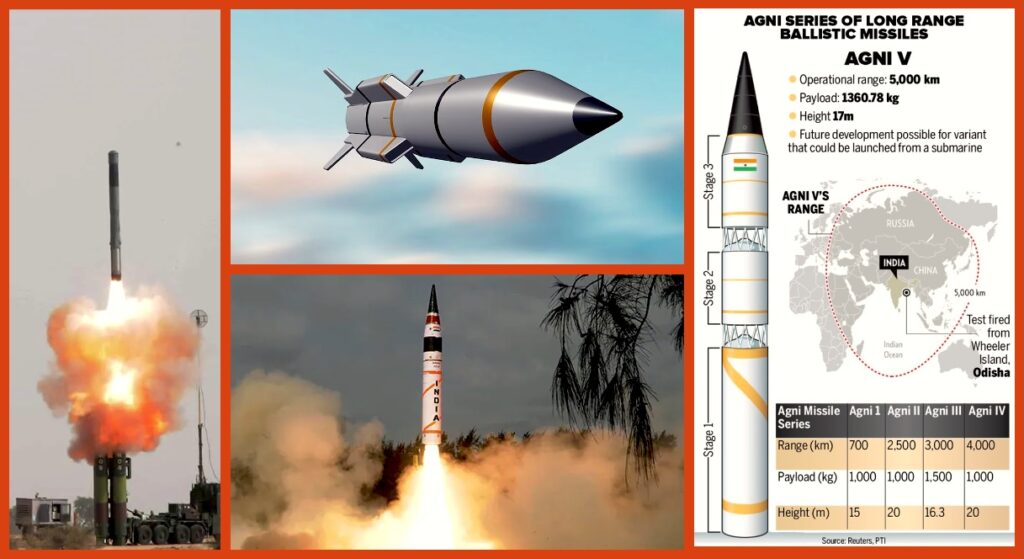
The Agni series, from the short-range Agni-I to the intercontinental Agni-V, forms the ballistic core of India’s strategic deterrent. Born from the modest Prithvi project of the 1980s, the Agni family now represents a generation of mastery in solid-fuel propulsion, guidance, and canisterized mobility.
Alongside Agni stand the Prahaar and Shaurya, bridging the tactical and strategic spectrum, and the K-series – K-15 Sagarika and K-4 – built for submarine launch. Together they ensure India’s nuclear deterrent remains credible, mobile, and survivable.
India’s ballistic missiles are fully indigenous, both in design and production, and their development marks one of the quietest yet most profound success stories of post-Independence science.
Astra – India’s Arrow in the Sky
If Agni defines deterrence and BrahMos defines precision, then Astra defines autonomy in the air.
The Astra-I is India’s first beyond-visual-range air-to-air missile (BVRAAM), built for the Su-30MKI and Tejas. With a range of around 110 kilometres and a top speed exceeding Mach 4.5, it rivals the American AIM-120 AMRAAM in reach and agility. Its indigenous active radar seeker allows it to track, chase, and kill with remarkable independence – a missile that thinks for itself.
The upcoming Astra-II stretches that reach to nearly 160 – 180 km, and Astra-III, powered by an advanced solid-fuel ducted rocket (SFDR), is being readied for 300 km-class performance – placing it squarely in the league of Europe’s MBDA Meteor, the benchmark of modern BVRAAMs.
Across the skies, Astra now flies in the same league as the world’s best. It is India’s answer to a field once ruled by foreign names – the American AMRAAM, the European Meteor, the Israeli Derby ER, the Russian R-77-1, and China’s PL-15.
The difference is ownership. Where others come with conditions and codes, Astra carries none. India does not need American permissions, French software patches, or European technicians to arm its fighters. It can produce, upgrade, and integrate Astra across fleets – from Su-30s to Rafales – without a single foreign clearance.
Meteor may glide longer, but Astra is the arrow India owns entirely – an indigenous weapon of reach, control, and confidence.
Barak and the Israeli Handshake
The Barak-8, co-developed with Israel, occupies the same space between indigenous and imported that BrahMos does. Deployed as the MRSAM and LRSAM variants for the Indian Navy and Air Force, it is a jointly produced system with Indian manufacturing dominance.
Its 70–100 km engagement range, precision radar, and all-weather agility have already been battle-proven in service. India holds the licence and infrastructure to export or modify Barak variants — and that makes it as strategically independent as any indigenous product.
This collaboration also seeded India’s next generation of Akash-NG and QRSAM missiles, where Israeli radar and Indian propulsion come together under an Indian nameplate.
Why India Still Imports
For all its technological ascent, India’s missile story remains a work in progress — impressive in breadth, but still evolving in depth. The challenge today isn’t ambition but engineering detail: the miniaturisation of seekers, compact radar processors, sustained propulsion efficiency, and resilience against advanced electronic countermeasures. These are not failures of will, but the unfinished corners of a rapidly maturing ecosystem.
And in matters of defence, time often dictates the choice. When a threat builds in months and a domestic design takes years, even the most self-reliant nation must look outward — not as weakness, but as strategic pragmatism.
That is why India continues to buy the S-400 Triumf from Russia to guard its skies, the Spike anti-tank missile from Israel for frontline infantry, and Western systems such as SCALP/Storm Shadow for the Rafale’s deep-strike profile. The MICA and Meteor remain essential to India’s Western aircraft, the Harpoon equips U.S. built P-8I maritime patrol planes, and Barak-1 continues to shield legacy naval vessels. Even precision glide bombs like Spice-2000—used famously at Balakot—hold their place until the Indian equivalents scale up.
Each of these imports fills a precise operational gap while indigenous or joint programmes—Akash-NG, Astra-II, HELINA, Nirbhay, and others—advance toward maturity.
India imports select missile systems for clear, practical reasons:
Platform integration with foreign aircraft and ships that demand proprietary weapons.
Stop-gap capability, bridging time until homegrown systems are combat-ready.
Access to niche technologies in propulsion, seeker miniaturisation, and ECCM.
Strategic partnerships, sustaining diplomatic and industrial ties with Israel, France, Russia, and the United States.
In essence, India buys not because it cannot build, but because it cannot pause. Each import buys breathing space — a calculated investment in deterrence and readiness, while the next generation of Indian missiles takes flight.
The Export Turn: From Buyer to Seller
The most striking transformation, however, is not in what India buys — it’s in what it now sells. The landmark BrahMos deal with the Philippines cracked open a door long shut to Indian defence exports, signalling credibility that words alone could never achieve. That single sale has set off conversations across continents — with Armenia, Brazil, Cyprus, Greece, Indonesia, Malaysia, Vietnam, and several nations in the Middle East exploring follow-on acquisitions.
Building on that momentum, India is now pitching the Astra and Akash missile systems to countries such as Vietnam, Egypt, and multiple African partners. For decades, India was a buyer in a one-way market; today, it is emerging as a supplier of precision, reliability, and trust — reshaping the very direction of arms diplomacy in Asia.
What was once a self-reliant posture has evolved into a self-assured one. India is no longer shy of selling the tools of deterrence — it is beginning to monetise credibility.
Partnership Without Dependence
India’s missile story is not about isolationism; it’s about intelligent independence.
It builds alone where it must, partners where it can, and imports where time or technology demands.
The difference today is that India no longer needs to rely — it chooses to.
In that choice lies a quiet form of sovereignty — one measured not in megatons or Mach numbers, but in the freedom to build, to buy, and to sell on India’s terms.
Other Relevant Topics
- Ballistic or Cruise? Why BrahMos isn’t Agni – and what that means for India
- India’s Indigenous Propulsion Leap: From 2.7–4.7 kN engines to the BrahMos hypersonic edge
- US Missile Deal with Pakistan: Sparks regional debate and official clarifications
- Readiness Redefined: India’s long march from arsenal to integration
- India Successfully Test Fires Nuclear-Capable Agni-5: Extending strategic reach