US Secretary of State Marco Rubio’s Kolkata Visit to Missionaries of Charity: Diplomatic Gesture or Strategic Misread?
By Tattvam News Today | May 24, 2026
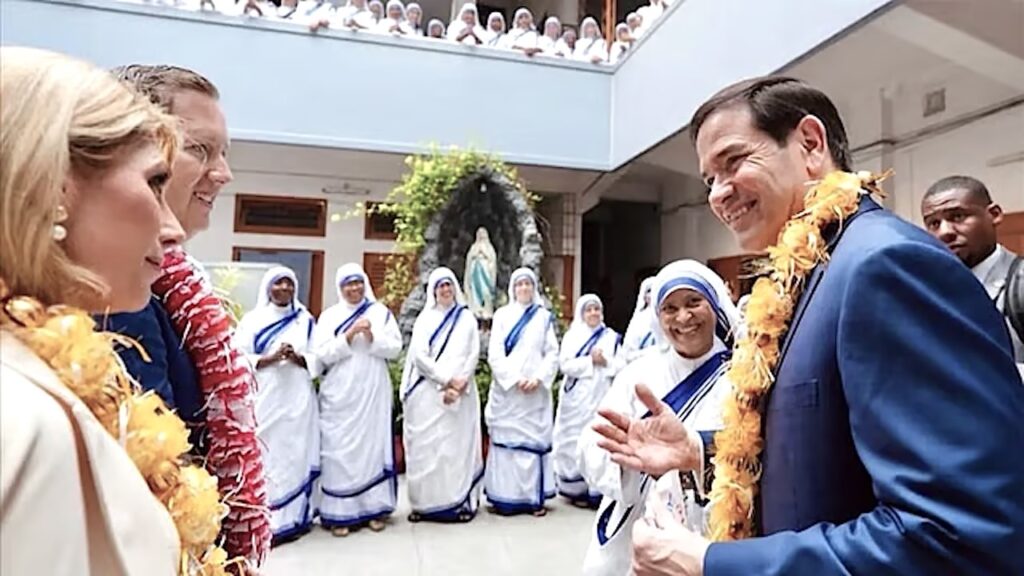
US Secretary of State Marco Rubio began his maiden official visit to India on May 23, 2026, not in New Delhi, but in Kolkata. His first stop was the Mother House of the Missionaries of Charity – the global headquarters of the organisation founded by Mother Teresa.
Accompanied by US Ambassador Sergio Gor, Rubio prayed at Mother Teresa’s tomb, interacted with the sisters, and visited the Nirmala Sishu Bhawan orphanage before proceeding to high-level engagements with Prime Minister Narendra Modi, Quad foreign ministers, and trade and defence officials in Delhi.
While the remainder of the visit focused on strategic cooperation, energy, trade, and Indo-Pacific coordination, it was the Kolkata stop that generated the strongest reaction online and in political circles.
What Happened in Kolkata?
According to US officials, Rubio’s Kolkata Visit was intended as a tribute to humanitarian service and shared values. Ambassador Gor described the moment as a reminder that the US-India partnership rests not only on strong policies, but also on shared values.
The symbolism, however, came at a politically sensitive moment in India.
The visit coincided with debate around India’s proposed Foreign Contribution (Regulation) Amendment Bill, 2026, introduced in the Lok Sabha earlier this year. The legislation seeks to tighten oversight over foreign-funded NGOs and establish mechanisms for handling assets of organisations whose FCRA registrations are cancelled, surrendered, or lapse.
Critics of the bill including opposition parties and some minority-linked organisations argue that it expands state control over civil society institutions. Supporters maintain that stricter scrutiny of foreign funding is necessary for transparency and sovereignty.
Against that backdrop, Rubio’s decision to begin his India visit at the headquarters of a globally known Christian charitable organisation inevitably acquired political meaning beyond symbolism.
Was This a Normal Diplomatic Gesture?
Diplomats frequently include symbolic or cultural visits in official itineraries. Foreign leaders visiting temples, mosques, memorials, churches, humanitarian institutions, or historical sites is neither unusual nor controversial in itself.
Rubio, a practicing Catholic, visiting a site associated with Mother Teresa is also understandable from a personal and ideological standpoint. In Western political and religious circles, Mother Teresa remains an enduring symbol of charity and missionary humanitarian work.
However, the choice carried different connotations in contemporary India.
Over the past two decades, Mother Teresa and the Missionaries of Charity have faced growing criticism from sections of Indian society, activists, and writers. Critics such as Christopher Hitchens, particularly in his book ‘The Missionary Position,’ accused the organisation of glorifying suffering, operating substandard medical facilities, and prioritising religious conversion alongside charitable work.
Other criticisms over the years have included allegations of poor medical hygiene, baptisms of dying patients without explicit consent, and portraying Kolkata primarily through the lens of poverty to sustain international fundraising narratives. Supporters of Mother Teresa and the Missionaries strongly reject many of these accusations and continue to view her legacy as one of extraordinary humanitarian commitment.
Nevertheless, public perceptions in India today are far more divided than they once were.
For many nationalist and conservative voices, the Missionaries of Charity has become associated with broader anxieties surrounding foreign-funded NGOs, religious conversion, and external influence in domestic social issues. In that context, Rubio’s Kolkata visit appeared politically tone-deaf to critics, particularly when India is simultaneously debating tighter oversight of foreign-funded institutions.
A more neutral cultural or civilisational stop or simply beginning directly with strategic meetings in Delhi may have avoided this controversy.
A Domestic American Audience?
Rubio’s Kolkata Visit may also have carried significance beyond India.
Rubio has long cultivated support among conservative Christian and Catholic constituencies in the United States. Publicly honouring Mother Teresa’s legacy aligns naturally with that political identity and resonates with faith-oriented voters in the US.
At a time when cultural and religious issues continue to shape American politics, the Kolkata visit may have served a dual purpose: diplomatic symbolism abroad and values-based signalling at home.
That does not necessarily imply interference in Indian affairs. But in diplomacy, symbolism matters and interpretations often depend less on intent than on timing and context.
Why the Optics Triggered Backlash
The criticism in India stemmed less from the visit itself and more from what many perceived it to symbolise.
Among the concerns raised online and in political commentary were:
Perceived External Signalling: Critics argued that visiting the Missionaries of Charity during debate over the FCRA Amendment Bill could be interpreted as indirect commentary on India’s NGO regulations or religious freedom debates.
Historical Sensitivities Around Conversion: Sections of Indian society remain deeply wary of missionary-linked organisations, particularly where charitable work and religious outreach are seen as intertwined.
Mismatch With Strategic Priorities: Given that the broader visit centred on Quad cooperation, defence, trade, and energy, some questioned why the opening gesture focused on a politically sensitive religious institution rather than a broader cultural or national symbol.
Social media reactions, especially on X, reflected these concerns sharply, with many nationalist commentators describing the move as poorly calibrated for the Indian political climate.
At the same time, others dismissed the outrage as excessive and viewed the stop as a harmless personal and humanitarian gesture.
India’s Government Chose Pragmatism
Notably, the Indian government avoided public confrontation over the episode.
There was no formal criticism from the Ministry of External Affairs, nor any attempt to politicise the Kolkata visit officially. Prime Minister Modi hosted Rubio warmly in Delhi, and official statements focused instead on trade expansion, defence cooperation, technology, energy security, and the broader Comprehensive Global Strategic Partnership.
The government’s restrained approach reflects strategic realism.
India and the United States today share converging interests on China, supply chains, maritime security, semiconductors, and defence cooperation. In that larger geopolitical framework, symbolic disagreements are unlikely to derail the relationship.
At the same time, New Delhi’s silence also conveyed confidence: India’s domestic regulatory decisions including FCRA oversight will proceed on its own terms regardless of external perceptions.
The Larger Lesson
The controversy surrounding Rubio’s Kolkata visit illustrates a broader reality in India-West relations: symbolism that appears benign in Washington or Europe can carry very different political meanings in India.
Diplomatic gestures are rarely interpreted in isolation. Timing, domestic politics, historical memory, and cultural sensitivities all shape public reaction.
For supporters, Rubio’s visit honoured a globally recognised humanitarian legacy. For critics, it reflected an outdated Western political instinct that remains insufficiently attuned to Indian sensitivities surrounding foreign-funded religious institutions.
Either way, the episode became an unintended reminder that in a rising and increasingly self-assertive India, optics matter almost as much as policy.