Unlocking Antarctica’s Hidden World: How Deep Ice Drilling Could Transform Climate Science and Human Knowledge
In one of the most remarkable polar science breakthroughs of recent years, researchers have drilled more than 3,400 metres through Antarctic ice to reach the hidden Qilin Subglacial Lake in East Antarctica. On 5 February 2026, during the 42nd Antarctic expedition season, scientists successfully accessed the lake at a depth of 3,413 metres, using advanced pressurised hot-water drilling technology.
This achievement opens a direct scientific window into an ecosystem that may have remained sealed off from the outside world for nearly three million years. Beneath Antarctica’s frozen surface lies not merely water, but a preserved archive of microbial evolution, ancient climate signals, and clues to how Earth’s ice sheets behave under pressure.
The expedition used clean hot-water drilling, in which purified water heated to about 90°C melts a narrow borehole through the ice while minimising contamination of the untouched subglacial environment. This allows researchers to collect water and sediment samples safely from one of Earth’s most pristine and least understood ecosystems.
What Lies Beneath: Understanding Subglacial Lakes
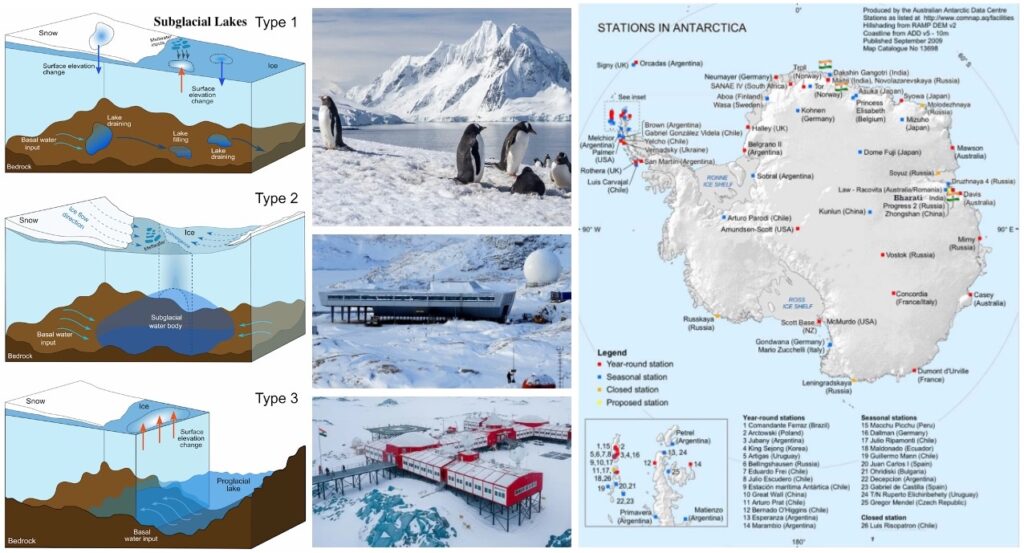
Subglacial lakes are bodies of liquid water trapped beneath massive ice sheets. They form when geothermal heat from Earth’s interior, combined with immense pressure and friction beneath the ice, melts the ice base.
Antarctica is now known to contain more than 700 such lakes, many of them interconnected through hidden drainage networks beneath the ice. Some are “active lakes,” periodically filling and draining, influencing how glaciers move above them.
These lakes are scientifically invaluable because they preserve:
- ancient microbial ecosystems adapted to darkness, cold, and pressure,
- chemical records of prehistoric climate conditions,
- evidence of long-term ice-sheet stability and movement.
In effect, they are natural time capsules buried under kilometres of ice.
A Scientific Quest Decades in the Making
The exploration of Antarctica’s buried lakes has unfolded over decades:
- Radar surveys in the late 20th century first revealed their existence.
- In 2012, Russian scientists reached Lake Vostok, one of Antarctica’s largest subglacial lakes.
- In 2013, the American WISSARD mission drilled into Lake Whillans, confirming active microbial life.
- Later, the SALSA programme sampled Mercer Subglacial Lake, uncovering layered sediments that preserved long-term geological history.
Now, Qilin Subglacial Lake represents the deepest successful hot-water drilling penetration in polar science history.
Located in Princess Elizabeth Land, around 120 km from Taishan Station, Qilin was formally named in 2022 and is regarded as one of East Antarctica’s most scientifically promising hidden lakes.
Why This Matters to Humanity
Though remote and invisible beneath Antarctic ice, these discoveries have profound real-world consequences.
Better Climate Predictions
Subglacial lake sediments preserve records of past ice-sheet responses to warming and cooling cycles. These records improve climate models that predict future sea-level rise.
For India, with over 7,500 km of coastline, such projections are critical. Coastal cities, ports, fisheries, and vulnerable low-lying communities depend on accurate sea-level forecasting.
New Frontiers in Biotechnology
Microorganisms surviving in oxygen-starved, sunless waters may possess unique enzymes or biochemical compounds useful in:
- medicine,
- antibiotic research,
- industrial biotechnology,
- environmental clean-up systems.
Searching for Life Beyond Earth
These extreme Antarctic ecosystems resemble environments believed to exist beneath icy moons such as Europa and Enceladus. Studying them helps astrobiologists refine methods for detecting extraterrestrial life.
Ice Sheet Stability and Disaster Preparedness
Subglacial hydrology affects glacier speed and ice-sheet collapse risks. Understanding these underground water systems improves forecasting of sudden glacial shifts linked to global climate hazards.
India’s Expanding Role in Antarctic Science
India remains an active and respected contributor to polar research through the National Centre for Polar and Ocean Research (NCPOR), headquartered in Goa. National Centre for Polar and Ocean Research
Its Antarctic stations—Maitri and Bharati—continue to support long-term work in glaciology, atmospheric science, microbial ecology, and climate monitoring. Maitri Research Station Bharati Research Station
India’s upcoming 46th Scientific Expedition to Antarctica (2026–27), following the 45th mission, is expected to deepen national involvement in polar climate studies. As global polar science becomes increasingly collaborative, India’s role is growing both scientifically and strategically.
The Road Ahead: Antarctica as Earth’s Climate Archive
Under the Antarctic Treaty framework, international scientific cooperation continues to unlock secrets buried beneath the ice without territorial rivalry overshadowing research goals.
Qilin Subglacial Lake is more than a technical milestone—it is a gateway to understanding:
- how life survives in extreme isolation,
- how ancient Earth climates evolved,
- how present-day ice sheets may respond to future warming.
For India and the wider world, these distant discoveries are not abstract polar curiosities. They are essential pieces of the climate puzzle shaping coastlines, weather systems, biodiversity, and planetary resilience in the decades ahead.